Build vs Buy for AI Code Review: The Hidden Cost of Rolling Your Own LLM Reviewer
We built Diffnix from scratch. That means we know every hidden cost in the build path, every place where the scope expands unexpectedly, and every decision that seemed simple in week one and became a maintenance obligation in month six. This is the breakdown so you can make the right call before committing six months of your best engineers' time.

Introduction
The build argument for internal AI tooling sounds clean: maximum control, customized to your codebase, no vendor lock-in, no recurring SaaS cost, no compliance question about external data transmission. For teams that have built other internal tools successfully, building an AI code reviewer feels like a natural extension.
The first two weeks reinforce the instinct. You connect a diff to GPT-4, write a prompt that says "review this code," and get something that looks useful in about 10 hours of engineering time. The demo is convincing.
Then reality arrives.
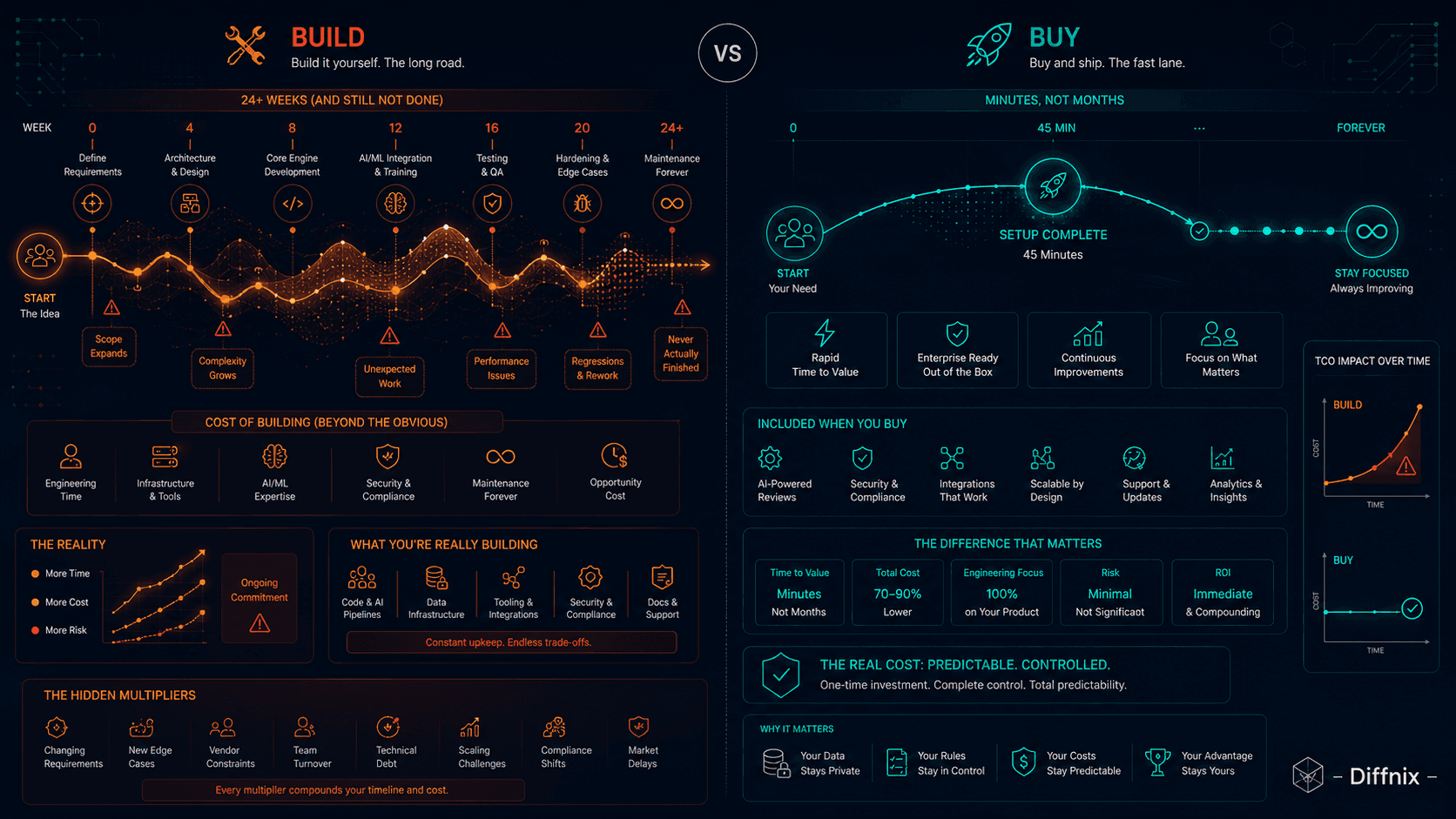
Production-quality AI code review is not a prompt. It is a pipeline: structured diff parsing, context enrichment with cross-file resolution, multi-dimensional reasoning, confidence scoring, false positive filtering, output formatting, CI integration, model version management, and ongoing maintenance as the underlying models update. Each of those is a meaningful engineering problem. Together, they represent 4-6 months of focused engineering work to implement correctly.
This post documents what that build actually costs, when it makes sense anyway, and how to make the decision before sinking engineering time into it.
What "Building an AI Code Reviewer" Actually Requires
The naive version of the problem: send diff text to an LLM, post the response. This works in demos. It fails in production for three reasons:
Diff blindness. Sending raw diff text to an LLM means the model reasons about a text fragment without understanding the file structure, the position context from hunk headers, or the distinction between added, removed, and context lines. The result: comments on unchanged lines, incorrect line number references, and findings that ignore the structural information encoded in the diff format.
Missing codebase context. The changed lines are almost never sufficient to evaluate correctness. What does the calling code pass to this function? What does the model definition look like? What is the established authorization pattern for comparable endpoints? None of that is in the diff. A model reasoning without it produces generic or hallucinated findings.
No signal on quality. A single LLM prompt produces a response at whatever quality level the model defaults to. There is no confidence scoring, no false positive filtering, no way to know which findings are well-grounded versus speculative. Developers receive 15 findings, learn that 10 of them are wrong, and stop reading.
Solving these three problems is where the real engineering work lives.
The Full Build Timeline
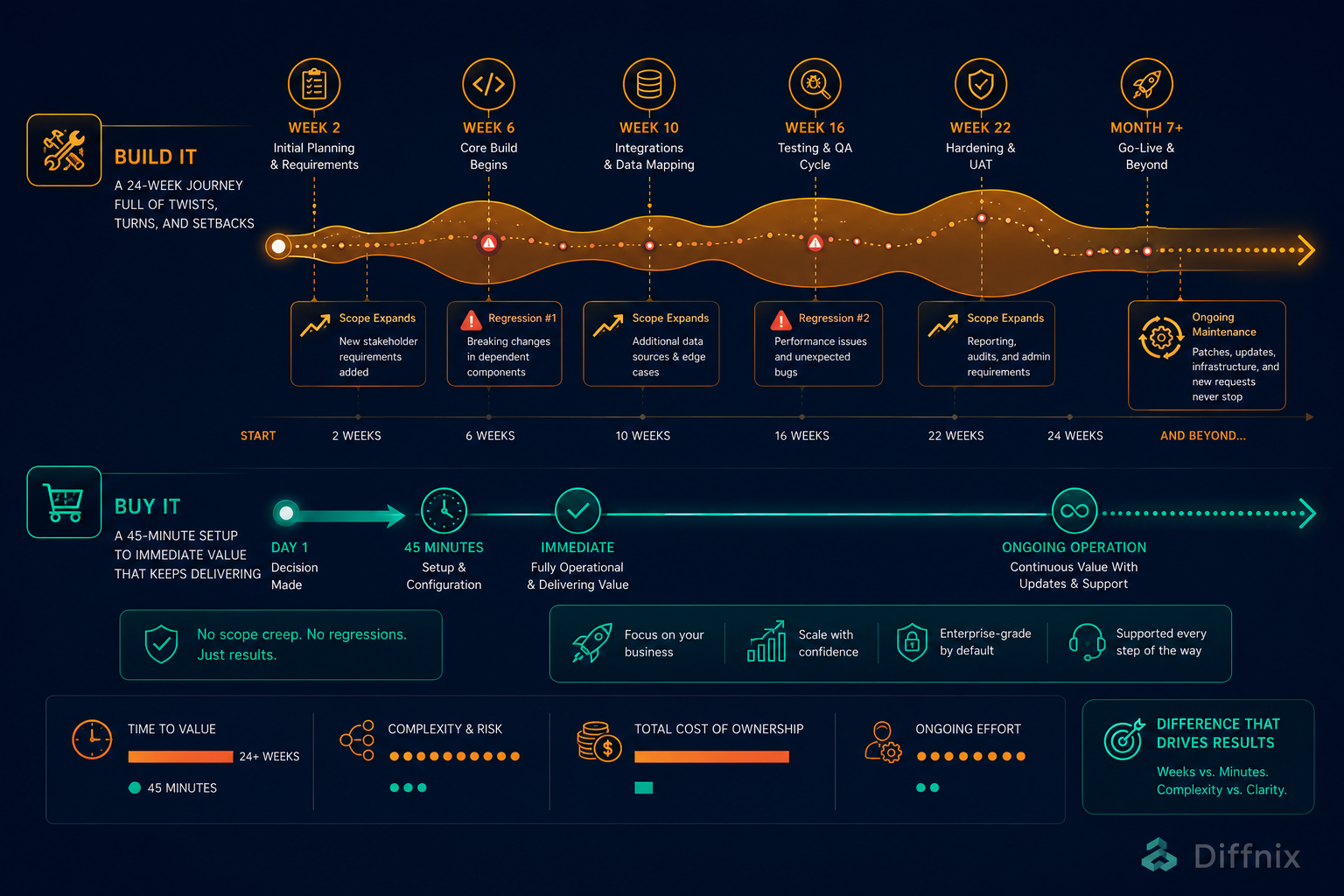
Here is the actual timeline from a 60-person engineering organization that built their own AI reviewer, tracked the work weekly, and documented the scope growth as it happened.
Weeks 1-2: The naive integration
Two senior engineers integrated the diff text with a GPT-4 API call and deployed it to a test repository. Output quality was useful on small, isolated PRs. On larger PRs and cross-file changes, the findings were either generic or wrong. The team identified the root cause: no structured diff parsing, no context enrichment.
# Week 1 implementation: naive but working in demos
def review_pr(diff_text: str) -> list[str]:
    response = openai_client.chat.completions.create(
        model="gpt-4",
        messages=[
            {"role": "user", "content": f"Review this code diff:\n\n{diff_text}"}
        ]
    )
    return response.choices[0].message.content.split("\n")
# Problems: wrong line numbers, comments on unchanged code,
# no caller context, no false positive filtering
Weeks 3-6: Structured diff parsing
Engineering rebuilt the diff ingestion layer to parse unified diffs into a typed structure: hunk headers, line position metadata, added versus removed versus context line classification. This produced correct line number mapping and eliminated comments on unchanged code. Finding quality improved but false positive rate remained high without context enrichment.
Weeks 7-10: Confidence scoring attempts
The team tried to add confidence scoring to filter low-quality findings. Multiple approaches were attempted: asking the model to rate its own confidence (unreliable), using semantic similarity to filter findings below a threshold (required fine-tuning), and applying rule-based post-processing on finding text patterns (brittle). Stability was not achieved. The false positive rate remained at approximately 45%.
Weeks 11-16: Context enrichment
This was the hardest phase. Fetching caller locations required implementing a lightweight static analysis pass to identify where changed functions were called from, then fetching those call sites from the repository. Import resolution required understanding the language's module system well enough to translate import statements into file paths. Interface resolution required understanding class hierarchies.
The implementation was language-specific: Python required one implementation, Java required another. TypeScript required a third. Each had edge cases that required weeks of debugging.
# Week 13: partial context enrichment
def enrich_hunk_context(hunk: ParsedHunk, repo_path: str) -> EnrichedHunk:
    # Find callers of the changed function
    callers = find_callers(
        function_name=extract_function_name(hunk),
        language=hunk.language,
        repo_path=repo_path,
    )
    # Bug: find_callers fails on dynamically-dispatched methods,
    # generators, and closures. Filed as issue #147.
    imports = extract_imports(hunk.file_path, hunk.language)
    return EnrichedHunk(hunk=hunk, callers=callers, imports=imports)
By week 16, context enrichment was working for the majority of cases. Edge cases (dynamic dispatch, closures, decorator patterns) produced incorrect caller resolution. These were filed as known issues.
Weeks 17-24: Model update disruption
In week 17, OpenAI released GPT-4-turbo. The engineering team's prompt layer, which had been tuned specifically for GPT-4's reasoning patterns, produced significantly lower quality output on GPT-4-turbo. Prompts written for one model version do not transfer reliably to the next.
The team spent weeks 18-22 rewriting the prompt layer for GPT-4-turbo. In week 23, GPT-4o was released, producing another prompt compatibility assessment. The prompt layer became a permanent maintenance obligation.
Month 7 onward: Ongoing maintenance
One engineer was assigned part-time (estimated 20-30 hours per month) to maintain the system: handling model update regressions, addressing edge case bugs from the issue backlog, monitoring the false positive rate, and updating the CI integration as the GitHub Actions API changed.
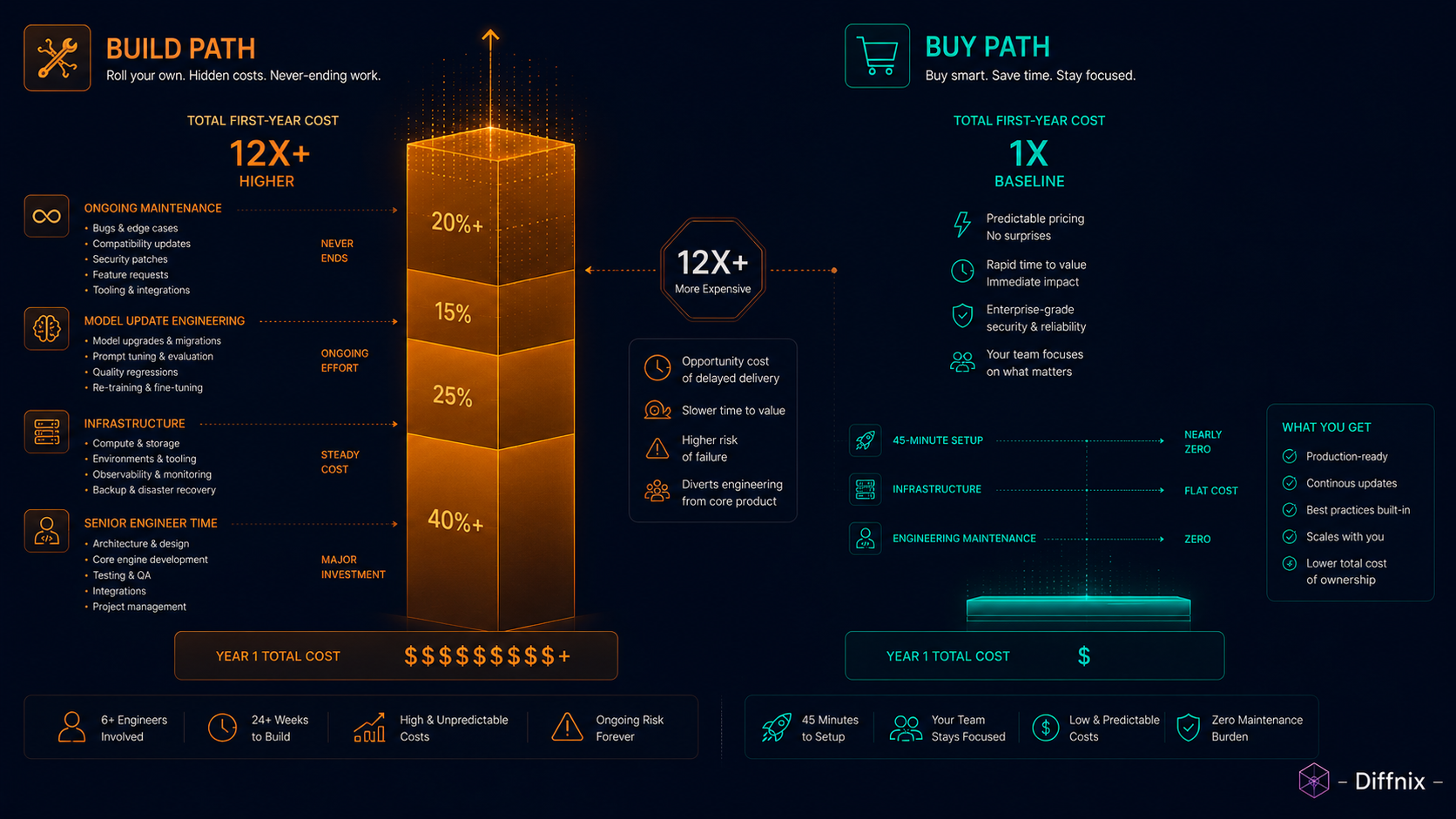
Total cost:
Category | Cost |
|---|---|
2 senior engineers, 6 months build | $360,000-420,000 |
1 engineer, 12 months part-time maintenance (year 1) | $60,000-90,000 |
Infrastructure (GPU server for local inference or API fees) | $15,000-40,000 |
Engineering time on model update rewrites | $20,000-30,000 |
Total first-year cost | $455,000-580,000 |
The tool they built worked reasonably well after month 6. It was not better than Diffnix on semantic quality benchmarks (context enrichment was less complete) and it required ongoing engineering investment that diverted senior engineering capacity from product work.
At month 8, the team migrated to Diffnix. Setup took 45 minutes. The two engineers who had been maintaining the internal tool moved to product engineering.
When the Build Decision Makes Sense
The build case is strongest when three conditions are true simultaneously:
Unique requirements. Your codebase has review requirements that no existing tool addresses: a proprietary language or DSL, domain-specific correctness rules that require custom reasoning, or integration requirements with internal systems that no vendor supports.
Existing AI infrastructure. You already have an AI/ML platform team, GPU infrastructure, and model deployment pipelines. The incremental cost of building an AI reviewer on top of existing infrastructure is lower than building it from scratch.
Organizational patience. Six months of two senior engineers with ongoing maintenance is an acceptable cost given the expected return. The work is interesting, the team will learn from it, and the strategic value of the internal tool justifies the investment.
When these three conditions are not all true, the economics favor buying.
📌 Insight: The teams that build internal AI review tools and succeed are almost universally the ones who had existing ML platform infrastructure. The teams that fail are the ones who underestimate the infrastructure overhead and discover that building the ML pipeline is the hard part, not the review logic.
Real-World Use Case: The $500,000 Decision
The 60-person engineering organization described above gave us access to their actual cost tracking with the agreement to anonymize identifying details.
Their engineering VP's post-mortem on the build decision: "We underestimated the context enrichment complexity by a factor of three. We thought it would take two weeks. It took eight. And we did not account for model updates at all. Every time OpenAI changed the model, we lost a week of an engineer's time on prompt regressions. That was not in the plan."
The migration to Diffnix at month 8 was not a business failure. The internal tool worked. But the calculation changed: the tool cost approximately $80,000 per month in engineering time over the first year. Diffnix costs a flat infrastructure fee plus roughly 4 hours per month in maintenance. The savings in year two were significant enough that the migration was straightforward to justify.
Their retrospective takeaway: "If we had been building on top of an existing ML platform with model deployment pipelines already in place, the build might have made sense. We were not. We spent two months building infrastructure that we thought was two weeks of work. That is where the decision went wrong."
The Alternative: What 45 Minutes Gets You
For comparison, here is what the Diffnix setup process actually looks like for a team starting from scratch.
Step 1: Provision the inference server (20-30 minutes)
A server with 48GB of VRAM, model downloaded via Ollama or vLLM, HTTP inference endpoint running and verified.
Step 2: Configure Diffnix (10-15 minutes)
# .diffnix/config.yml
inference:
  provider: local
  endpoint: http://inference.internal:11434
  model: codellama:34b-instruct

pr_inspector:
  confidence_threshold: 0.60
  dimensions:
    correctness: true
    security: true
    performance: true
    maintainability: false  # enable when ready

github:
  token: ${GITHUB_TOKEN}
  post_findings_as_comments: true
  max_findings_per_pr: 6
Step 3: Connect to the repository (5-10 minutes)
Install the GitHub App, configure the webhook, run a test PR.
Total: 45-60 minutes from zero to findings on real PRs.
The context enrichment, multi-dimensional reasoning, confidence scoring, and cross-hunk analysis that took the 60-person team six months to build are in the default configuration.
Advanced Tips for Teams Genuinely Considering Building
Run a two-week proof of concept before committing
Build the simplest possible version: structured diff parsing, no context enrichment, single-pass reasoning. Deploy it to one repository for two weeks and evaluate the output quality on your actual PRs. If the output quality without context enrichment is already useful, you are starting from a stronger position. If it is not, you have two weeks of data rather than six months of sunk cost.
Scope the context enrichment work carefully before committing
Context enrichment is where most teams underestimate. Before committing to the full build, scope the caller resolution implementation for your primary language. How does your language handle dynamic dispatch? How many edge cases in import resolution are in your codebase? Talk to an engineer who has built static analysis tooling before. The scope is almost always larger than initial estimates.
Budget for model update cycles explicitly
Every time the LLM provider updates their model, your prompts need reassessment. Budget 2-4 engineer-days per major model update and multiply by the expected number of updates per year (historically 3-5 for GPT-4 class models). If that number changes your economics significantly, factor it into the build-versus-buy decision before committing.
⚠️ Warning: The "we can build it ourselves" argument often underweights the opportunity cost of the engineers doing the building. Two senior engineers spending six months on an AI reviewer are not spending six months on the product features that generate revenue. The question is not just "can we build it" but "should we, given what those engineers could be doing instead?"
Conclusion
Building your own AI code reviewer is a valid engineering decision for a specific profile of organization: one with unique requirements, existing ML infrastructure, and the patience to invest 6-12 months before the tool reaches production quality.
For most organizations, the economics favor buying. The build cost is higher than initial estimates. The maintenance obligation is permanent. The opportunity cost of senior engineering time is real. And production-quality tools available today include the context enrichment, multi-dimensional reasoning, and confidence scoring that took the teams who built their own 4-6 months to implement.
We built Diffnix from scratch. We know what the build path costs because we paid it. We are not selling you a product to avoid the work. We are telling you that the work took us six months of focused engineering by a team that had done it before.
For most engineering organizations, 45 minutes of setup is a better investment than six months of build.
Diffnix is a private, AI-powered code intelligence platform that understands your code, not just scans it. Your code stays on your network. The pipeline we built is what you get from the first PR.
Book a demo before you commit to building.