AI Code Review as Mentorship: Teaching Junior Developers Without Burning Out Your Seniors
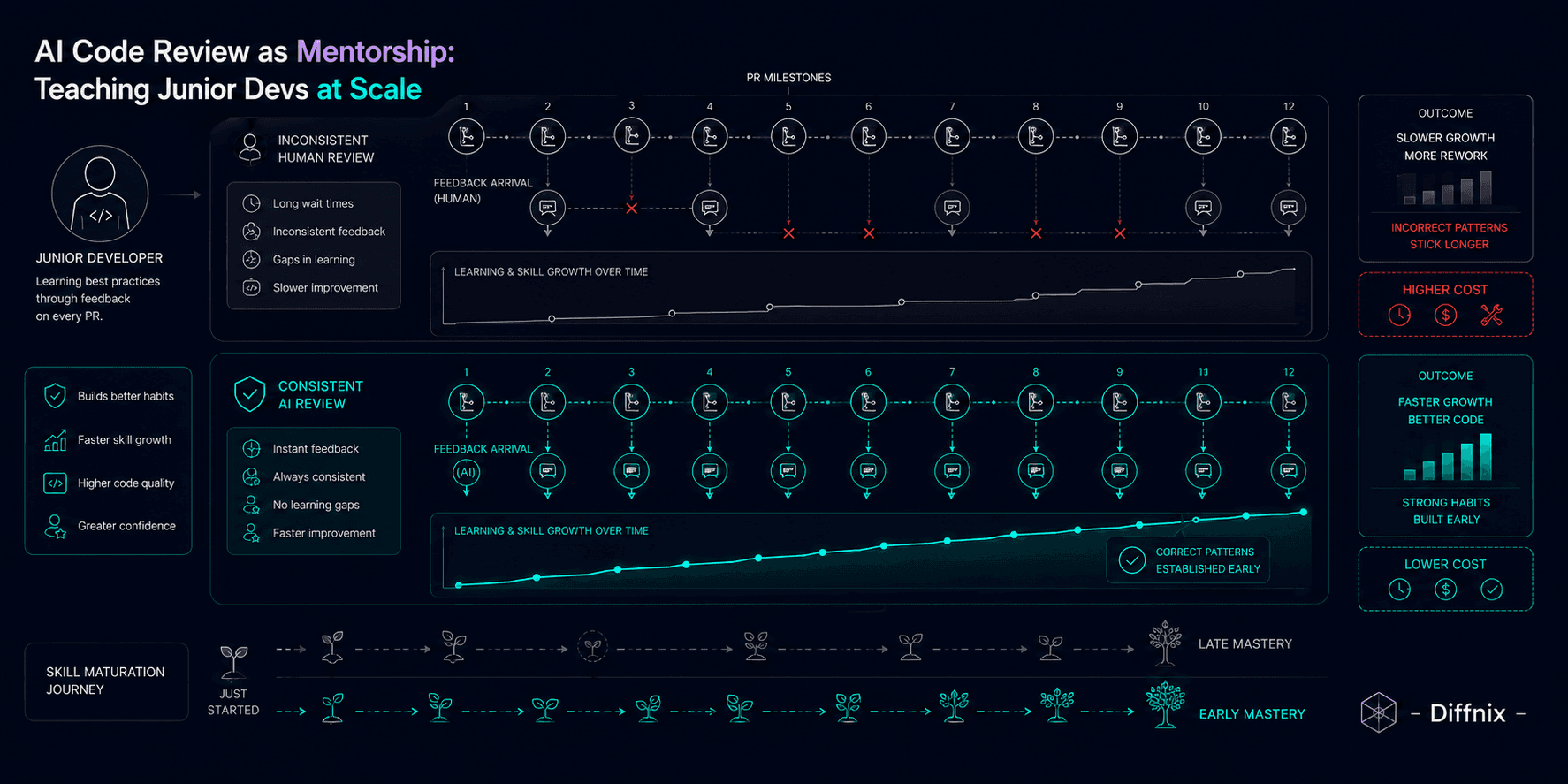
Junior developers learn fastest from immediate, specific, consistent feedback on their actual code. Senior engineers rarely have the bandwidth to provide that feedback at the frequency it needs to happen. This post explains how AI code review fills that gap, what the learning arc looks like with consistent feedback, and why it is more effective than periodic mentorship sessions.

Introduction
Every engineering manager managing a team with junior developers has noticed the same pattern. Junior engineers grow fastest when they get fast, specific feedback on every PR. But the people qualified to give that feedback are the senior engineers who are already the review bottleneck.
The typical result: junior developers get thorough review on some PRs, cursory review on others, and no review on the ones that slip through the queue during busy periods. The feedback they receive varies by reviewer, by day, and by how much time the reviewer has. The patterns they need to internalize take months to stick because the feedback is inconsistent.
This is not a failure of the senior engineers. They are doing good work under constrained bandwidth. The problem is structural: high-quality feedback at high frequency requires time that the people best qualified to give it do not reliably have.
AI code review changes the math on this. Not by replacing the mentorship relationship, which requires human judgment and relationship context that AI cannot replicate. But by providing the consistent, immediate, specific feedback layer that accelerates pattern internalization between the less frequent human mentorship interactions.
What Junior Developers Actually Need to Grow
The research on skill development is consistent on this point: learning accelerates when feedback is immediate, specific, and consistent. These three properties compound.
Immediate feedback connects the action to the consequence while the mental model is still active. A PR comment that arrives two days after the code was written lands in a different cognitive context than one that arrives within hours. The developer has moved on to other work. Re-engaging with the earlier code is additional context-switching overhead.
Specific feedback tells the developer what was wrong, why it was wrong, and what the correct approach is. "This could be improved" is not specific. "This function does not close the database connection in the exception handler, which causes connection leaks under failure conditions. Use a context manager instead." That is specific. It teaches.
Consistent feedback means the same pattern gets the same response regardless of which reviewer handles the PR, what day it is, or how busy the queue is. Inconsistent feedback is confusing: if the same pattern is flagged one week and approved the next, the developer does not know which behavior is correct.
Human review provides excellent feedback when the reviewer has time and focus. It provides none of these properties consistently at scale. That is the gap AI review fills for junior developer growth.
What the Learning Arc Looks Like
The concrete example comes from a junior developer on a backend team who submitted 12 PRs over two months. In 8 of those 12 PRs, there was a missing database connection close in the exception handler.
The pattern:
# The pattern that appeared in 8 of 12 PRs
def get_user_data(user_id: int) -> dict:
    try:
        conn = get_db_connection()
        result = conn.execute("SELECT * FROM users WHERE id = ?", [user_id])
        data = result.fetchone()
        conn.close()          # closed here on success
        return dict(data)
    except Exception as e:
        logger.error(f"Failed to fetch user {user_id}: {e}")
        # conn.close() missing here on failure path
        raise`
When the exception path runs, the connection is never closed. Under normal operation, this is invisible. Under a load spike or a database error, it causes connection pool exhaustion.
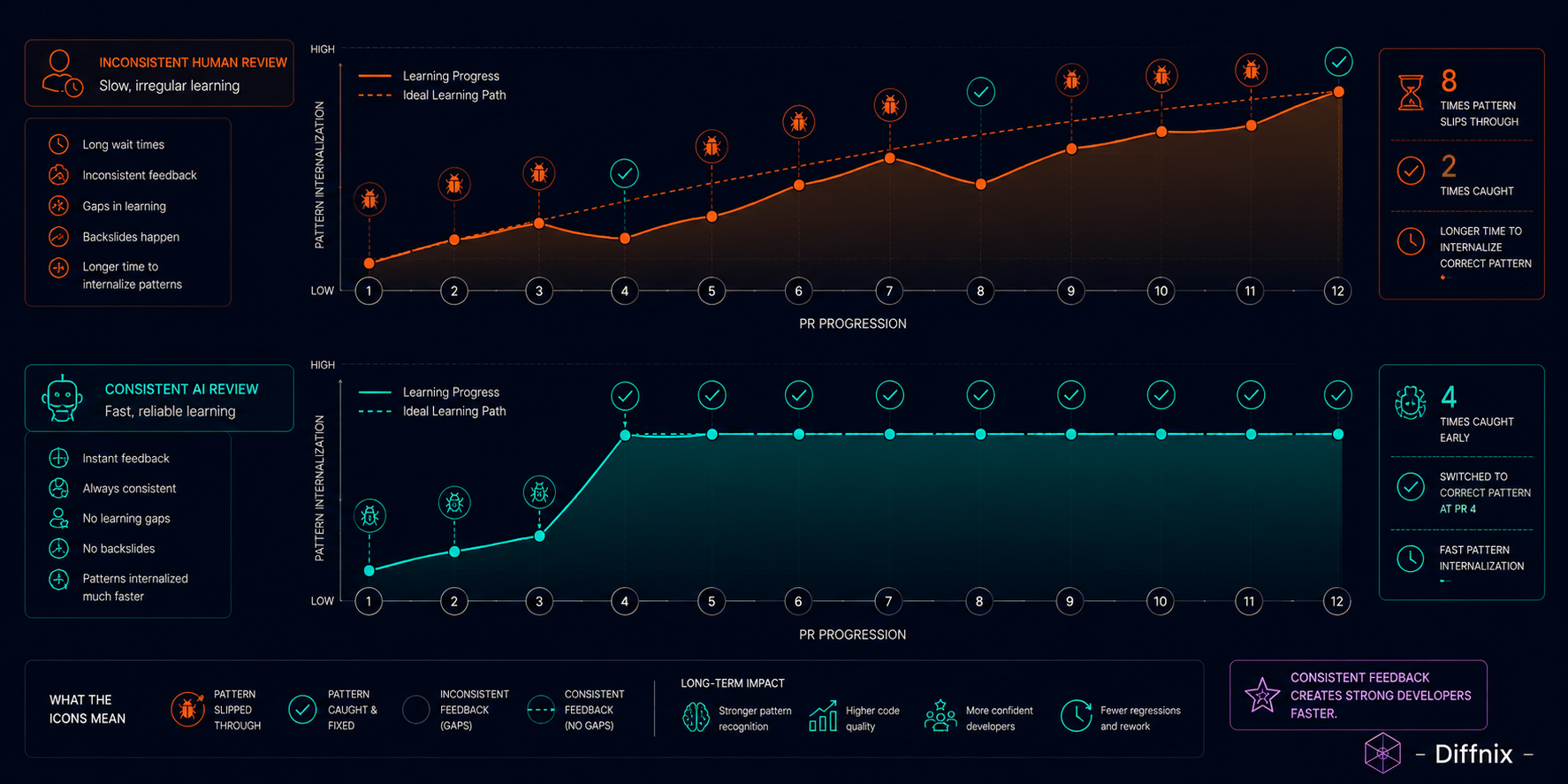
With inconsistent human review, this pattern was flagged in PR 1 and PR 5. It was approved in PRs 2, 3, 4, 6, 7, and 8. Different reviewers, different days, different results.
With consistent AI review, the finding appeared in PRs 1, 2, and 3. In PR 4, the developer used a context manager correctly. In PRs 5 through 12, the context manager pattern was used consistently.
# The correct pattern the developer internalized by PR 4
def get_user_data(user_id: int) -> dict:
    with get_db_connection() as conn:   # context manager closes on all paths
        result = conn.execute("SELECT * FROM users WHERE id = ?", [user_id])
        data = result.fetchone()
        return dict(data)
    # conn.close() happens here automatically on both success and exception
The Diffnix finding on PR 1:
FINDING [Correctness / Major] — db/users.py, Line 12

The database connection opened on line 3 is closed in the success path
(line 7) but not in the exception handler.

If an exception occurs during query execution, the connection is never
returned to the pool. Under repeated exceptions or high load, this causes
connection pool exhaustion.

Recommended: use a context manager to ensure the connection closes on
all code paths:

    with get_db_connection() as conn:
        result = conn.execute(...)
        return dict(result.fetchone())
The same finding, word for word, appeared in PRs 2 and 3. By PR 4, the developer had internalized the pattern.
With inconsistent human review: the pattern appeared in 8 PRs and was only flagged twice. Learning happened at approximately half speed.
With consistent AI review: the pattern appeared in 3 PRs before being eliminated. Learning happened in 3 iterations instead of 8.
💡 Tip: The educational value of AI review compounds over time. In the first month, developers receive findings on patterns they have not internalized yet. By month three, finding frequency drops significantly because developers have learned from the consistent feedback. This is measurable progress, not just automation. Track finding recurrence by developer over 90 days and you will see the learning arc directly in the data.
Why Consistency Matters More Than Depth
Senior engineers provide deeper, more contextually nuanced feedback than AI review does. They understand the team's history, the business context, and the long-term architectural direction in ways that AI cannot replicate.
That depth is valuable. It is also rare, time-limited, and inconsistently delivered.
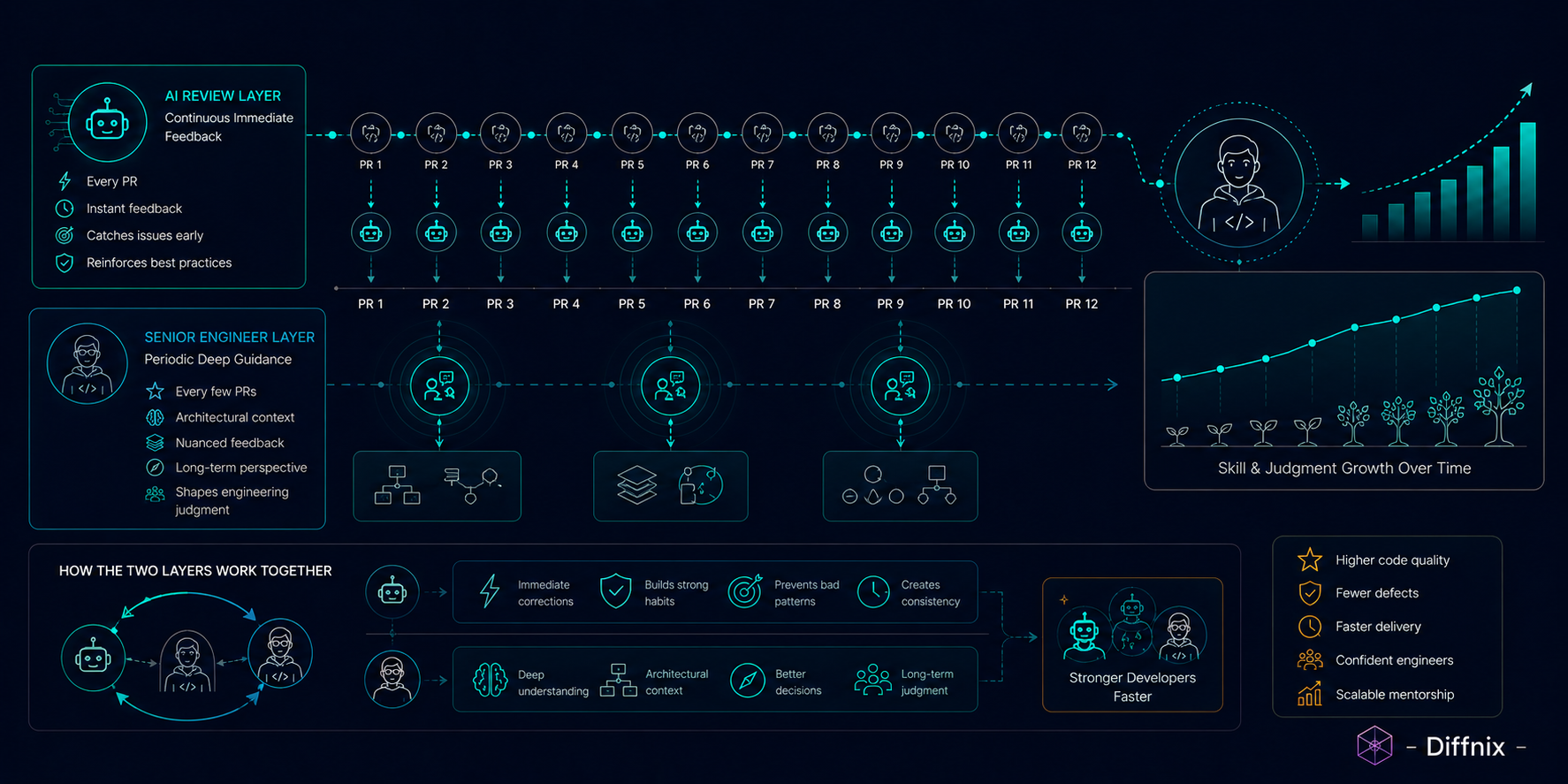
Junior developers need both: deep feedback periodically and consistent feedback continuously. The common mistake is providing only the periodic deep feedback (monthly 1:1 code reviews, quarterly tech debt sessions, annual performance reviews with code quality observations) and leaving the continuous consistent layer empty.
That empty layer is where most daily learning happens, and its emptiness is where most bad patterns accumulate.
AI review fills the continuous layer. Senior engineers provide the periodic depth. Together they provide the complete feedback architecture that accelerates developer growth.
The senior engineer's review time becomes more leveraged when AI handles the continuous layer. Instead of catching the same null guard pattern for the sixth time with this developer, the senior engineer's review comment is about architecture. That is a better use of their attention and a better learning experience for the developer.
Real-World Use Case: Three Iterations to Pattern Internalization
The junior developer whose story appears above was a six-month employee on their first production backend engineering role. Their senior engineer mentor reviewed their PRs when available, which averaged once per week given queue pressures.
Before AI review was adopted, the DB connection close pattern appeared in 8 PRs over two months. The senior engineer caught it in PRs 1 and 5. In the other 6 PRs, either a different reviewer handled the PR or the pattern was missed under review pressure. The developer received two clear signals and six no-signals. With no-signal interpreted as "this is acceptable," the pattern persisted.
After AI review adoption, the pattern appeared in PRs in the new batch. Finding on PR 1. Finding on PR 2. Finding on PR 3. By PR 4, context manager used correctly.
The senior engineer's feedback changed too. Instead of commenting on connection handling, their review of PR 5 onward focused on query optimization, error message quality, and caching strategy. The routine patterns had been handled. The mentorship interaction became higher-level.
The developer, asked about the change six months later: "The immediate feedback was the big thing. When I got the finding on my own PR within minutes of opening it, I could see exactly what was wrong while I still had the code in my head. Fixing it felt natural. Waiting two days for a review comment and then going back to code I barely remembered was harder to learn from."
For teams where this mentorship model matters at scale, the async code review guide for distributed teams covers the workflow in distributed contexts where the timezone gap makes senior engineer feedback even more delayed.
Advanced Tips for Engineering Managers Running Junior Teams
Use AI finding frequency as a growth metric
The frequency of repeated findings for a specific developer is a leading indicator of learning velocity. If the same finding category appears in 6 consecutive PRs, that developer needs direct mentorship on that pattern, not more AI findings. Use the finding recurrence data to identify where human intervention adds the most value.
Configure the educational tone in findings
Most AI review tools allow configuration of finding verbosity and explanation depth. For teams with many junior developers, configure findings to include the "why" explicitly, not just the "what." "This is wrong" teaches less than "this causes X under Y conditions, here is why, here is the correct approach."
Pair AI findings with a learning resources document
Create a team-maintained document that maps common finding categories to internal examples of correct implementation, links to relevant documentation, and historical context for why the standard exists. Link to this document from your AI review configuration or onboarding materials. When a developer receives a finding, they have immediate access to the deeper explanation.
⚠️ Warning: AI review findings should be framed as collaborative feedback, not as criticism from an automated system. Teams that position AI review poorly sometimes find that junior developers feel surveilled rather than supported. The framing matters: "the AI review helps you get feedback immediately so you do not have to wait for a reviewer" is different from "the AI review will check that you did not make mistakes." The first framing accelerates adoption. The second creates resistance.
Conclusion
Junior developers grow fastest with immediate, specific, consistent feedback. Senior engineers are the people most qualified to give that feedback and least available to give it continuously. AI review fills the continuous feedback layer, allowing senior engineers to focus their limited review time on the architectural and contextual guidance that requires human judgment.
The result is faster developer growth, better code quality from junior engineers, and more leveraged use of senior engineer attention. All three outcomes compound over time.
We built Diffnix to be genuinely educational in its findings, not just corrective. Every finding explains what the issue is, why it matters, and what the correct approach looks like. That explanation structure is intentional. The goal is a reviewer that teaches as it reviews.
Diffnix is a private, AI-powered code intelligence platform that understands your code, not just scans it.
See how Diffnix scales mentorship across your entire engineering team.