Async Code Reviews at Scale: Why Distributed Teams Need an AI Reviewer That Never Sleeps
A reviewer who is asleep cannot unblock a developer who is not. For distributed engineering teams, PR wait time is mostly timezone overhead, not reviewer capacity. This post explains the async review problem, what AI first-pass review does to the timezone gap, and how one three-timezone team cut time-to-merge from 2.8 days to 1.1 days without changing headcount.

Introduction
Distributed engineering is a permanent feature of how software is built now. Teams across US, Europe, and Asia are common. Fully remote teams with engineers across eight time zones exist. The tooling for distributed collaboration has improved substantially.
Code review has not fully caught up.
The core problem is structural. Code review is a synchronous activity packaged as an asynchronous one. A developer submits a PR and waits. A reviewer eventually looks at it and comments. The developer waits again for the reviewer to re-review after fixes. The cycle continues. In a co-located team, each wait is measured in hours. In a distributed team, each wait is measured in calendar days because the relevant person is simply offline.
A PR submitted by a US-West developer at 4pm on a Friday waits until Monday morning Pacific time before the US reviewers start their week. If the designated reviewer is in London, they have already had their Monday before the US developer arrived. The PR has been waiting 64 hours and no substantive feedback has arrived.
This is not a process failure. It is the natural outcome of doing synchronous-by-nature work across asynchronous time zones. The process is fine. The constraint is physics.
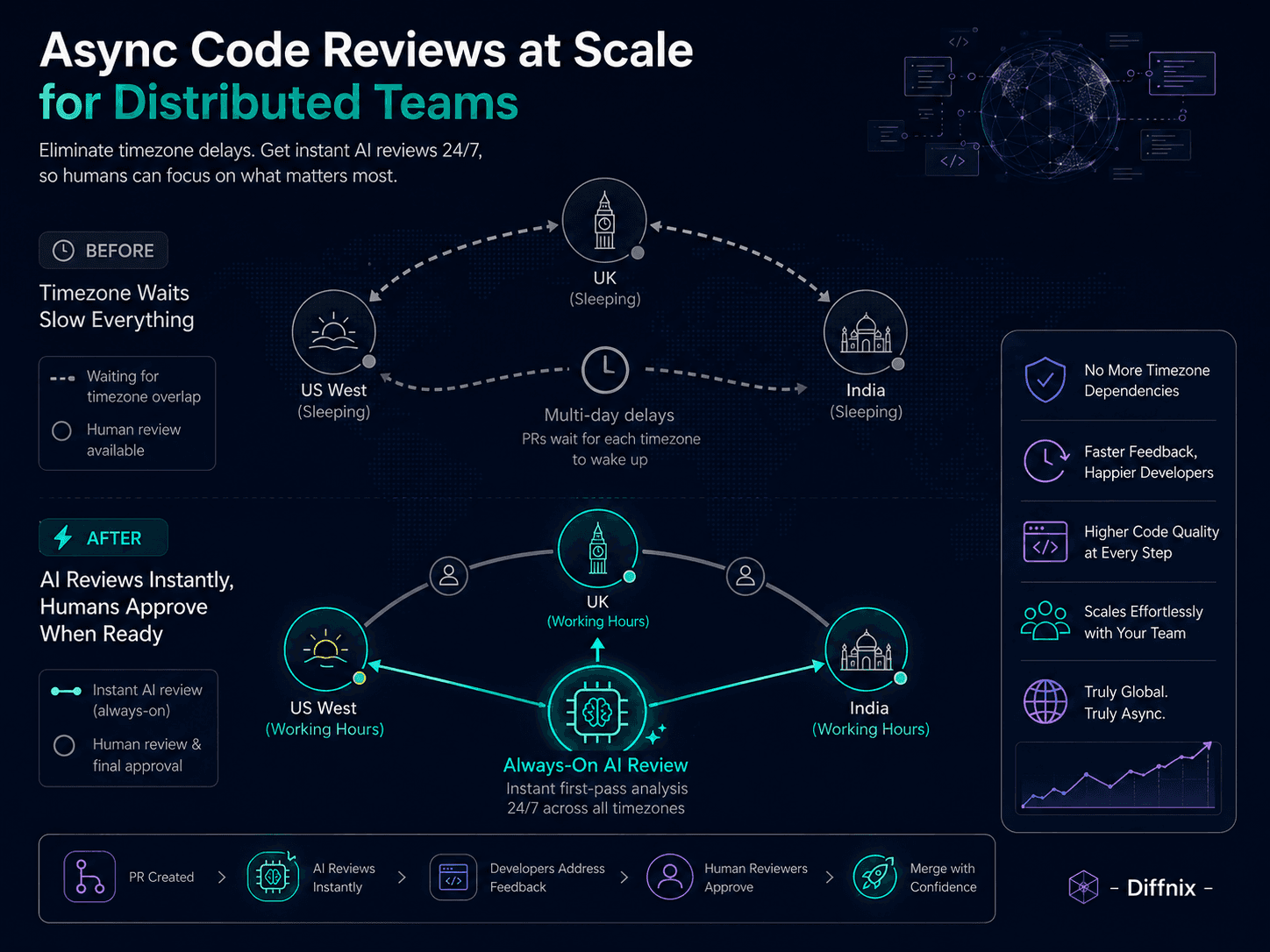
AI first-pass review breaks the timezone constraint by removing timezone as a variable. A reviewer that never sleeps, never leaves the office, and posts findings within two minutes of a PR opening does not care whether the PR was submitted at 4pm Friday Pacific or 2am Saturday UTC.
The Anatomy of PR Wait Time in Distributed Teams
For co-located teams, the breakdown of PR cycle time looks roughly like:
Waiting for reviewer availability: 30-40% of total time
First review and author response: 30-40%
Second review and approval: 20-30%
For distributed teams across significant timezone differences (more than 6 hours), the breakdown shifts dramatically:
Waiting for timezone overlap: 55-70% of total time
Review interactions: 25-35%
Final approval: 5-10%
The dominant cost is not the review itself. It is waiting for the time of day when both the author and the reviewer are online simultaneously. In teams with one hour of overlap per day, a single review cycle that misses the overlap window costs 23 hours.
Most PR cycle time improvements in distributed teams focus on the review interaction portion: faster reviews, more reviewers, smaller PRs. These improve the 25-35% slice while leaving the 55-70% slice untouched.
AI first-pass review attacks the dominant cost. When AI posts findings within two minutes of the PR opening, the author has substantive feedback available during their working session, regardless of where reviewers are in the world. They can address findings immediately. When the human reviewer's working day starts, the PR arrives pre-processed: findings addressed, author context documented, obvious issues resolved.
The single review cycle that used to cost 23 hours because of timezone gap now costs the time for the author to address AI findings (30-60 minutes) plus the time for the human reviewer to do their review the next morning (15-20 minutes). Total: a few hours across a 24-hour period instead of multiple multi-day cycles.
How Timezone Gaps Multiply Review Cycles
The math gets worse when you consider that most PRs require more than one review cycle. An initial review generates comments. The author fixes them. The reviewer re-reviews. Sometimes there is a third cycle.
In a co-located team, a three-cycle review might take a day. Each cycle is measured in hours.
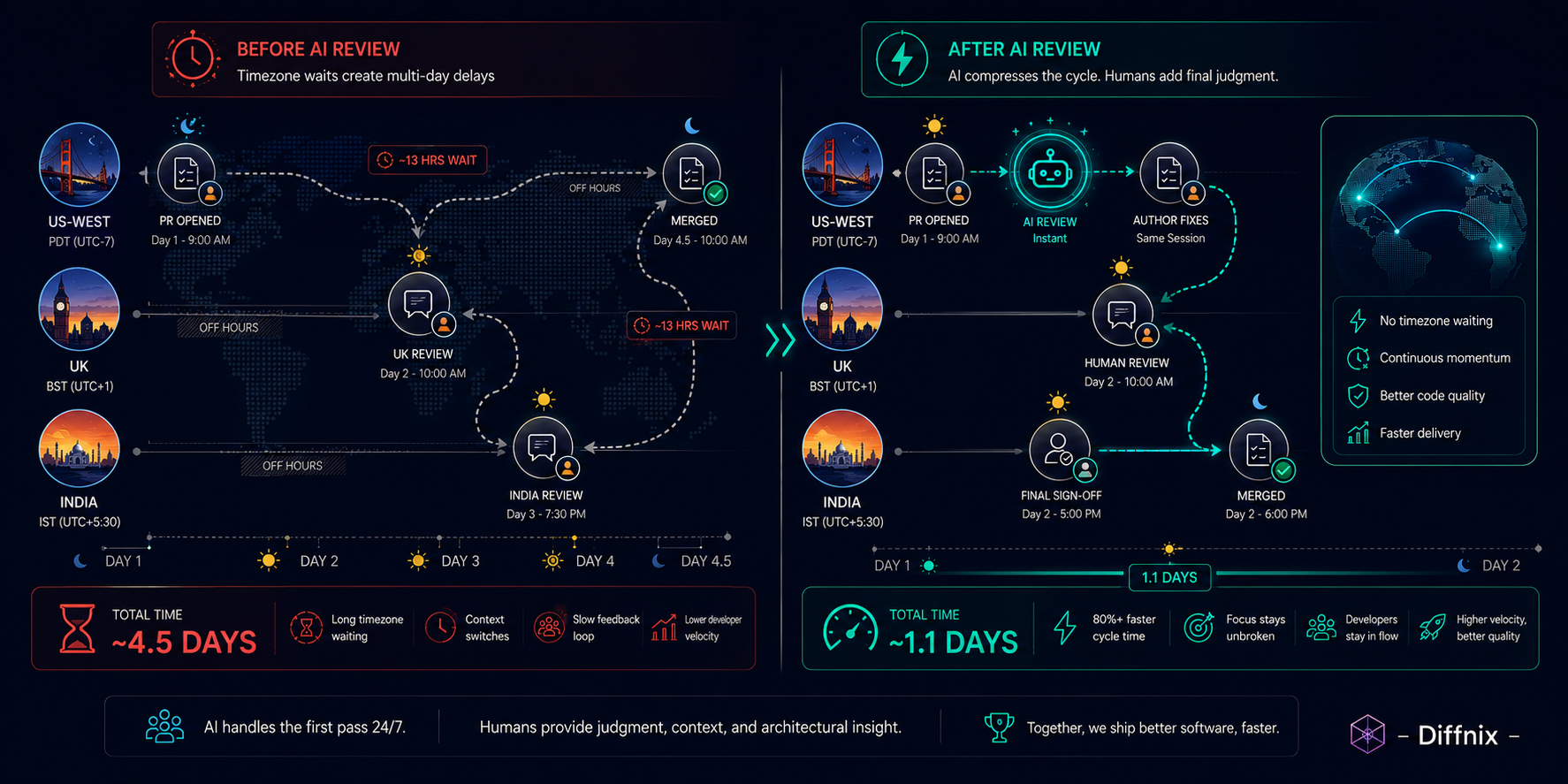
In a three-timezone distributed team (US-West, UK, India), each cycle is measured in days:
CYCLE 1:
  US-West developer submits PR at 4pm Friday
  UK reviewer sees it Monday morning (64 hours later)
  UK reviewer leaves 3 comments
  US-West developer sees them Monday morning their time
  US-West fixes and updates (8 hours to address comments)

CYCLE 2:
  UK reviewer is in afternoon meetings, reviews Tuesday morning
  Leaves 1 more comment (16 hours to re-review)
  US-West developer addresses Tuesday morning their time

CYCLE 3:
  India reviewer needs to sign off for compliance
  Reviews Wednesday morning India time
  Approves (16 hours)

Total time-to-merge: 4.5 business days
Actual work time: 3-4 hours
Timezone overhead: 4+ days
Three cycles, three time zones, four days. The code spent 4 hours being worked on and four days being moved around the world waiting for the next person to wake up.
AI first-pass review changes the first cycle fundamentally. The PR gets AI findings in 2 minutes. The author addresses them in the same working session. When the UK reviewer opens the PR Monday morning, many of the comments they would have made are already addressed. First cycle is effectively complete before any timezone overhead accumulates.
📌 Insight: Reducing review cycles from three to 1.5 average in a three-timezone team does not reduce total time-to-merge by 50%. It reduces it by approximately 65-70%, because each eliminated cycle saves the full timezone round-trip, not just the review time.
How AI First-Pass Review Integrates With Async Workflows
The integration is straightforward. AI review triggers on PR open (and on every push to the PR branch) and posts findings as inline comments. No human needs to be online for this to happen. No approval is required. The findings appear immediately, regardless of what time it is or who is currently working.
# .github/workflows/async-ai-review.yml
# Triggers on PR open and every push to the PR branch

name: Async AI Code Review

on:
  pull_request:
    types: [opened, synchronize, reopened]

jobs:
  ai-review:
    runs-on: self-hosted      # runs on your infrastructure, code stays local
    steps:
      - name: Checkout PR
        uses: actions/checkout@v3
        with:
          fetch-depth: 0

      - name: Run PRInspector
        uses: diffnix/pr-inspector-action@v2
        with:
          inference_endpoint: ${{ secrets.DIFFNIX_ENDPOINT }}
          pr_title: ${{ github.event.pull_request.title }}
          pr_description: ${{ github.event.pull_request.body }}
          confidence_threshold: 0.60
          post_comments: true
This runs on every PR, regardless of timezone, regardless of reviewer availability. The developer gets findings within two minutes of submitting.
The author's workflow becomes:
Submit PR at end of their working day
Read AI findings before closing laptop
Address clear findings in the same session
Go offline with the PR in an improved state
Human reviewers in other timezones open a pre-processed PR the next morning
The human reviewer's workflow becomes:
Open PRs at start of working day
Read AI findings and author responses (most of the first-pass context is already there)
Add architectural review, approve or request changes
Close the loop in a single session rather than multiple cycles
For teams with strict compliance review requirements, the async model also works well for the sign-off layer: compliance reviewers can review pre-processed PRs on their own schedule without being blocked on the back-and-forth that typically delays simple compliance checks.
Real-World Use Case: 2.8 Days to 1.1 Days
A product engineering team was distributed across three locations: US-West (8 engineers), UK (6 engineers), and India (5 engineers). The team built a B2B SaaS platform with mixed TypeScript and Python services.
PR workflow was standard: open PR, request review from the relevant team, wait. For cross-team PRs that needed sign-off from more than one location, the timeline was painful.
Before AI review:
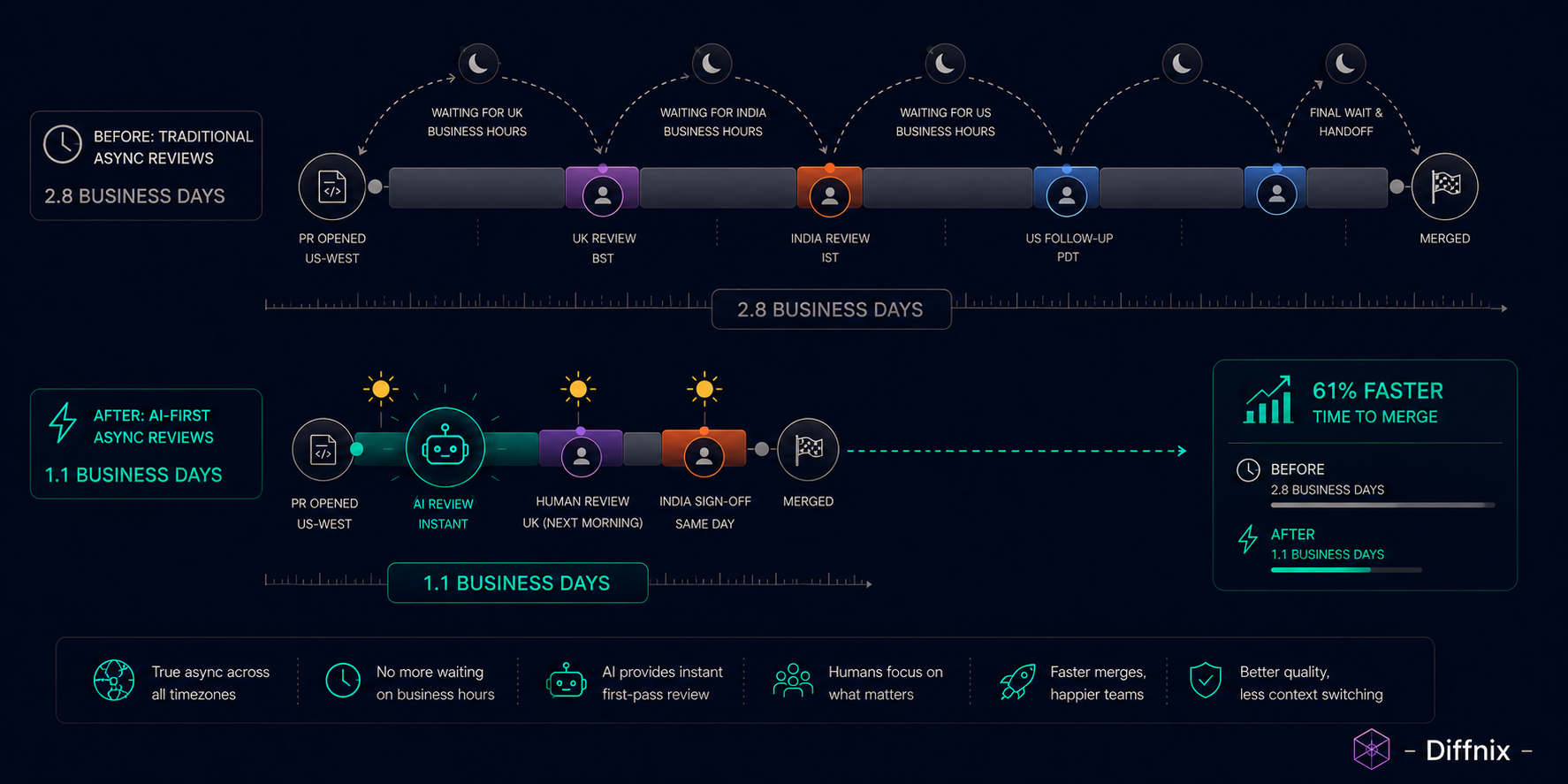
Average time-to-merge: 2.8 business days
PRs requiring cross-timezone review: approximately 60% of total
Most frequent complaint in retrospectives: waiting for review
Most common reason for review delay: reviewer in a different timezone
After adopting Diffnix with AI first-pass review on all PRs:
Average time-to-merge: 1.1 business days
Reduction: 61%
PRs requiring cross-timezone sign-off: same (60%)
Retrospective feedback: "the PR queue basically disappeared from the agenda"
The 1.1-day average includes the PRs that require multiple human reviewers. The single-reviewer PRs average under 18 hours. The cross-timezone multi-reviewer PRs average 1.5-2 days, down from 3.5-4 days.
What changed: the first review cycle now happens autonomously. By the time the human reviewer in the next timezone opens the PR, the obvious issues are resolved and the context is documented. The human review is a final quality gate, not a first-pass scan.
The team lead's observation at the 90-day mark: "The AI review being immediate means developers actually read and address findings before going offline. That was not happening before because there was nothing to read. Now the PR is in a better state when it reaches human reviewers, and human reviewers spend less time on each PR. Both sides get faster."
For the broader velocity picture and how these improvements compound across an engineering organization, the complete AI PR velocity guide covers all the dimensions together.
Advanced Tips for Engineering Managers of Distributed Teams
Make AI findings part of the async handoff protocol
Build AI review into the standard PR workflow documentation. The protocol: open PR, read AI findings before end of day, address obvious issues or document disagreement in PR comments, then hand off. When reviewers in other timezones open the PR, they arrive at context-rich pre-processed state rather than a cold PR.
Use finding acknowledgment as a forcing function for author preparation
Configure your workflow to require that the PR author acknowledges AI findings (resolves them, dismisses them, or comments on them) before the PR moves to the review queue. This ensures that by the time a human reviewer opens the PR, the first pass has been completed by the author. One team implemented this as a simple GitHub Action that marks the PR as "AI findings pending author review" until all findings are addressed or explicitly dismissed.
Measure the cycle count specifically for cross-timezone PRs
Track time-to-merge separately for same-timezone PRs and cross-timezone PRs. The improvement from AI review is most dramatic in the cross-timezone category because each eliminated review cycle saves the full timezone round-trip. If your cross-timezone PRs are not improving proportionally to same-timezone PRs, the workflow adoption for the async handoff protocol needs reinforcement.
⚠️ Warning: AI first-pass review reduces timezone overhead for the first review cycle. It does not eliminate timezone coordination for subsequent cycles that require architectural discussion, design decisions, or significant back-and-forth. For PRs that introduce major changes requiring extended discussion, the timezone gap remains a real constraint. AI review helps most for the majority of PRs that are focused changes with limited review discussion.
Conclusion
Distributed teams have a PR velocity problem that has nothing to do with review quality. The constraint is time zones, not expertise. Reviewers are perfectly capable. They are just asleep.
AI first-pass review removes timezone as a variable in the first review cycle. Two minutes from PR open to first substantive findings, regardless of where the development team is or what time the submission happened. The PR arrives at human reviewers pre-processed. The review cycle that previously took days compresses to hours.
For the team in this post, that was the difference between 2.8 days and 1.1 days. For every cross-timezone review cycle eliminated, two or three days of developer wait time disappears.
We built Diffnix to work as an always-on reviewer because engineering teams should not be blocked by time zones. The code never leaves your network. The review never waits for business hours.
Diffnix is a private, AI-powered code intelligence platform that understands your code, not just scans it.
See how Diffnix works as an always-on reviewer for distributed teams.