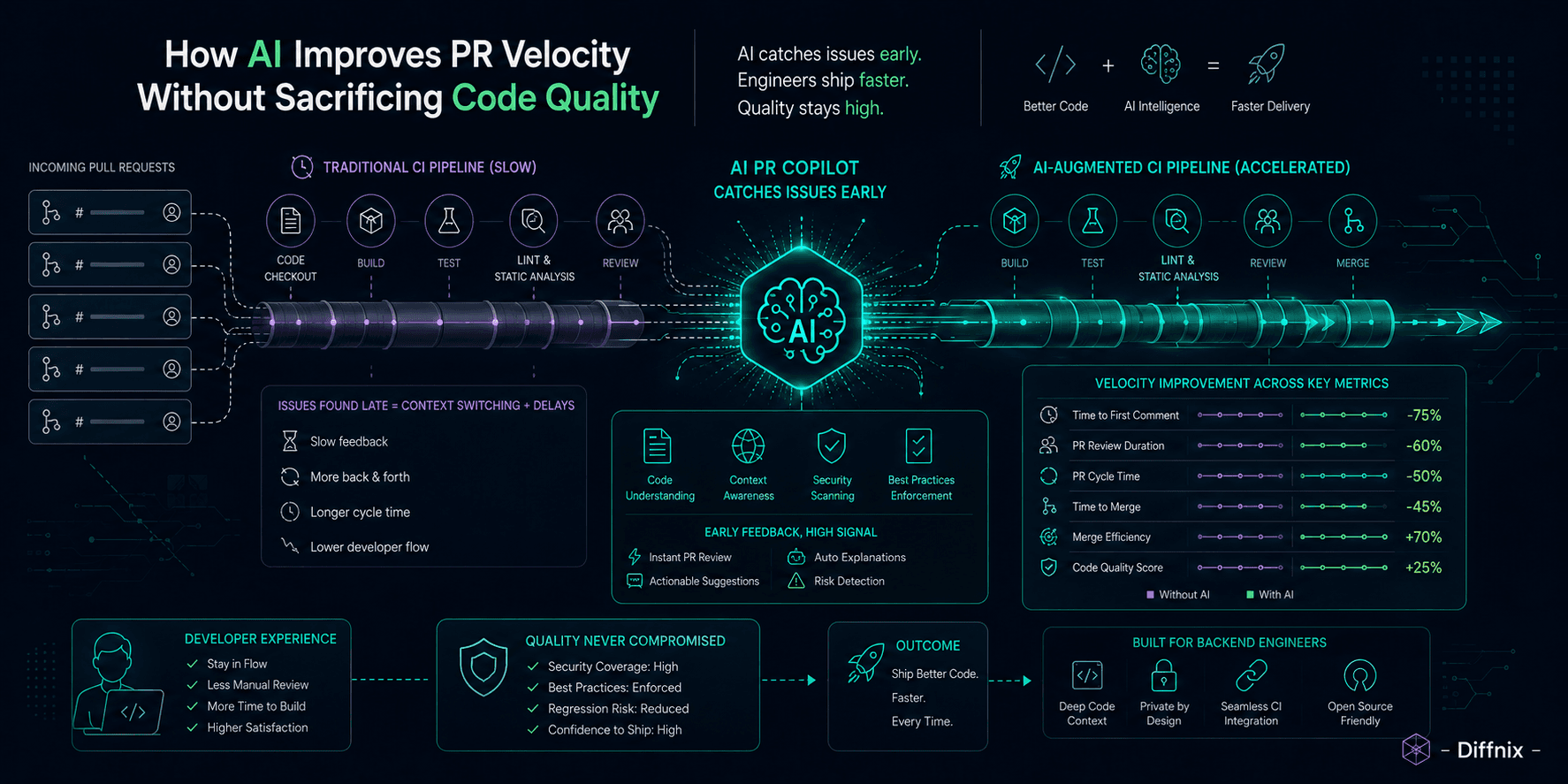
How AI Improves PR Velocity Without Sacrificing Code Quality
The argument that velocity and quality are a tradeoff assumes human review is the only variable. It is not. This guide explains how AI code review at the PR stage breaks that tradeoff, what metrics actually measure velocity improvement, and how to implement it in a way that makes both your reviewers and your engineering leadership happy.

Introduction
Every engineering organization has had this conversation at some point. A VP asks why PRs are taking four days to merge. An engineering manager explains that quality review takes time. The VP says to move faster. The engineering manager says faster means shallower. Both are correct, and the conversation ends without resolution.
The stalemate is based on a real observation: when teams push for faster reviews under pressure, quality actually does drop. Reviewers spend less time per PR. They approve things that look structurally sound without verifying that they work correctly. Bugs ship. The team moves fast and then spends twice as long fixing production issues.
But the observation has a hidden assumption: that human review speed is the binding constraint on PR velocity. It usually is not.
The actual binding constraint for most teams is waiting time. PRs do not take four days to review. They spend four days waiting for a reviewer to have time. The review itself takes 20-40 minutes once it starts. The queue is the problem, not the review.
AI first-pass review at the PR stage changes this equation by separating the work that requires human judgment from the work that does not. When an AI reviewer handles the routine checks automatically and immediately after the PR opens, two things happen: the PR queue time drops significantly because the first substantive review happens in minutes rather than hours, and human reviewer time decreases because they are reviewing annotated code rather than cold code.
The result is faster PRs and better PRs at the same time. This is the mechanism this guide explains.
What PR Velocity Actually Measures
"Velocity" is used loosely in engineering conversations. Before optimizing for it, it helps to know which component you are actually trying to improve.
The time from PR open to PR merge breaks down into distinct phases:
Time to first review comment: How long after the PR opens does the first substantive feedback arrive? For most teams, this is the largest single component of total PR time. It is driven entirely by reviewer availability, not review quality.
Time in review: How long does the actual review process take once a reviewer starts? This includes back-and-forth comment cycles and re-review after fixes.
Time to approval: How long from first review to final approval? This includes the time for the author to address comments and the time for the reviewer to re-check.
AI review primarily compresses the first component. It posts a first-pass review within two minutes of the PR opening. That means the author can start addressing feedback during the same working session rather than the next day.
A secondary effect: it also compresses the time-in-review component. Reviewers reading an AI-annotated PR spend their time evaluating findings and checking architecture rather than scanning for the issues the AI already surfaced. Average human review time per PR typically drops 40-60% when AI handles the first pass.
📌 Insight: Most time-to-merge improvement from AI review comes from eliminating the waiting period before the first review comment, not from making human review faster. This is why teams that adopt AI review primarily as a "review assistant" (showing AI findings alongside the diff for human consideration) see more improvement than teams that use it as a pure automation layer.
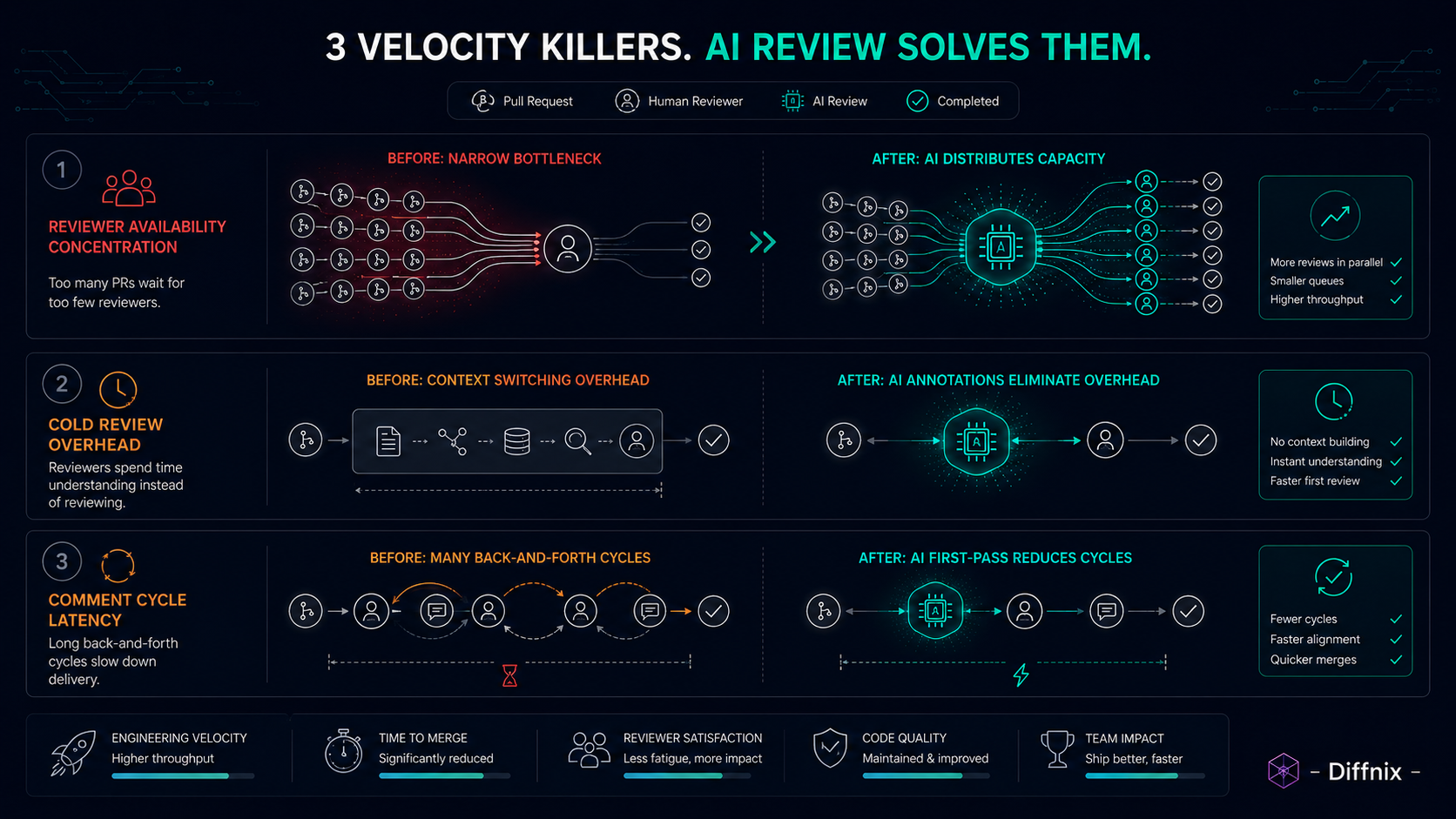
The Three Biggest Velocity Killers
Understanding what to fix requires knowing what is actually causing the slowdown.
Reviewer availability concentration. In most engineering organizations, two or three engineers do the reviews that actually find bugs. Everything funnels through them. They are at capacity. PRs wait.
This is not a hiring problem. Adding more reviewers does not fix it because review quality expectations concentrate the real review work back toward the most experienced engineers. What fixes it is distributing the routine first-pass work to AI so that experienced reviewers can process more PRs in the same time.
Cold review overhead. A reviewer opening a PR cold needs to understand what changed, why, what depends on it, and what could break. That context-building takes 10-15 minutes before any actual evaluation begins. It is the reason a 30-minute review often takes 45 minutes in practice.
AI review eliminates cold review overhead for the categories it covers. When a reviewer opens a PR that already has AI findings posted, they start from context rather than from scratch. They evaluate findings, check architecture, and consider edge cases. The upfront orientation time is gone.
Comment cycle latency. A reviewer leaves a comment. The author is not online. The fix goes in the next morning. The reviewer is in meetings. Re-review happens the afternoon after that. One comment cycle takes 36 hours across a distributed team.
AI review cannot fully solve this, but it reduces the number of cycles by catching the issues that would have generated those comments automatically. Fewer comment cycles means fewer round-trip delays.
How AI Review Changes the Velocity Math
The mechanism is simple. The numbers tell the story clearly.
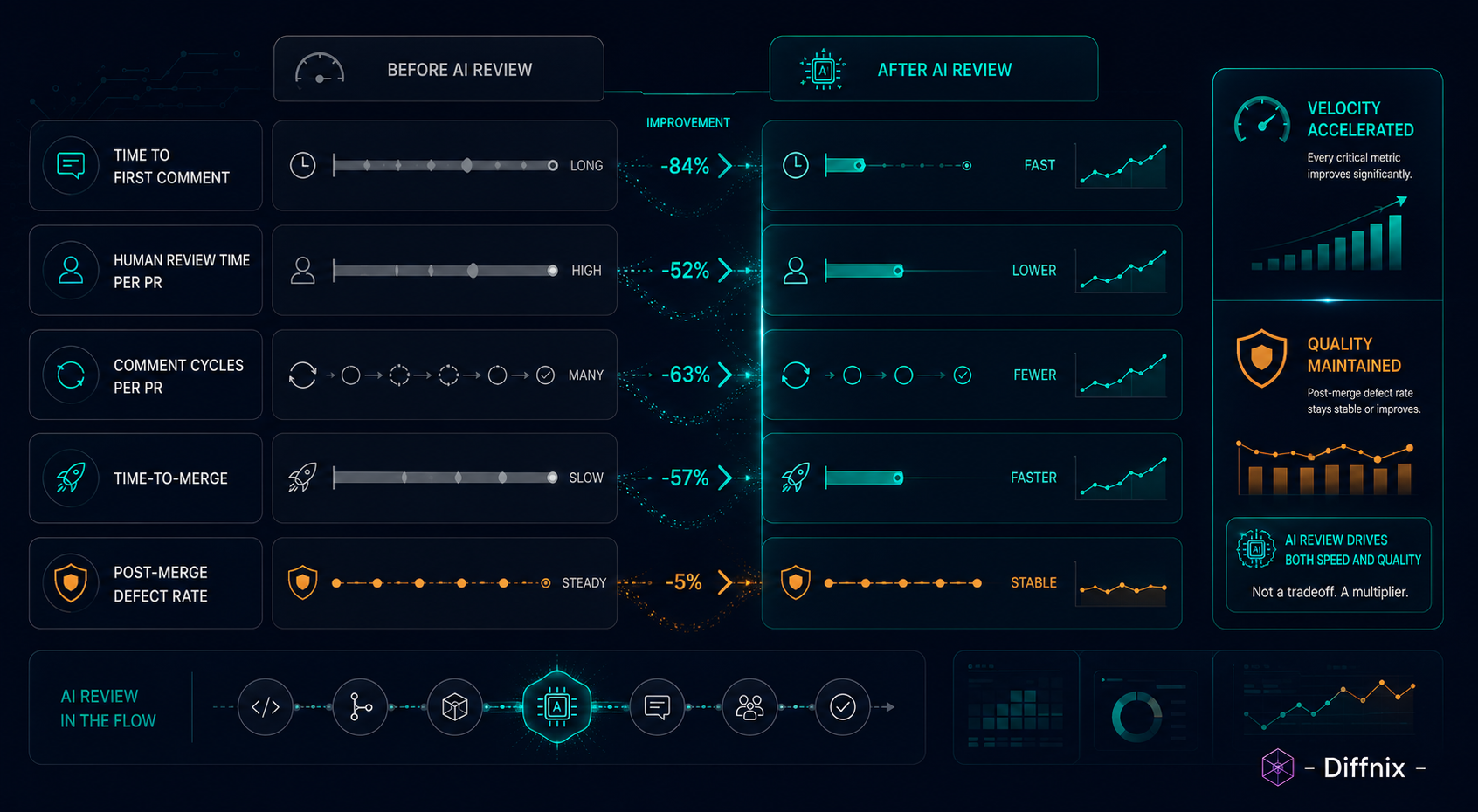
Before AI review (typical team profile):
Average time to first review comment: 18-22 hours
Average human review time per PR: 38 minutes
Average PRs per reviewer per day: 4-6
Average comment cycles per PR: 2.1
Average time-to-merge: 2.8-3.5 business days
After AI first-pass review:
Time to first review comment: 2 minutes (AI), then human follow-up same or next day
Average human review time per PR: 16-20 minutes (reviewing findings vs cold reading)
Average PRs per reviewer per day: 15-22
Average comment cycles per PR: 1.3-1.5 (AI catches many issues that would have generated human comments)
Average time-to-merge: 0.4-1.2 business days
The improvement is not from making individual reviews faster. It is from eliminating the waiting time and reducing the back-and-forth cycle count.
The finding rate does not drop. It typically increases, because AI catches categories of issues that human reviewers frequently miss under time pressure (null guards, type coercions, missing authorization checks). The finding rate on the categories AI handles well goes up. The human reviewer's finding rate on architectural and business-logic issues stays constant because they are not spending that attention on the routine checks anymore.
# Example CI integration for AI first-pass review
# .github/workflows/pr-review.yml

name: AI Code Review

on:
  pull_request:
    types: [opened, synchronize]

jobs:
  ai-review:
    runs-on: ubuntu-latest
    steps:
      - name: Run Diffnix PRInspector
        uses: diffnix/pr-inspector-action@v2
        with:
          inference_endpoint: ${{ secrets.INFERENCE_ENDPOINT }}
          confidence_threshold: 0.60
          dimensions: "correctness,security,performance"
          post_findings_as_comments: true
          max_findings_per_pr: 6
This runs automatically on every PR open and every push to the PR branch. The author gets findings within 2 minutes of opening the PR.
Metrics That Tell You It Is Working
Velocity improvement from AI review is measurable. These are the metrics worth tracking:
Time to first substantive comment: Track from PR open timestamp to first non-trivial review comment (filter out automated checks). This should drop significantly in the first 30 days.
Human reviewer time per PR: Have reviewers log approximate time spent per PR for 30 days before and 30 days after adoption. Expect a 35-50% reduction.
Comment cycle count per PR: Track the average number of review-response-re-review cycles before approval. This should drop from 2+ to 1.3-1.5.
Time-to-merge by PR size bucket: Separate small PRs (under 100 lines) from medium (100-300 lines) and large (300+ lines). AI review has the largest impact on medium and large PRs where cold review overhead is highest.
Post-merge defect rate: This is the quality metric that confirms velocity improvement did not come at the cost of quality. If defect rate holds steady or drops while velocity improves, the trade-off assumption has been falsified.
✅ Best Practice: Measure all five metrics for 60 days before adopting AI review, then continue measuring for 60 days after. The before-after comparison is the evidence that makes the ROI case to engineering leadership.
Common Implementation Mistakes
Positioning it as a replacement for human review. This creates a trust problem immediately. Engineers who believe AI is replacing their review process resist adoption. The correct positioning: AI is the first pass, human review is the final gate. This is accurate and much easier to adopt.
Using default confidence settings across all repositories. Default settings optimize for a balanced finding rate. A team that wants maximum velocity impact should tune thresholds for their specific risk profile. High-risk repos (payments, auth) should surface more findings. Low-risk repos should surface fewer. Generic defaults produce a mediocre result everywhere.
Not updating the review workflow. When AI findings appear on every PR, the human reviewer needs to know how to incorporate them. If reviewers ignore the AI findings and do their standard cold review, the benefit disappears. Build a simple workflow: read AI findings first, address obvious ones, then do architectural review. This takes 5 minutes to explain and makes a significant difference.
Measuring only velocity and not quality. If you optimize for time-to-merge without measuring defect rate, you will not know if quality held. Track both from day one.
⚠️ Warning: Teams that see velocity improve dramatically in the first 30 days sometimes reduce human review rigor in response, assuming the AI is covering the quality gap. AI review covers specific categories well and misses others. Human review remains the final quality gate for architectural decisions, business logic correctness, and team convention compliance.
How Diffnix Approaches Velocity
We built Diffnix because we kept seeing engineering teams treating velocity and quality as competing priorities when the real constraint was something different: human reviewer attention was being spent on work that did not require human judgment.
The AI review pipeline in Diffnix is designed specifically to address this. It posts findings within two minutes of a PR opening. It covers the correctness, security, performance, and maintainability dimensions that create the most comment cycles when missed. It runs confidently enough on what it knows and stays quiet on what it does not.
The result is that your senior engineers spend their review time on the things that actually require their expertise. Architecture. Business logic. Cross-service impact. Team conventions that only make sense given the history of the codebase. Those are the things humans do better than AI. Let AI handle the rest.
Diffnix is a private, AI-powered code intelligence platform that understands your code, not just scans it.
Conclusion
PR velocity and code review quality are not a tradeoff. They are both constrained by how human reviewer attention gets allocated. When AI handles the routine first pass, human reviewers go faster and miss fewer things at the same time.
The cluster articles in this pillar go deep on each dimension of engineering velocity improvement:
How AI code review cut PR review time by 50% with real before-after metrics
The PR bottleneck problem and how to remove it from your engineering org
How consistent AI review prevents technical debt from entering the codebase at review time
How AI code review acts as a mentorship system for junior developers
Ready to see the velocity improvement in your own team's numbers? Try PRInspector on your next PR.