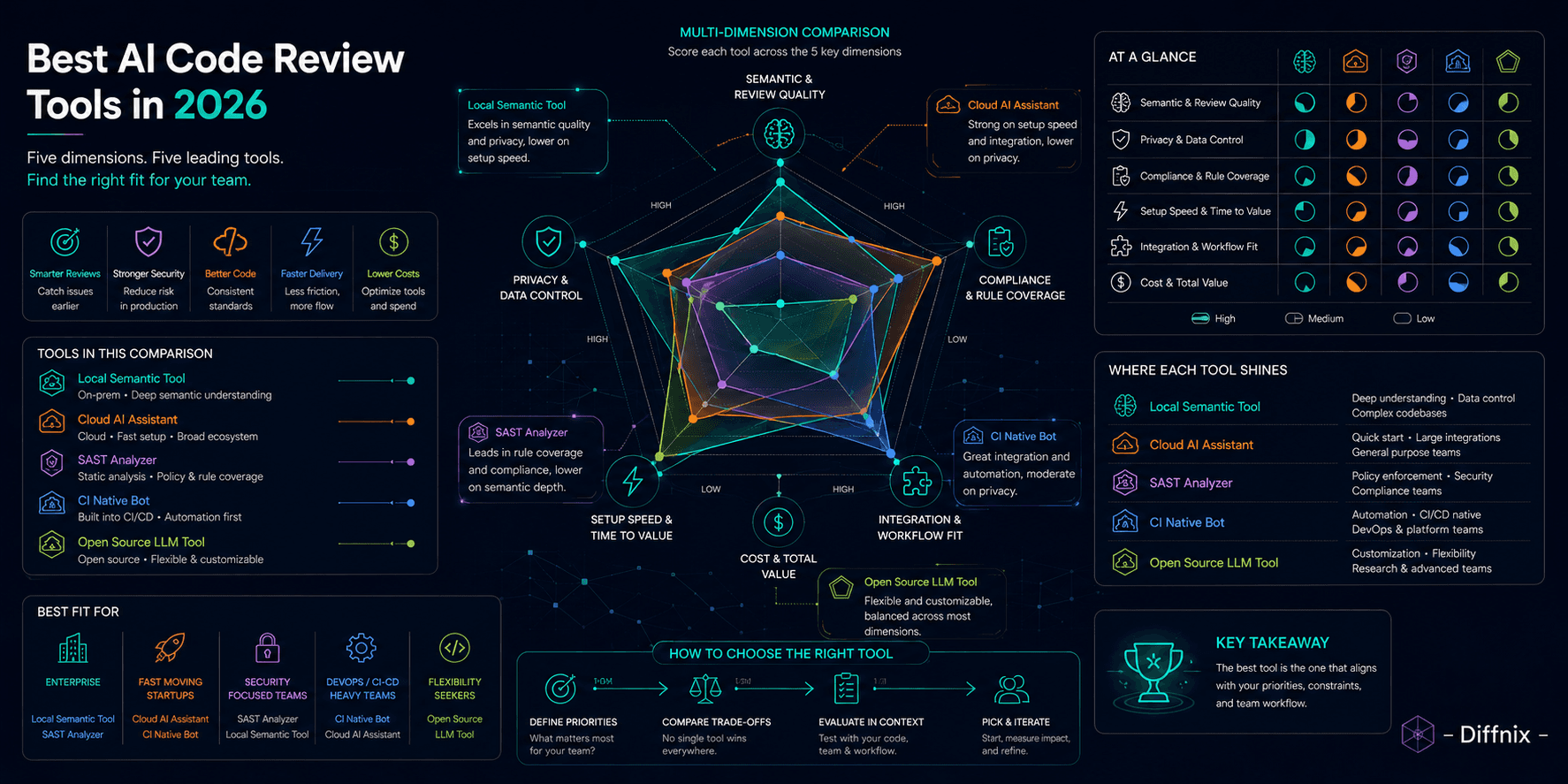
Best AI Code Review Tools in 2026: An Honest Comparison (Including Where Diffnix Leads)
We benchmarked AI code review tools against real PR workflows across three evaluation teams, not cherry-picked demos. This is what the tools actually did on real code, including where the cloud tools performed well, where SAST-based tools hit their ceiling, and where local semantic analysis made the difference.

Introduction
Most "best AI code review tools" posts are thinly veiled affiliate content or competitive marketing dressed up as journalism. You get a list of tools, a feature table with conveniently checkmarks in the right columns, and a conclusion that was written before the evaluation happened.
This post is different. Three real engineering teams ran four tools for 30 days on their actual PR workflows. They were not told to use specific tools or reach specific conclusions. The results include cases where the cloud tools performed better than expected, where SAST-based analysis caught things the AI tools missed, and where all five tools failed on the same class of bug.
The evaluation covered five tools:
Diffnix PRInspector (local semantic AI)
GitHub Copilot Code Review (cloud, GPT-4-powered)
CodeRabbit (cloud, PR-native review agent)
SonarQube Cloud with AI features (SAST with LLM overlay)
A custom internal LLM reviewer (built by one of the evaluation teams)
What We Evaluated and How
Three teams participated in the 30-day evaluation:
Team A: 12-person SaaS startup, TypeScript and Node.js, no regulated data, no compliance requirements. Priority: finding rate and ease of adoption.
Team B: 8-person healthcare technology team, Python and Django, HIPAA-regulated environment, patient data handling code. Priority: privacy architecture and compliance posture.
Team C: 20-person fintech platform team, mixed Java and Python, SOC2 Type II certified, proprietary algorithm development. Priority: semantic review quality and IP protection.
Each team evaluated two tools simultaneously for 30 days on real PRs (not sandboxed). At the end, we collected: finding rate, false positive rate, compliance assessment results, developer satisfaction scores, and setup friction observations.
No vendor knew they were being evaluated against competitors.
Tool 1: GitHub Copilot Code Review
What it does well:
GitHub Copilot Code Review is the most polished integration in the category. For teams already on GitHub with Copilot Business or Enterprise licenses, it requires approximately five minutes to enable. The UI integration is excellent: findings appear inline in the PR diff view with the same visual treatment as human reviewer comments.
Finding quality on standard correctness categories is good. GPT-4 backing means the model has strong general reasoning. For small to medium PRs in common languages, the findings are specific and actionable.
Team A (startup, no compliance requirements) rated it highest for setup experience and finding relevance on standard TypeScript and Node.js PRs.
Where it falls short:
Cloud architecture with code transmitted to Microsoft and OpenAI infrastructure. For Team B (healthcare), the privacy policy review identified that submitted code data is retained and processed under Microsoft's standard data terms. Without a specific HIPAA BAA covering the Copilot Code Review feature, Team B could not adopt it for their patient-data-adjacent codebases.
Finding quality on cross-file logic bugs was mixed. On the IDOR test PR (the standard evaluation benchmark), Copilot flagged a potential authorization concern but did not identify the specific ownership check that was missing, citing general best practices rather than the actual gap in the codebase.
Best for: Small to mid-size teams on GitHub without compliance requirements, looking for the fastest setup and lowest friction adoption.
Tool 2: CodeRabbit
What it does well:
CodeRabbit has the best PR comment UX in the category. Findings are organized, prioritized, and include actionable suggestions that integrate well with the developer's edit workflow. Onboarding is approximately 10 minutes. The walkthrough review summaries (a high-level overview of what changed and what was flagged) are genuinely useful for reviewers who want context before diving into the diff.
For Team A, CodeRabbit and Copilot Code Review performed comparably on finding rate and quality on standard code review categories.
Where it falls short:
Cloud architecture with the same privacy implications as Copilot Code Review. Team B's compliance assessment found the same issues: code transmitted externally, no HIPAA BAA available for the standard plan.
On the semantic evaluation benchmarks (IDOR, mass assignment, command injection via user-controlled subprocess arguments), CodeRabbit's finding rate was lower than Diffnix on context-dependent security bugs. It performs well on pattern-based security issues (SQL injection via string concatenation was caught reliably) but misses authorization-layer vulnerabilities that require understanding the permission model.
Best for: Startups and growing teams without compliance requirements who want excellent review UX and fast adoption.
Tool 3: SonarQube Cloud with AI Features
What it does well:
SonarQube is the most mature tool in the comparison by a significant margin. Fifteen years of accumulated security rules, technical debt tracking, complexity metrics, and quality gate integration. The AI features added in recent versions improve the explanation quality around existing findings and add natural-language suggested fixes.
Team C (fintech, SOC2) already had SonarQube deployed. The AI features added genuine value on top of the existing integration by making findings more actionable and reducing the time developers spend looking up documentation.
On known vulnerability patterns (SQL injection, hardcoded credentials, insecure random number generation, known insecure function calls), SonarQube's finding rate was the highest in the evaluation. Its rule set is deep.
Where it falls short:
SonarQube's AI features do not expand what gets caught. They expand how findings are explained. If a vulnerability is not in the rule set, the AI layer does not find it.
On the context-dependent evaluation benchmarks, SonarQube's finding rate was the lowest in the comparison. The IDOR test PR passed with zero findings. Mass assignment via Rails params without strong_parameters was not caught. These are not in the rule set because they require understanding the application's authorization model, which rule-based analysis cannot access.
Best for: Enterprise teams with existing SonarQube investment, teams that need deep known-pattern coverage and technical debt tracking, teams where compliance documentation of findings matters.
Tool 4: Custom Internal LLM Reviewer
Team C had spent six months building an internal AI review tool before the evaluation. Their tool used GPT-4-turbo via API, with custom diff parsing and a prompt engineering layer developed by two senior engineers.
What it does well:
Maximum control over finding types, tuning, and workflow integration. The team had configured it specifically for their Java and Python codebase patterns and had addressed several false positive categories that off-the-shelf tools produce for their specific domain.
Where it falls short:
Building it consumed approximately six months of two senior engineers' time. When GPT-4-turbo was updated mid-build, the prompt layer required a significant rewrite. One engineer was assigned part-time to maintaining the tool. The ongoing engineering maintenance cost was estimated at 20-30 hours per month.
Finding quality on context-dependent bugs was lower than Diffnix, because their context enrichment implementation was less sophisticated. The custom tool did not resolve caller locations or fetch interface definitions; it only used the diff and the immediate file context.
The team's engineering lead observation: "We built it to have control. We got control, but we also got a maintenance obligation that we did not fully account for."
The build vs buy analysis covers the economics of this decision in full detail.
Tool 5: Diffnix PRInspector
What it does well:
Among the five tools, Diffnix produced the highest finding rate on context-dependent security bugs across all three evaluation teams. The IDOR test PR generated a specific finding that cited the model definition, the comparable authorized endpoints, and the exact line where the ownership check should be added. The mass assignment test PR generated a finding that named the specific unprotected model attributes.
For Team B (healthcare), the local deployment architecture was the decisive factor. Code never left their network. No compliance assessment was needed because there was no external data transmission to assess. The HIPAA question was resolved by architecture, not by legal review.
For Team C (fintech, SOC2), local deployment satisfied the SOC2 Confidentiality criterion for source code handling without requiring a vendor assessment. Setup time was 50 minutes for the inference server plus 10 minutes for the GitHub integration.
Where it falls short:
Setup time is higher than cloud tools. The 50-minute inference server setup is not burdensome, but it is not the 5-minute onboarding that cloud tools offer.
Hardware is required. A server with 48GB of VRAM is the recommended minimum for the 34B parameter model. Teams without existing GPU infrastructure need to provision it.
False positive rate was slightly higher than Copilot Code Review on style and maintainability findings. For teams that want to run the security and correctness dimensions only, disabling the maintainability dimension brings the false positive rate to competitive levels.
Best for: Teams in regulated industries (HIPAA, GDPR, SOC2, ISO 27001), teams with proprietary IP that cannot leave the network, teams that need the highest finding rate on context-dependent security and correctness bugs.
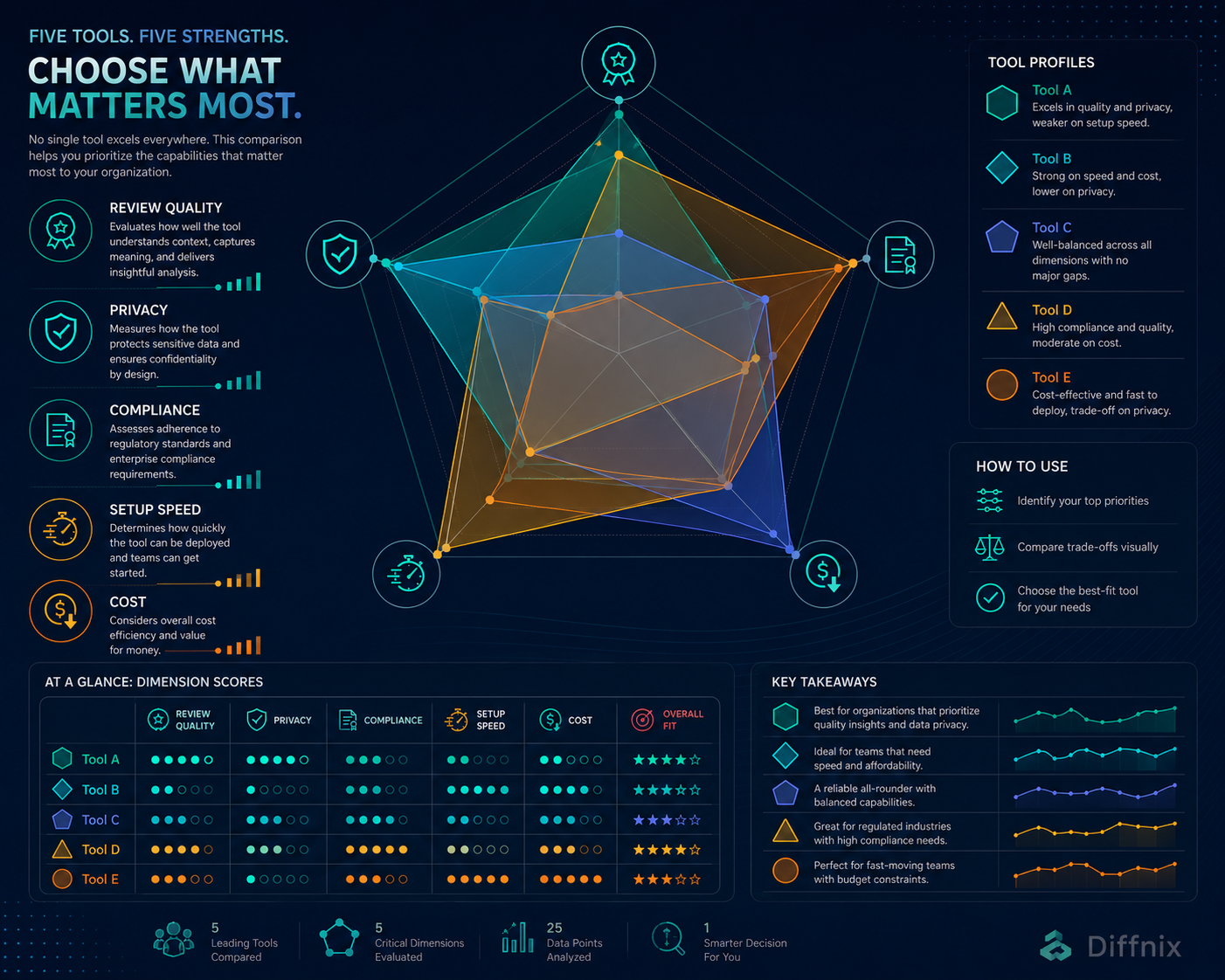
The Comparison Table
Dimension | Diffnix | Copilot Code Review | CodeRabbit | SonarQube AI | Custom Build |
|---|---|---|---|---|---|
Review depth | Semantic reasoning | Good (GPT-4) | Good | SAST-based | Depends on build quality |
Code privacy | Local only | Cloud | Cloud | Cloud optional | You control |
HIPAA / GDPR fit | Yes, by design | Needs DPA and BAA | Needs DPA | Depends | You control |
SOC2 posture | No external transmission | Vendor assessment required | Vendor assessment required | Vendor assessment required | You control |
IDOR detection | Yes | Partial | Partial | No | Depends |
Mass assignment detection | Yes | No | No | No | Depends |
Setup time | 45-60 minutes | 5 minutes | 10 minutes | 30 minutes | 3-6 months |
Ongoing maintenance | Low | Zero | Zero | Low | High (20-30 hr/month) |
Infrastructure required | Yes (GPU server) | No | No | No | Yes (GPU server or API) |
Price model | Flat / self-hosted | Per-seat subscription | Per-seat subscription | Per-instance | Engineering time and infrastructure |
Best for | Regulated teams, IP protection | Small teams, GitHub native | Startups, fast adoption | Enterprise SonarQube users | Teams with unique requirements |
Real-World Evaluation Results
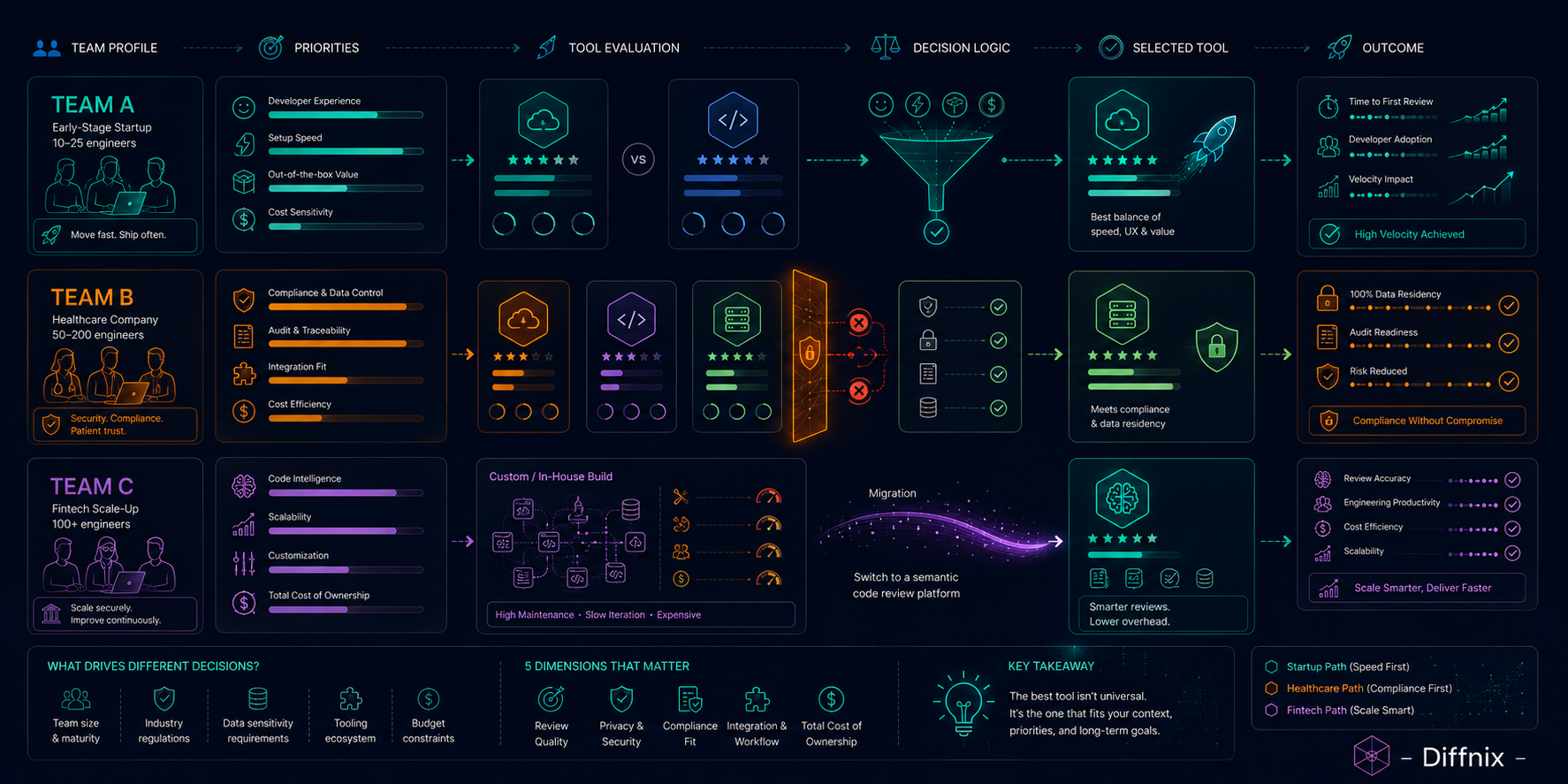
The three evaluation teams reached different conclusions based on their requirements.
Team A (startup, no compliance): Adopted CodeRabbit for its best-in-category PR UX and fast setup. Finding quality was sufficient for their risk profile. The privacy trade-off was acceptable given no regulated data.
Team B (healthcare, HIPAA): Adopted Diffnix. The privacy architecture resolved the compliance question before finding quality was even evaluated. Local deployment meant no legal review, no BAA negotiation, no compliance monitoring overhead. The setup overhead of 50 minutes was, in their words, "the cheapest compliance decision we made all year."
Team C (fintech, SOC2): Migrated from custom build to Diffnix. Their custom tool had consumed six months of engineering time and required ongoing maintenance. Diffnix's semantic quality was comparable or better on context-dependent bugs, with zero ongoing maintenance from their engineering team. The migration freed the two engineers who had been maintaining the custom tool to work on product features.
Advanced Tips for Running Your Own Evaluation
Use a standard benchmark PR set
Before evaluating any tool, create a set of 5-10 test PRs from your codebase that represent the bug categories you care about: one IDOR, one SQL injection via non-obvious path, one logic error requiring cross-file context, one N+1 performance issue. Run every tool against this set and score the findings. This produces comparable data across tools rather than impressionistic assessments.
Evaluate the false positive rate separately from the finding rate
A tool that finds 20 issues per 100 PRs with 40% false positive rate is less useful than a tool that finds 12 issues per 100 PRs with 10% false positive rate. Developers who receive frequent false positives stop reading findings within two to three weeks. Precision matters as much as recall.
Include a compliance review in the evaluation timeline, not after adoption
Run the privacy policy review and compliance assessment during your evaluation, not after adoption. For regulated teams, the compliance outcome often determines the tool before finding quality is assessed. Including it in the evaluation prevents a situation where you adopt, train developers, integrate with workflows, and then discover the compliance issue six months later.
⚠️ Warning: Demo performance does not predict production performance. Every vendor presents their tool on carefully selected examples during demos. The only data that matters is performance on your actual PRs, in your actual codebase, reviewed against your actual review standards. Require a 30-day production evaluation before committing.
Conclusion
No single tool wins on all evaluation dimensions. The right choice depends on your team's specific requirements across review quality, privacy architecture, compliance obligations, integration fit, and total cost of ownership.
For teams without compliance requirements and with small budgets, cloud AI tools offer the fastest setup and lowest friction. For teams in regulated industries or with IP protection requirements, local semantic analysis is the only architecture that eliminates compliance risk by design. For teams with existing SonarQube investment, the AI features add UX value without changing the underlying finding coverage.
Diffnix is a private, AI-powered code intelligence platform that understands your code, not just scans it. It wins on the dimensions that matter most for security-conscious engineering teams. For other team profiles, we are honest that a different tool may be the better fit.
Compare Diffnix against your current tool or start a local trial.