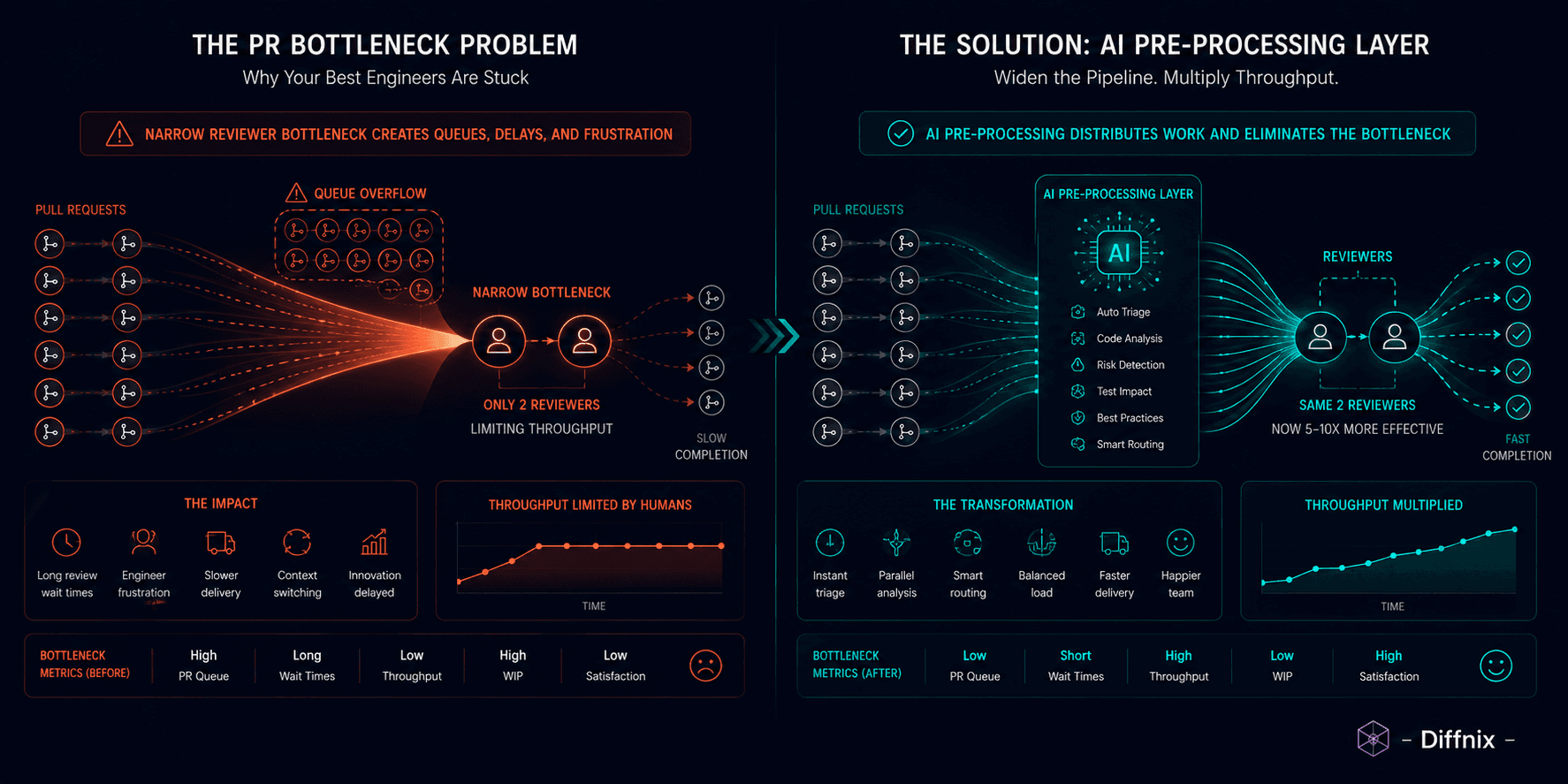
The PR Bottleneck Problem: Why Your Best Engineers Are Stuck Reviewing Instead of Building
Two engineers reviewing 80% of all PRs is not a process problem. It is a structural one. This post explains exactly why review work concentrates at the top of engineering organizations, why the standard fixes do not work, and how AI first-pass review distributes the load without distributing the accountability.

Introduction
Most engineering organizations have a version of the same problem. There are two, maybe three people whose reviews everyone trusts. Their names appear on 70-80% of approved PRs. They are the people who catch things. They are also perpetually behind on reviews, have long queues, and are blocked from doing the deep technical work that actually requires their expertise.
Everyone knows this is a problem. The solutions tried are predictable: ask the bottleneck engineers to review faster, hire more senior engineers, require more engineers to review more PRs, split PRs into smaller pieces.
None of these work consistently. The faster-review pressure produces shallower reviews. The new senior hires eventually join the bottleneck instead of relieving it. The broader review requirements create a two-tier system where most approvals are rubber stamps and one or two engineers are still doing the real reviews. Smaller PRs reduce individual PR complexity but increase coordination overhead and may actually slow features to completion.
The root cause is not being addressed by any of these interventions. The root cause is that review work is inherently expertise-intensive, and in a typical engineering organization, expertise is scarce. Distributing review accountability does not distribute expertise. It just creates more rubber stamps.
The lever that actually works is different: automate the work that does not require expertise, so that the work that does require expertise can be processed more efficiently.
The Bottleneck Math
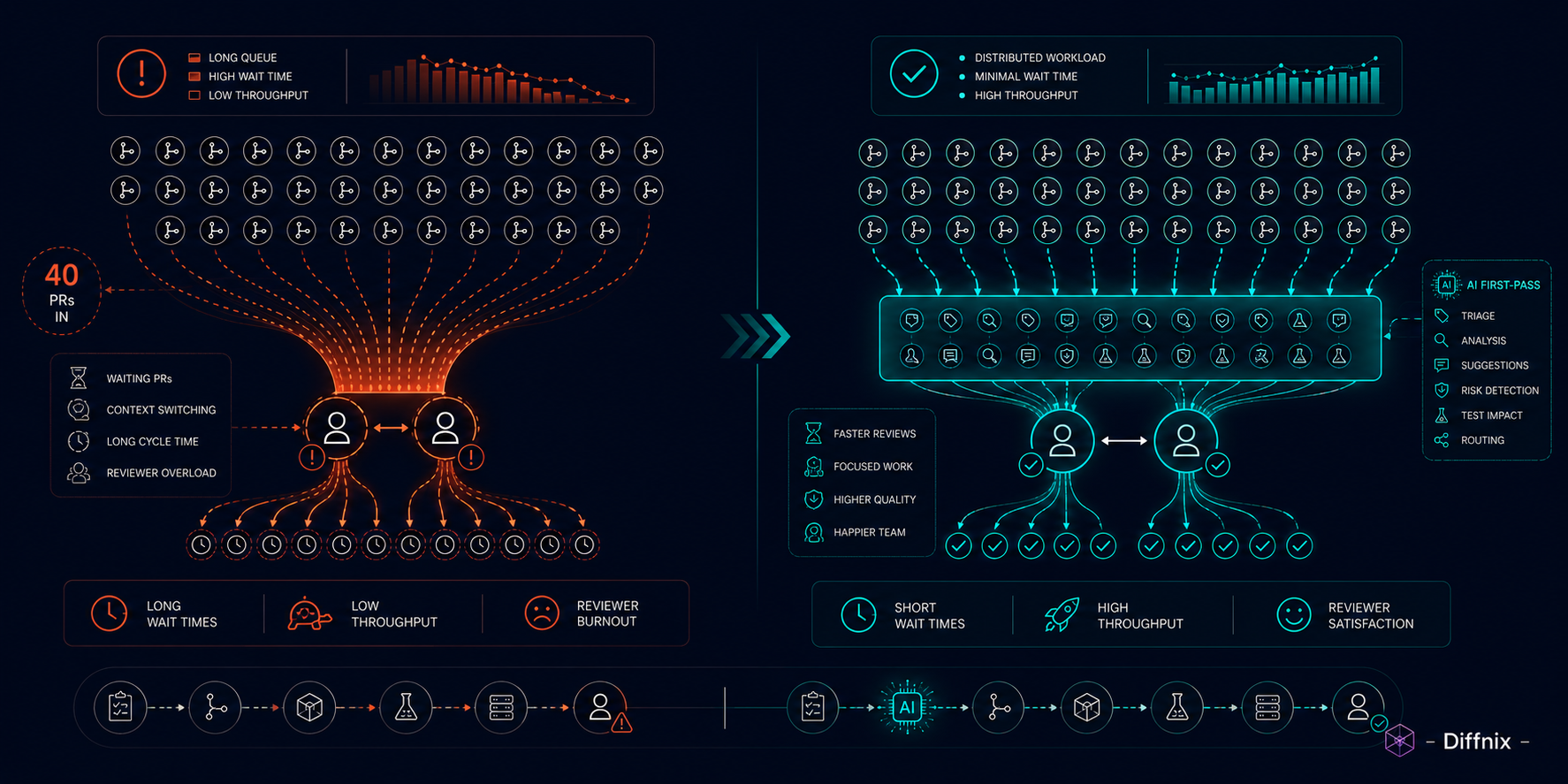
The numbers make the problem concrete. Here is a real example from a 40-engineer engineering organization.
Two principal engineers were reviewing 85% of all PRs. Not because they were assigned to do so. Because when other reviewers approved something, developers would often wait for one of the two principals to take a look before actually merging. Informally, the principals had become the de facto final gate on anything significant.
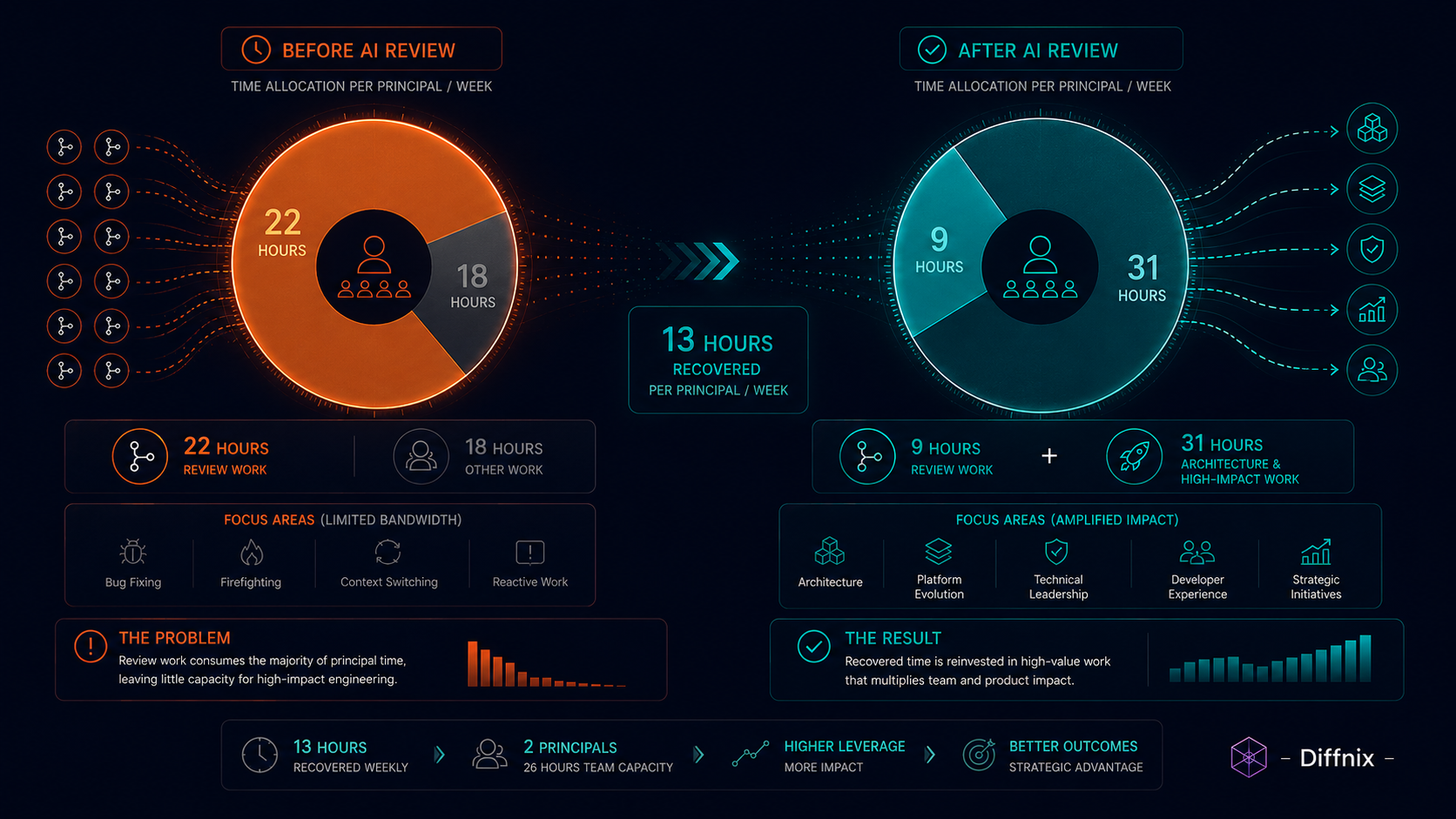
Average review queue depth for these two engineers: 8-12 open PRs at any given time. Average wait for a PR to get to the top of their queue: 3.2 business days. Average time each principal spent on review work per week: 22 hours. That is 55% of a standard 40-hour work week spent on reviewing other people's code.
The opportunity cost: those 22 hours were not spent on architectural design, on building out the infrastructure platform that would benefit all 40 engineers, on mentoring mid-level engineers, or on the performance investigation that had been on the backlog for six weeks. Those activities kept getting pushed because there was always a review queue to get through first.
CURRENT STATE (40-engineer team, 2 principal reviewers)

PRs submitted per week:          ~40
PRs reviewed by principals:      ~34 (85%)
Average wait per PR:             3.2 business days
Principal review hours/week:     22 hours each (44 hours total)
Principal time on non-review:    ~18 hours each per week

Opportunity cost:
  Blocked: Architecture work, platform improvements, mentoring
  Root cause: High-value time consumed by routine review work
The two principals are not doing bad work when they review. They are doing valuable work that is misallocated. The expertise required to review a null guard fix is not the same as the expertise required to review a new service authentication architecture. But both land in the same queue.
Why Adding More Reviewers Does Not Fix It
The intuitive solution: distribute reviews more broadly. Require three reviewers per PR instead of one. Onboard more engineers into the review rotation. Make review a team responsibility rather than an individual one.
The reason this does not work is that it conflates approval with review. Adding more approvers to a PR does not add more expertise to the review. It adds more rubber stamps.
Developers are not irrational. When they see that a PR has been approved by three mid-level engineers but not by either principal, they know the review that matters has not happened yet. The informal expectation that a principal should look at anything significant persists regardless of how review is formally structured.
The quality standard lives in the reviewer's expertise, not in the review process. Process changes that do not change who has expertise and how that expertise is deployed do not change the effective bottleneck.
📌 Insight: The bottleneck is not the principals themselves. It is the concentration of expertise-intensive review work at those individuals. The correct fix is not to force that work to others who lack the expertise. The correct fix is to reduce the amount of expertise-intensive work in the queue by automating the work that does not require expertise.
How AI First-Pass Review Changes the Distribution
AI first-pass review addresses the bottleneck by changing what lands in the queue in the first place.
When AI handles the first-pass review on every PR, a significant percentage of the routine issues (null guards, type coercions, missing authorization checks, performance patterns, style regressions) are flagged and addressed before the PR ever reaches a human reviewer. The developer fixes those issues. The PR that reaches the principal is already cleaner.
The principal's review time drops because they start from a pre-addressed state. They are evaluating what the AI found and adding their architectural judgment, not scanning for basics. Average review time per PR drops from 38-45 minutes to 15-20 minutes.
The same principal can now process 2x as many PRs per day in the same number of hours, because each PR takes half as long. The queue depth drops. The wait time drops.
Critically: the quality of the principal's review does not drop. The issues they care about (architecture, business logic, security design) have not changed. Those are still evaluated with full attention. What changed is that the principal is no longer spending half their review time on things an AI can catch reliably.
AFTER AI FIRST-PASS REVIEW (same 40-engineer team)

PRs submitted per week:          ~40
AI first-pass completion:        100% within 2 minutes
Developer pre-addresses routine issues before human review
Principal review time per PR:    15-20 minutes (vs 38-45)
Principal review hours/week:     9-11 hours each (vs 22)
Time freed per principal/week:   11-13 hours

Redeployed to:
  Architecture design sessions
  Platform improvement work
  Mentoring mid-level engineers
  Technical backlog investigations
The principals are still doing the reviews. They are doing them faster because the routine work is pre-handled.
Real-World Use Case: The 26 Recovered Hours
The 40-engineer team described above tracked the impact of AI first-pass review over a 90-day period after adoption.
Before adoption, both principal engineers spent approximately 22 hours per week on code review. After 90 days with AI first-pass review running on all PRs, the average dropped to 9 hours per week each.
The 26 hours recovered per week across both principals was not absorbed by vacation or social media. They directed it toward a platform initiative that had been on the roadmap for eight months but kept getting deferred due to review load. The initiative shipped six weeks after the review load dropped. It reduced infrastructure costs by approximately $8,000 per month by eliminating some redundant caching layers that had accumulated as workarounds over three years.
The connection between "freed up principal engineer time" and "platform improvement that saved $8k/month" is not a claim that Diffnix generates $96,000 per year in infrastructure savings. It is a claim that bottleneck engineering talent, when freed from review queue management, produces work that compounds over time. The compounding effect is where the real return on investment lives.
Average PR wait time for the team over the same 90 days: dropped from 3.2 business days to 1.1 business days. Developer satisfaction with the review process, measured informally via quarterly retrospective: improved.
For the quantified cost dimension of this problem, the real cost of shallow code reviews covers the financial analysis in detail.
Advanced Tips for Engineering Leaders
Map the actual review distribution before proposing solutions
Before implementing anything, spend 30 minutes pulling your PR data. How many unique reviewers approved PRs in the last quarter? What percentage of PRs did the top 3 reviewers approve? What was the average wait time for their review versus others? This data typically reveals that the concentration is worse than people assume and makes the case for intervention more persuasive.
Reposition AI review as reviewer support, not reviewer replacement
The principals and senior engineers who are the current bottleneck may initially resist AI review if they perceive it as devaluing their expertise. The correct framing: AI review removes the work they find least interesting (routine checks) and gives them more time for the work they find most interesting (architecture, mentoring, design). This framing is accurate and usually resonates.
Set a reviewer target throughput with AI enabled
Once AI review is running, set an explicit target for how many PRs each reviewer should process per day and use queue depth as the monitoring metric. If the queue depth remains high after 30 days, the threshold settings or workflow adoption needs adjustment. The goal is to get queue depth to near zero, not just to add AI to the existing workflow.
⚠️ Warning: Do not eliminate the principal engineer from the review loop when AI review adoption increases throughput. The throughput increase should translate to more PRs reviewed with the same quality, not the same number of PRs reviewed with less quality because the principal only scanned the AI findings. AI review covers specific categories well and misses others. Principal judgment remains the final quality gate for architectural and business-logic correctness.
Conclusion
The PR bottleneck is a structural problem caused by expertise concentration, not a process problem caused by slow reviewers. Process changes that distribute review accountability without distributing expertise create more rubber stamps, not better reviews.
The fix is different: automate the routine first-pass work that does not require senior expertise, so that senior expertise gets applied to the work that actually requires it. The queue clears. The wait time drops. The principals recover hours they can spend on work that compounds.
At Diffnix, we observed this pattern consistently across the teams we worked with. Your best engineers doing repetitive review work is not just a velocity problem. It is a talent allocation problem with compounding opportunity costs.
Diffnix is a private, AI-powered code intelligence platform that understands your code, not just scans it.
See how Diffnix distributes review expertise across your entire team.