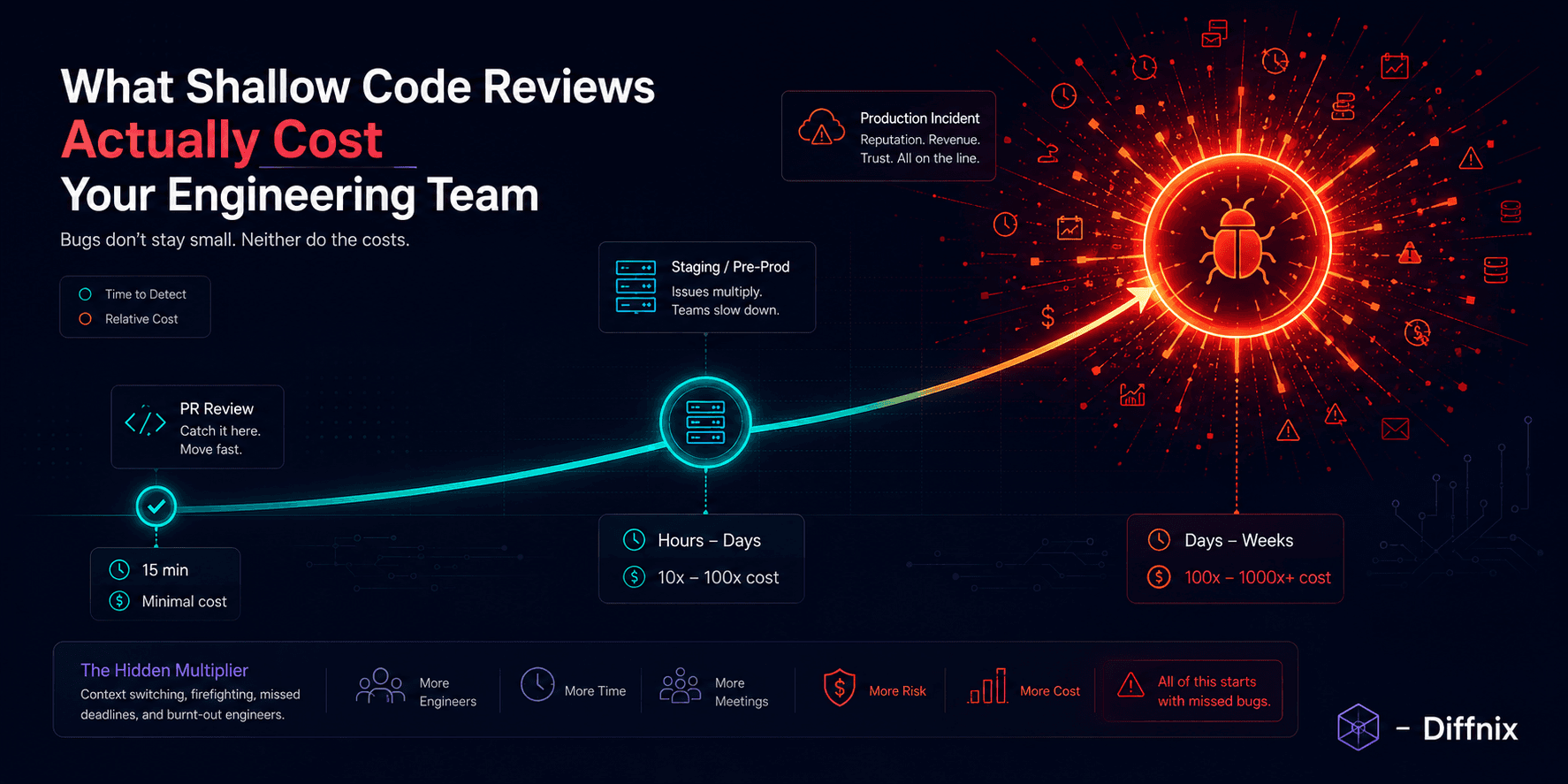
What Shallow Code Reviews Actually Cost Your Engineering Team
Teams measure PR velocity obsessively and review quality almost never. This post quantifies the real cost difference between a bug caught at review and a bug found in production, traces a specific $30,000 incident back to a 15-minute PR approval, and makes the financial case for treating code review quality as an engineering efficiency investment.

Introduction
Your team merged 47 PRs last week. Average time-to-merge: 6 hours. Your sprint velocity is up. The engineering metrics dashboard looks healthy.
And two weeks ago, a payment bug that passed review cost your team four days of engineering time, issued $18,000 in incorrect refunds, and required a customer communication that your VP of Customer Success had to personally sign off on.
The bug was in an 80-line PR. The review took 15 minutes. The reviewer left one comment: "Looks good."
That comment, and thousands like it every day across thousands of engineering teams, represents the most expensive silence in software development. Not because the reviewer was careless. Because the metrics your organization tracks reward velocity and leave review quality entirely unmeasured.
This post makes the cost of that measurement gap concrete.
The Cost Curve Nobody Tracks
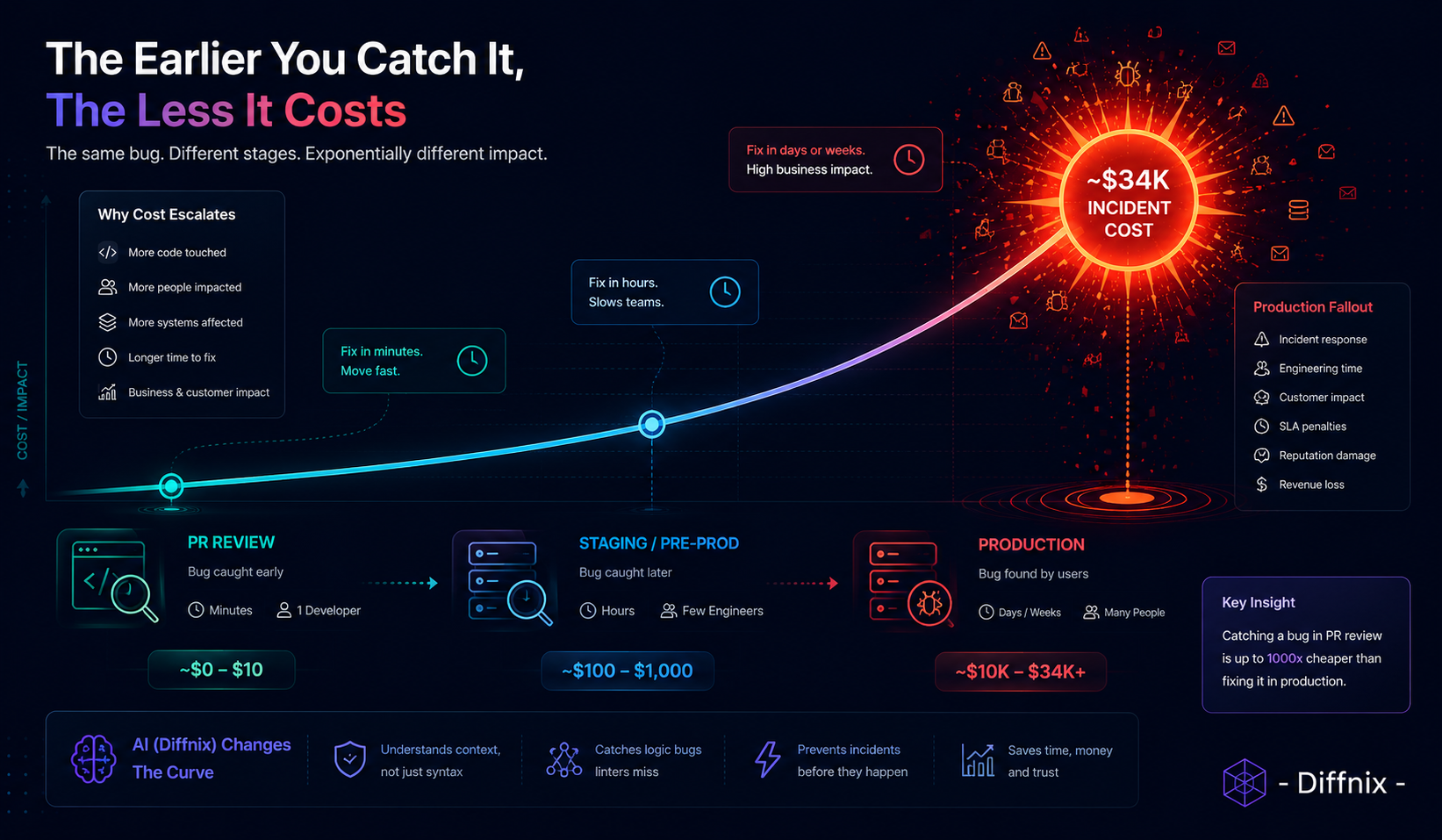
There is a well-understood principle in software quality: the cost to fix a defect scales with how late in the development process it is discovered. The multipliers vary by study and context, but the directional truth is consistent across every serious analysis of software development economics.
Finding a bug while writing the code: minutes of rework. Finding it in code review: tens of minutes. Finding it in staging: hours, including root cause analysis and re-deployment. Finding it in production: days — plus incident response, customer impact, potential SLA implications, and the investigation required to understand what data was affected and for how long.
The practical version of this in engineering teams: a typo caught in review is a 2-minute fix. The same typo caught after a production deployment is a hotfix, a deployment pipeline run, a deployment freeze review, and a post-mortem.
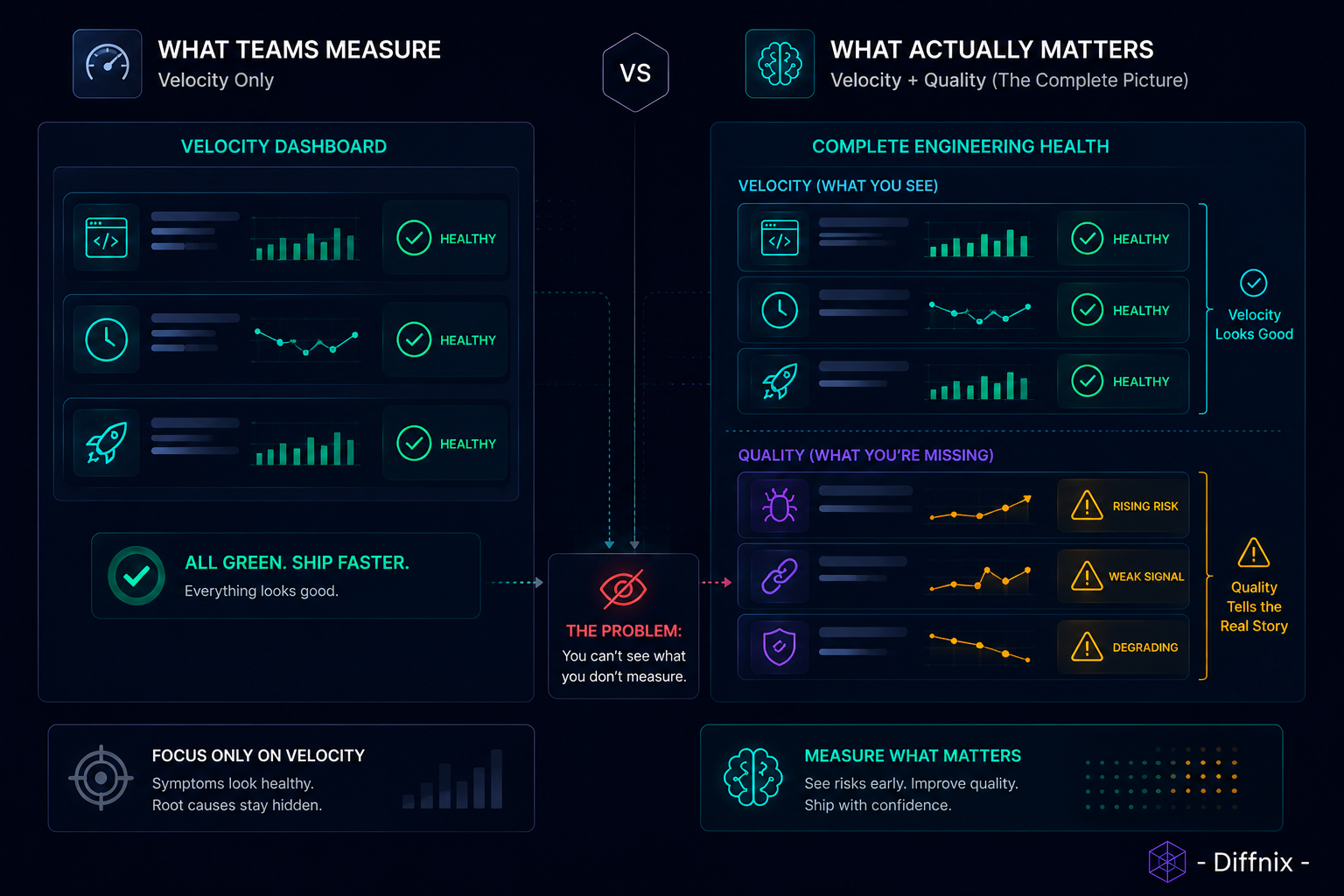
What engineering teams actually measure: lines of code per sprint, PRs merged per week, deployment frequency, time-to-merge. All velocity metrics. All measuring activity. None of them tell you whether the code that was reviewed was reviewed well.
📌 Insight: PR velocity and PR quality are not correlated. A team that merges 60 PRs per week with shallow reviews is not shipping better software than a team that merges 35 per week with thorough ones. Velocity metrics tell you how fast you are moving. They do not tell you what percentage of what you are shipping will break.
Why Review Quality Degrades and Stays Degraded
Review quality does not degrade because engineers stop caring. It degrades because the conditions under which review happens guarantee that sustained, high-quality attention is not maintainable at scale.
Attention is finite and not tracked. A senior engineer performing a code review applies a certain amount of cognitive effort. That effort is not unlimited. A reviewer doing PR number three of the day applies more scrutiny than the same reviewer doing PR number eleven. There is no metric for this. No one is tracking "review depth per engineer per day." The degradation is invisible in the data.
Expertise concentration. In most engineering organizations, two to four senior engineers do the reviews that actually find substantive bugs. Everyone else approves things that look structurally sound. This is not a failure of the junior or mid-level engineers. They are approving based on what they know how to check. But the result is that review quality is highly concentrated in a few people who are perpetually under volume pressure.
The social dynamics of blocking. A PR that has been waiting three days has a social cost attached to blocking it. The developer is waiting. The story is due in the sprint. The reviewer has been tagged twice. Approving is one click. Writing a substantive block comment requires articulating the concern precisely and accepting the friction. Under volume pressure, approvals accumulate. Blocks require effort.
Diff blindness at scale. Reviewers read diffs, not programs. A diff shows what changed, not what the code does in context. The information needed to catch the most consequential logic bugs — the calling context, the type definitions, the downstream behavior — is almost never in the diff itself. Working harder does not help when the information required to find a bug is simply not present.
These are systemic conditions, not individual failures. They cannot be fixed by telling engineers to "review more carefully." They are resolved by changing what information reviewers have access to and by distributing the routine work that does not require senior-engineer judgment.
The Real Numbers: A $30,000 PR Approval
Let me walk through a specific incident that illustrates what "shallow review" actually costs.
The PR. A fintech team's developer modified the refund calculation logic for a promotional discount feature. The PR was 80 lines across two files: the discount calculation function and its unit test. Review time: 15 minutes. Reviewer comment: "Looks good, nice clean implementation." Approved and merged.
The bug. The refund calculation applied a promotional coupon code twice under a specific edge condition: a first-time purchase combined with an active referral credit on the account. The condition required both a referral-originated account and a coupon code on the same order. It did not occur in any test scenario because the test fixtures did not include the referral account setup.
The diff that was approved (simplified):
# payments/discount.py

def calculate_refund(order, applied_credits):
    base_refund = order.total
    for credit in applied_credits:
        base_refund = apply_credit(base_refund, credit)
    return base_refund

# The bug: apply_credit was also called for the coupon inside the
# order.promotions list, which was iterated separately downstream.
# Under the referral + coupon condition, the coupon appeared in
# both applied_credits and order.promotions.
The discovery. Twenty-two days after the PR merged, the finance reconciliation team flagged a discrepancy. Investigation confirmed 200 accounts had received double refunds.
The cost breakdown:
Category | Amount |
|---|---|
Double refunds issued | $18,000 |
Engineering investigation: 2 engineers, 2 days | $9,600 |
Fix implementation and deployment | $2,400 |
Customer communication and support overhead | $2,400 |
Finance reconciliation and audit trail | $1,600 |
Total incident cost | $34,000 |
What prevention would have cost. A semantic AI reviewer, enriching the diff with the discount calculation logic, the apply_credit function, and the order.promotions iteration path, would have flagged the double-application condition for the referral + coupon case. The finding would have taken 10 additional minutes for the reviewer to read and verify. Prevention cost: approximately $80 in engineering time.
One 80-line PR. One 15-minute review. $34,000.
The Measurement Gap That Keeps This Invisible
The reason this pattern repeats across teams is not ignorance of the cost curve. Engineering leaders generally understand that bugs cost more in production. The reason it repeats is that review quality is not measured, so no one knows it is degrading until an incident reveals it.
Your current metrics dashboard probably shows:
PRs merged per week: improving
Time-to-merge: improving
Deployment frequency: improving
Test coverage: stable
What it almost certainly does not show:
Defect escape rate (bugs merged through review vs caught at review)
Post-merge defect traceability (which PRs produced bugs in production)
Review depth by PR size or risk category
Bug discovery stage distribution (% found at review vs staging vs production)
Without those metrics, review quality is invisible. The velocity metrics look healthy right up until the incident.
Building even the simplest version of review quality tracking — logging when a production incident traces back to a specific PR — creates the data needed to make the case for investment in the right places.
Consistent Review vs Good Reviewers
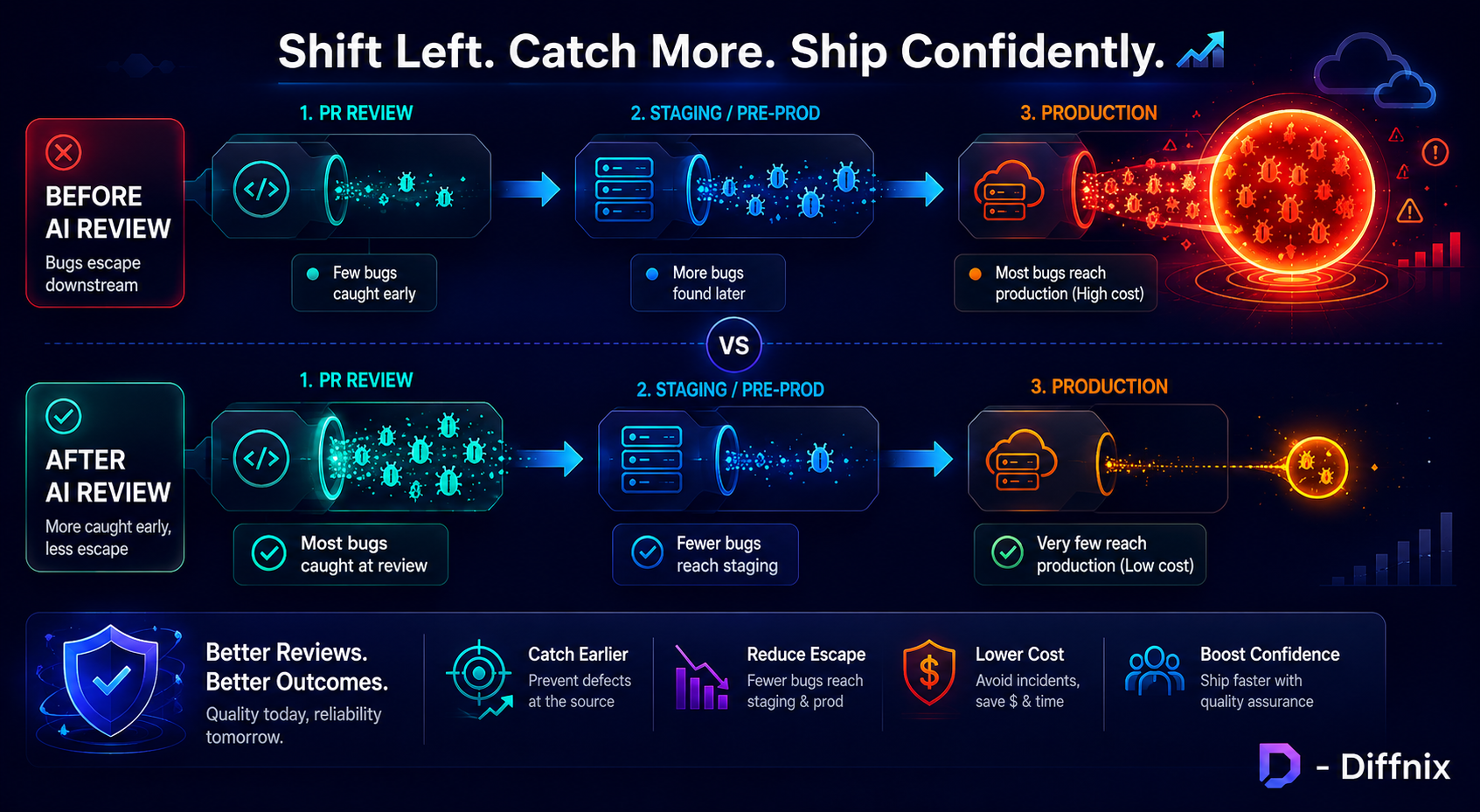
The case for AI-assisted review is not that AI is more capable than your senior engineers. It is that AI is consistent in a way that humans are not.
Your best reviewer on a Tuesday morning at 9am versus the same reviewer at 4pm on the last working day before a sprint review: not the same review quality. Both are the same person. The difference is attention budget, and no organizational process reliably controls for it.
AI review applies the same analysis to every PR. It does not have an attention budget. It does not have social dynamics around blocking. It does not accelerate when the sprint is ending. This is not superiority — it is a different kind of reliability.
The teams seeing the largest reduction in production defect rates from AI-assisted review are not the ones replacing senior engineer judgment. They are the ones using AI review to handle the routine correctness checks (null guards, type coercions, missing authorization, N+1 queries) so that senior engineers can apply full attention to the architectural decisions and domain-specific logic that actually requires their experience.
For context on what types of logic bugs survive normal review and why, and how AI semantic analysis catches them through context enrichment, those posts cover the mechanism in detail.
How to Build the Business Case for Review Quality Investment
For engineering leaders who need to make this case internally:
Step 1: Measure what you are not measuring now. For the next four weeks, track every bug found after a PR merged. For each one: how many engineering hours did it take to find, fix, and deploy? Which PR introduced it? How long was the review? Multiply hours by your fully-loaded engineering hourly rate. This is your current cost of shallow review, in actual dollars.
Step 2: Find your highest-cost incident from the last 12 months. Almost every engineering organization has one. Trace it back to the PR. Note the PR size, the review time, and the review comment. Ask: what would it have taken to catch this at review? That answer is your prevention cost benchmark.
Step 3: Calculate the multiplier. Divide the incident cost by the estimated prevention cost. For most teams, this number is between 50 and 500. That is your ROI floor for any investment in review quality that prevents one comparable incident per year.
Step 4: Set a review quality metric and track it. Simple starting point: the percentage of production bugs traceable to PRs that merged with fewer than two substantive review comments. This number should decrease over time if your review quality is improving. If it does not change regardless of what you do, your review process has a structural problem.
⚠️ Warning: Teams that calculate ROI for AI review based on estimated savings before measuring actual incident costs consistently underestimate the return. Estimate first — it will get you to consider the investment. Measure first — it will tell you whether the investment was worth it. The measured number is almost always higher than the estimate, because incident costs include investigation time, customer impact, and opportunity cost that estimates tend to omit.
Conclusion
The business case for code review quality does not require making a philosophical argument about engineering excellence. It requires measuring two numbers: what your current production bugs cost, and what catching them at review would have cost instead.
Most teams, when they run that calculation seriously for the first time, find a multiplier between 50 and 200. One prevented incident of average severity pays for years of investment in review quality improvement.
We built Diffnix because we kept seeing this math play out and watching teams continue to invest only in velocity. The velocity metrics looked fine. The incident costs were invisible because nobody was connecting the post-mortem back to the PR approval.
Diffnix is a private, AI-powered code intelligence platform that understands your code — not just scans it. It makes review quality consistent — not perfect, but consistent — across every PR, every reviewer, every hour of the working day.
The complete AI code review guide covers the full picture of where AI review fits alongside your existing quality stack.
Book a live PRInspector walkthrough and see what it finds in your PRs.