How AI Code Review Cut Our PR Review Time by 50% (Without Lowering Quality)
Cutting review time while maintaining quality sounds like a contradiction. It is not. This post walks through the exact workflow change that took one team's average PR review time from 47 hours to 19 hours, explains what caused the improvement, and shares the before-after metrics that prove quality held throughout.

Introduction
When engineering managers talk about improving PR velocity, the conversation usually stalls at the same point. You can push reviewers to move faster, but faster review tends to mean shallower review. You can add more reviewers, but expertise concentration means the same two or three people end up doing the real review work anyway. You can break PRs into smaller pieces, but that creates coordination overhead that often negates the speed gain.
The teams that actually move the needle on time-to-merge are not the ones working harder on any of these levers. They are the ones who identified the real constraint and addressed it directly.
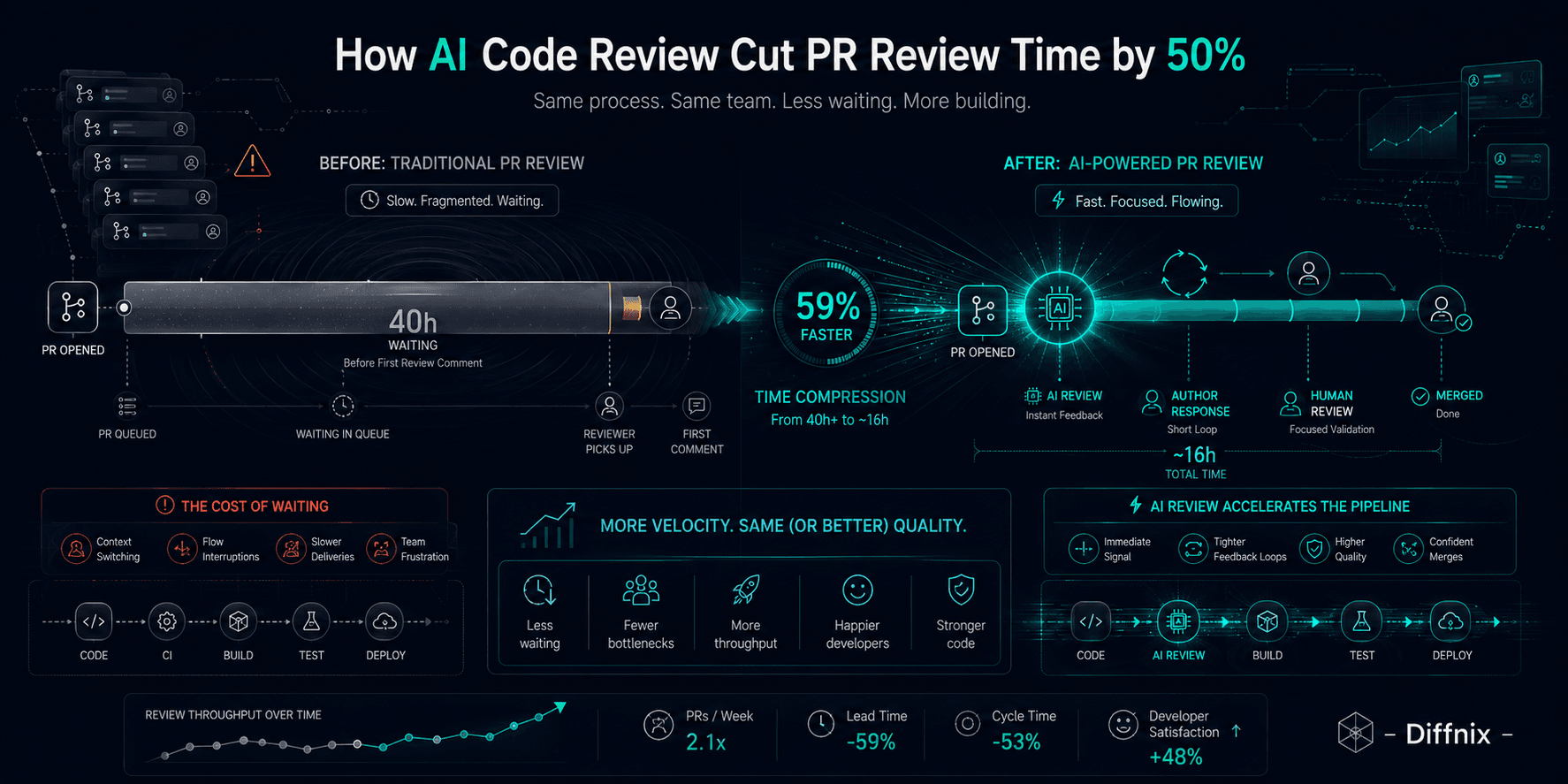
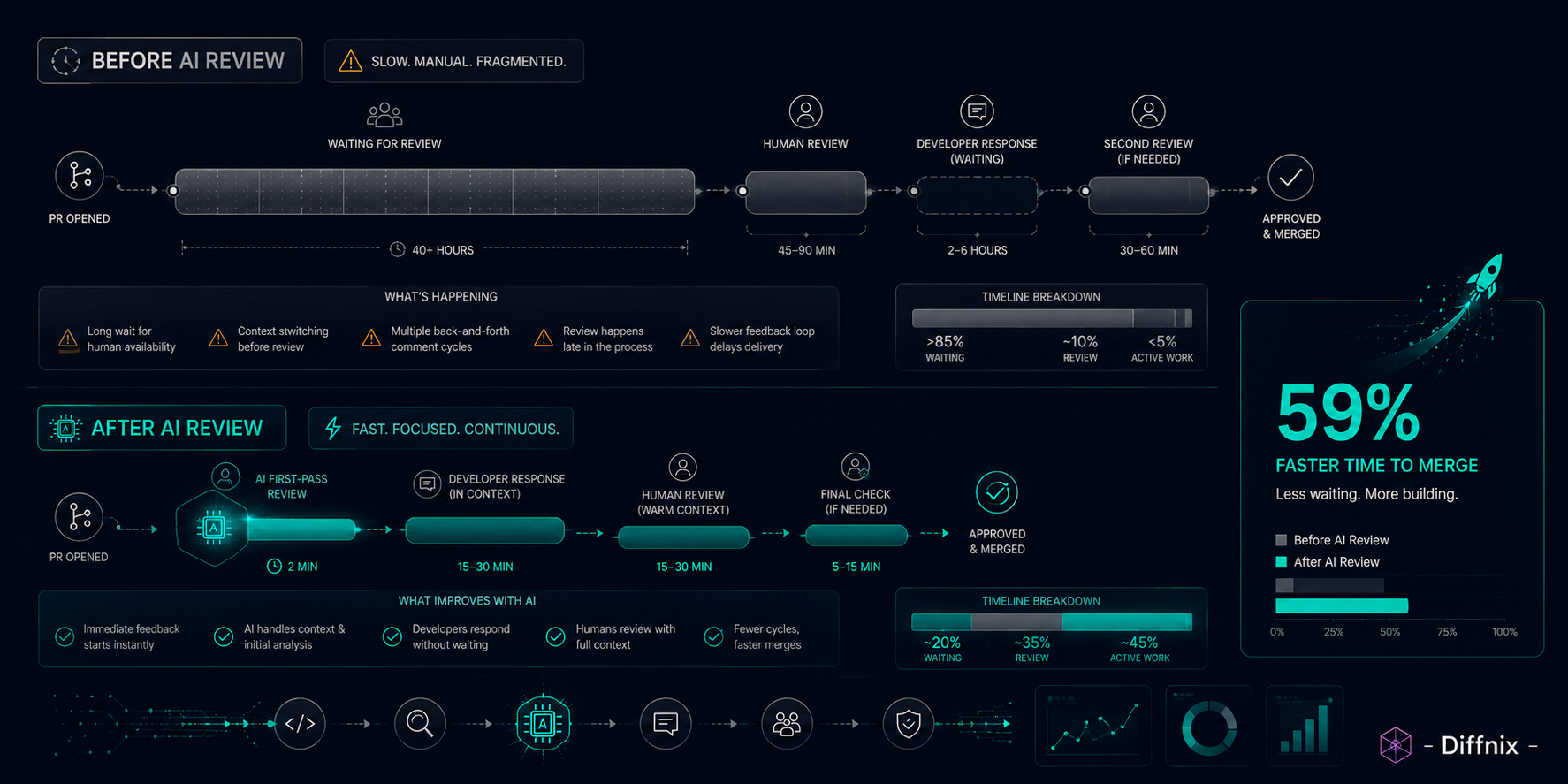
For most engineering teams, the real constraint is not review duration. It is wait time. A PR does not take 47 hours to review. It spends 40 of those hours waiting for a reviewer to have the bandwidth to open it. The review itself takes 35-40 minutes once it starts.
Solve the wait time problem and you solve most of the velocity problem. AI first-pass review solves it by posting substantive findings within two minutes of a PR opening, every single time, regardless of what else is going on.
What "50% Faster" Actually Means
The 50% figure comes from a specific team's specific measurement. A three-person frontend engineering team tracked PR cycle time metrics for 60 days before adopting AI review and 60 days after. The numbers:
Before AI review:
Average time from PR open to first review comment: 41 hours
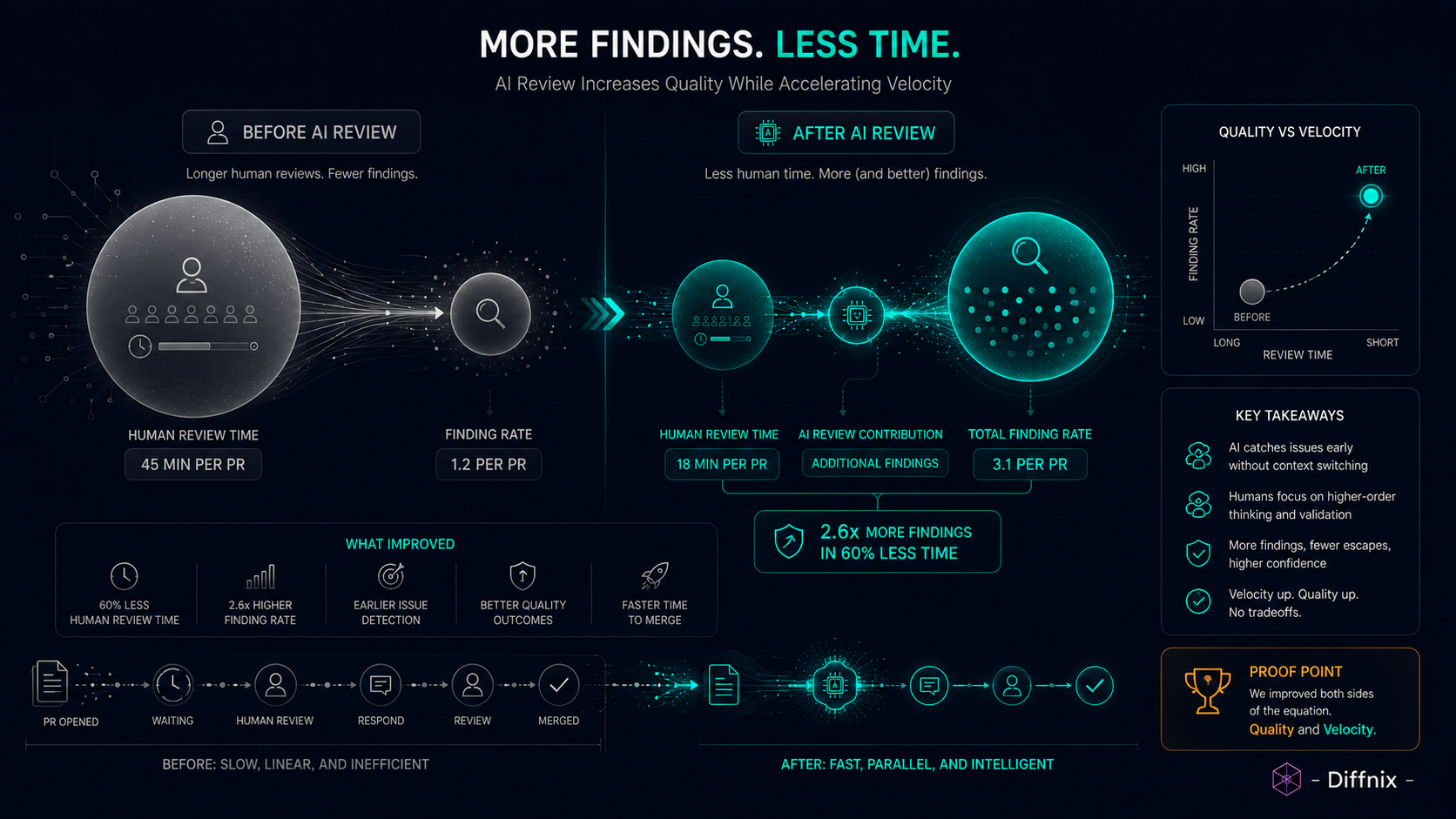
Average human review duration per PR: 45 minutes
Average issues flagged per PR: 1.2
Average comment cycles before approval: 2.3
Average time-to-merge: 47 hours
After AI review (first 60 days):
Average time from PR open to first review comment: 3 hours (AI posts in 2 minutes, human follows same day)
Average human review duration per PR: 18 minutes
Average issues flagged per PR: 3.1
Average comment cycles before approval: 1.4
Average time-to-merge: 19 hours
Time-to-merge dropped from 47 hours to 19 hours. That is a 59% reduction. Quality improved: issues found per PR went from 1.2 to 3.1. Review duration per PR dropped from 45 minutes to 18 minutes.
The finding count went up while review time went down. That is the counterintuitive result that requires explanation.
Why Finding Rate Goes Up When Review Time Goes Down
Human reviewers in a cold review (no prior context, no AI findings) spend their first 10-15 minutes orienting. They read the PR description, understand what changed, identify which parts of the codebase are affected, and build a mental model of the change before evaluating anything. Only after that orientation phase does actual evaluation begin.
When AI findings are already present, that orientation phase is dramatically compressed. The reviewer reads the findings, which already contain the context summary, the specific issues flagged, and the line references. They evaluate those findings, add their own architectural observations, and move on.
The reviewer is now spending their 18 minutes entirely on evaluation and judgment rather than splitting it between orientation and evaluation. They find more architectural issues because they have more cognitive bandwidth for architecture. They raise fewer routine issues because the AI already caught them. The net finding rate increases.
BEFORE: 45 minutes per PR
  - Orientation (reading PR, building context): 15 min
  - Routine issue hunting (null checks, types, patterns): 18 min
  - Architectural evaluation: 12 min
  Total findings: 1.2 (mostly routine)

AFTER: 18 minutes per PR
  - Reading AI findings and evaluating them: 8 min
  - Architectural evaluation (freed up attention): 10 min
  Total findings: 3.1 (routine from AI + architectural from human)
The AI is not replacing the reviewer. It is restructuring how reviewer attention is spent. Routine issues move to AI. Architectural judgment stays human.
💡 Tip: To get the maximum benefit from this workflow shift, brief your reviewers explicitly on the new process. The workflow is: read AI findings first, assess each one (valid/invalid/needs investigation), then do architectural review. Reviewers who treat AI findings as background noise and do their full standard review get the wait-time benefit but not the review-time benefit.
The Workflow in Practice
Here is what the PR lifecycle looks like with AI first-pass review integrated:
T+0: Developer opens the PR. PR description explains the change intent.
T+2 minutes: AI review posts findings as inline PR comments. The developer sees them immediately and can start addressing obvious ones while the PR is in queue.
T+2 hours (approximately): Developer has addressed AI findings, updated the PR with fixes, added a comment explaining which findings they acted on and which they disagree with.
T+3-4 hours: Human reviewer opens the PR. They see: the original diff, the developer's fixes since the AI review, and the AI findings (some now resolved, some pending review). The context is complete. Cold orientation time: zero.
T+4-5 hours: Human reviewer comments on the AI findings that need discussion and adds their architectural observations. Total review time: 18 minutes.
T+5-6 hours: Developer addresses human reviewer comments.
T+6-8 hours: Re-review and approval.
Total time-to-merge: 6-8 hours. Not 47.
The biggest change is not in the review quality. It is in the workflow: the developer becomes an active participant in the first review cycle rather than a passive waitee. They get findings in minutes and can act on them immediately.
Real-World Use Case: The Frontend Team Numbers
The three-person frontend team used for this case study was shipping a React component library alongside a TypeScript API layer. PRs averaged 85-120 lines and were reviewed by a rotation of two senior engineers.
Before AI review, the team's biggest frustration was not review quality. It was the wait. PRs submitted at the end of the US-West working day waited until the next morning for feedback. Authors had lost context by then and needed 20-30 minutes to re-orient before addressing comments. Comment cycles multiplied.
After integrating Diffnix PRInspector into their CI pipeline, the workflow changed. PRs submitted at any hour got findings within two minutes. Authors addressed those findings in the same working session. When human reviewers opened PRs the next morning, the obvious issues were already resolved and the context was documented in the PR comments.
The review duration drop from 45 to 18 minutes was not the main story. The main story was comment cycle reduction from 2.3 to 1.4. Each cycle eliminated saved 6-12 hours in timezone-gapped review turnaround. Multiply by the number of PRs per month and the arithmetic explains the 59% time-to-merge improvement without requiring any individual to work faster or harder.
One observation from the team lead, 90 days in: "We stopped having the 'why hasn't this PR been reviewed' conversation. Everything gets the AI review immediately. Human review follows the same day. The queue essentially disappeared."
For teams distributed across time zones, the async dimension of this workflow matters even more. The async code review guide for distributed teams covers that scenario specifically.
Advanced Tips for Engineering Managers Driving Adoption
Track the comment cycle metric first
Time-to-merge is the headline metric but comment cycles is the leading indicator. When comment cycles drop, time-to-merge follows. If comment cycles do not drop in the first 30 days, the workflow is not being used correctly. Diagnose before adjusting the threshold settings.
Brief authors on how to respond to AI findings
The workflow only compresses if authors act on AI findings before the human reviewer opens the PR. Build this into your PR process explicitly: when you open a PR, read the AI findings and either address them or document why you disagree with them in a PR comment. Human reviewers then start from a resolved state rather than an unaddressed state.
Do not measure only during low-traffic periods
Sprint ends and pre-release periods create unusual PR volumes. Measure your baseline metrics during a representative normal period, not during a sprint crunch. The before-after comparison will be more accurate and more persuasive when it reflects normal conditions.
At Diffnix, we observed that teams who run a clean 60-day pre and 60-day post measurement consistently see the improvement and are much better positioned to make the internal case for continued investment than teams who measure informally.
⚠️ Warning: A finding rate increase in the first 30 days sometimes prompts concern that the AI is producing noise. Validate a sample of 20-30 findings from the first month before drawing conclusions. In most teams, 75-85% of AI findings are valid issues that would have generated reviewer comments if caught manually. The remainder are false positives that developers dismiss quickly. That is a reasonable precision rate for the value it produces.
Conclusion
Cutting PR review time by 50% does not require working harder. It requires solving the right problem. Most teams trying to improve velocity optimize for review speed. The actual constraint is wait time before the first review starts, not duration of the review itself.
AI first-pass review eliminates the wait. Two minutes from PR open to first substantive findings, every PR, every day, regardless of reviewer availability. Human reviewers follow with their architectural judgment applied to a pre-annotated PR rather than a cold diff.
The result is faster merges and better reviews at the same time. The velocity versus quality tradeoff was never about choosing between them. It was about what you do with reviewer attention.
Diffnix is a private, AI-powered code intelligence platform that understands your code, not just scans it. It runs locally so your code never leaves your network while your team gets the same velocity benefit.
Book a demo to see PRInspector's impact on your team's review cycle.