Technical Debt Is Approved in PRs: How Consistent AI Review Stops It Before It Ships
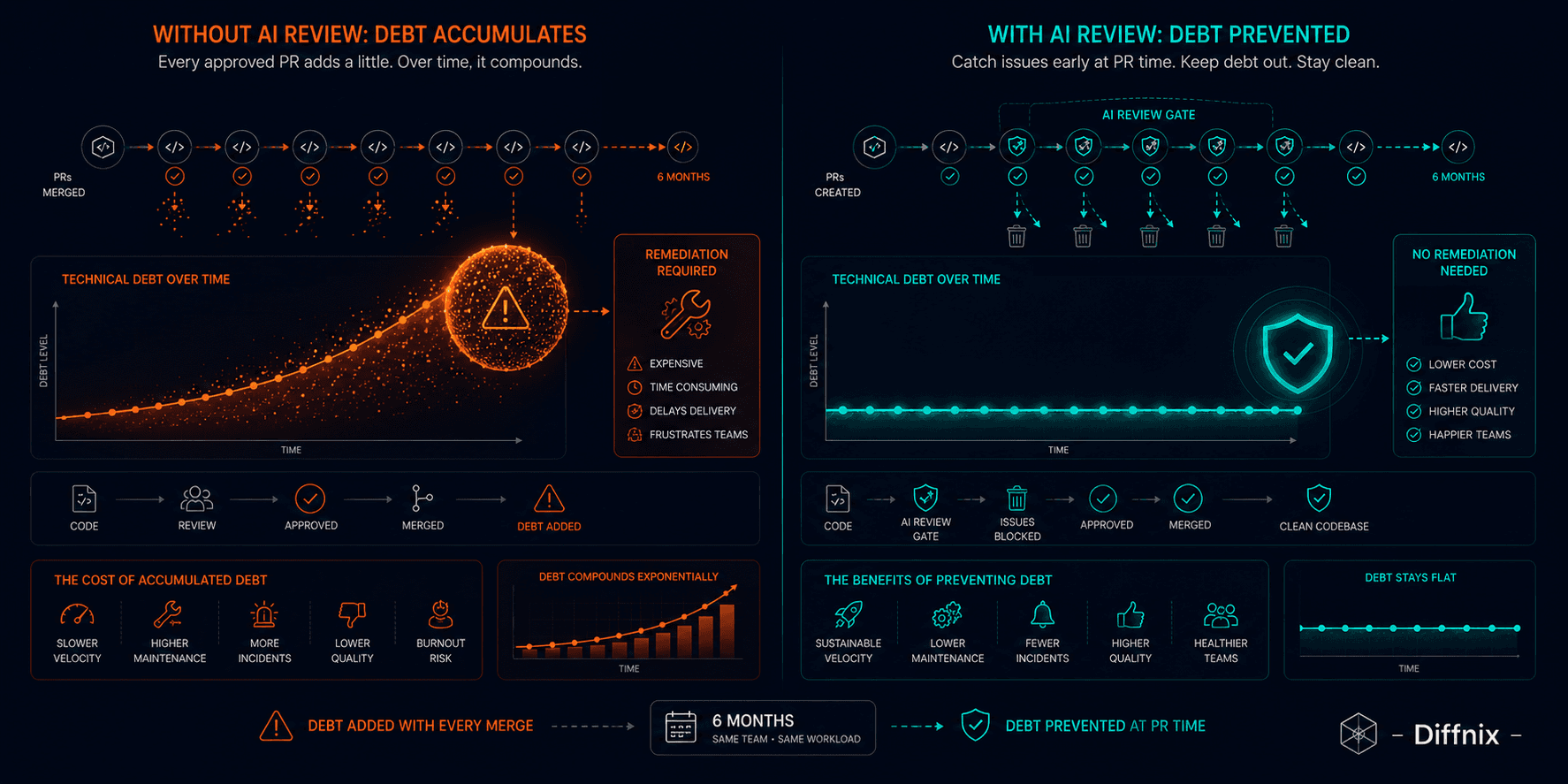
Most technical debt does not enter a codebase because developers cut corners. It enters because reviewers approve code that looks reasonable in isolation but creates compounding problems over time. This post explains where debt actually comes from, why inconsistent human review is the primary mechanism, and how AI-consistent review prevents the accumulation before it requires a sprint to fix.

Introduction
Every engineering team has a version of the same conversation every quarter. The backlog has grown. The codebase is getting harder to change. Features that should take two days take five. Someone eventually calls for a "tech debt sprint" and the team spends two weeks cleaning up patterns that accumulated across six months of approved PRs.
The sprint helps. Then the accumulation starts again. Next quarter: same conversation.
The standard diagnosis is that developers created the debt during coding. The standard fix is better code standards, architecture reviews, or linting rules. These help at the margins. They do not address the actual source of most debt.
Most technical debt is not created during coding. It is approved during code review.
A developer writes code under time pressure that is technically correct but takes a shortcut: an N+1 query that works at current scale, a domain concept handled with a string instead of a proper type, a function that does three things because factoring it out felt like over-engineering at the time. A reviewer looks at the change, sees that it works, and approves it. The debt enters the codebase with a green checkmark.
That moment, repeated 200 times over a quarter, is what a tech debt sprint is cleaning up.
Where Debt Actually Enters the Codebase
The distinction between "code written with debt" and "debt approved into the codebase" matters because it points to the correct intervention.
If debt is created during coding, the fix is better developer education and coding standards. These have value but limited ceiling: developers under time pressure will still take shortcuts, and no amount of education eliminates all of them.
If debt is approved during review, the fix is better review consistency. And here is the key insight: review consistency is exactly what breaks down at scale.
A senior engineer reviewing their third PR of the day with no prior context sees an N+1 query pattern in a new endpoint. They might flag it. They might approve it as "acceptable for now." The outcome depends on their energy level, their familiarity with the specific endpoint's performance profile, and whether they are running behind on a deadline.
The same senior engineer reviewing their twelfth PR of the day is more likely to approve the N+1 pattern. Not because they stopped caring. Because pattern recognition under cognitive load produces more false negatives.
The consequence: identical debt-generating patterns get different treatment depending on the reviewer's state at the moment of review. Over time, the patterns that happen to get reviewed when the reviewer is tired or busy accumulate. The patterns reviewed when the reviewer is fresh get caught and fixed.
This is not a failure of individual engineers. It is a predictable outcome of asking humans to apply consistent standards at high volume under variable cognitive conditions.
📌 Insight: The variance in human review quality across the day, the week, and as PR volume increases is the primary mechanism for debt accumulation in most codebases. AI review does not eliminate debt creation. It eliminates the variance that lets debt slip through.
The N+1 Pattern That Accumulated 34 Times
A backend team tracked which PRs generated follow-up tickets over a six-month period. They tagged each ticket with a root cause category and then traced it back to the PR that introduced it.
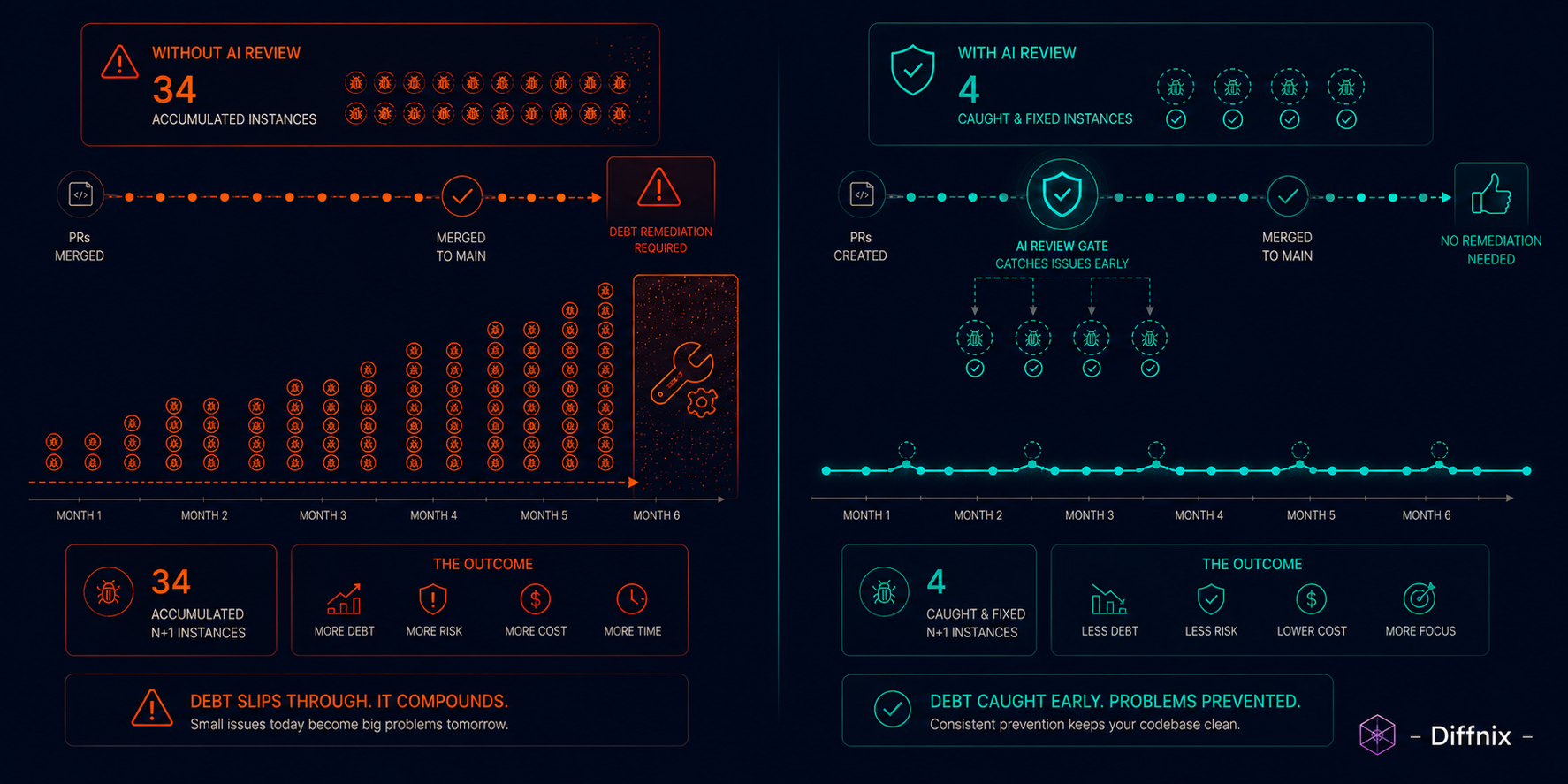
The finding: 67% of their technical debt tickets were traceable to a single pattern, approved 34 separate times across six months. The pattern: database queries inside loops.
# The pattern that appeared 34 times in different forms
# Each instance looks reasonable in isolation

def get_orders_with_items(order_ids: list[int]) -> list[dict]:
    orders = []
    for order_id in order_ids:
        order = db.session.query(Order).get(order_id)   # query inside loop
        items = db.session.query(Item).filter_by(order_id=order_id).all()
        orders.append({
            'order': order.to_dict(),
            'items': [item.to_dict() for item in items]
        })
    return orders
Each individual instance of this pattern looks reasonable: the function is simple, the logic is clear, the code does what it says it does. At low data volumes, it does not cause visible problems.
The pattern appeared in 34 PRs over six months because each instance was reviewed in isolation by a reviewer who saw a small, clean function and approved it. No single reviewer saw all 34. None of them knew the pattern was appearing 34 times.
Collectively, those 34 instances drove the quarterly performance regression that triggered the two-week remediation sprint.
A Diffnix finding on the first instance:
FINDING [Performance / Major] — api/orders.py, Line 8

Database query inside a loop detected. This function executes one query
per order_id in the input list, producing O(n) database round-trips.

For a list of 100 order_ids, this generates 200 database queries
(one Order query + one Item query per iteration).

Similar patterns in api/products.py and api/customers.py use
SQLAlchemy eager loading to handle this case with 2 queries total.

Suggested fix:
    orders = db.session.query(Order).filter(
        Order.id.in_(order_ids)
    ).options(joinedload(Order.items)).all()
The finding requires: knowing the pattern constitutes N+1, identifying the scale impact, finding comparable endpoints that handle it correctly, and suggesting a specific fix using the ORM's eager loading mechanism. All of this requires context outside the diff.
If the same finding had appeared on instances 2 through 34, none of those instances would have been approved. The pattern would not have accumulated. The remediation sprint would not have been needed.
How Consistent Review Prevents Compound Debt
The mechanism is simple: AI review applies the same analysis to every PR, regardless of what number in the day it is, regardless of how many other PRs are queued, regardless of whether the reviewer knows this specific pattern is appearing across 34 files.
Human review consistency is variable. It peaks when reviewers are fresh, informed, and unconstrained. It degrades under volume pressure, across time zones, and when the same pattern appears in slightly different forms in different files.
AI review consistency is flat. The same pattern in the 34th file gets the same finding as the pattern in the first file.
The compound effect over six months:
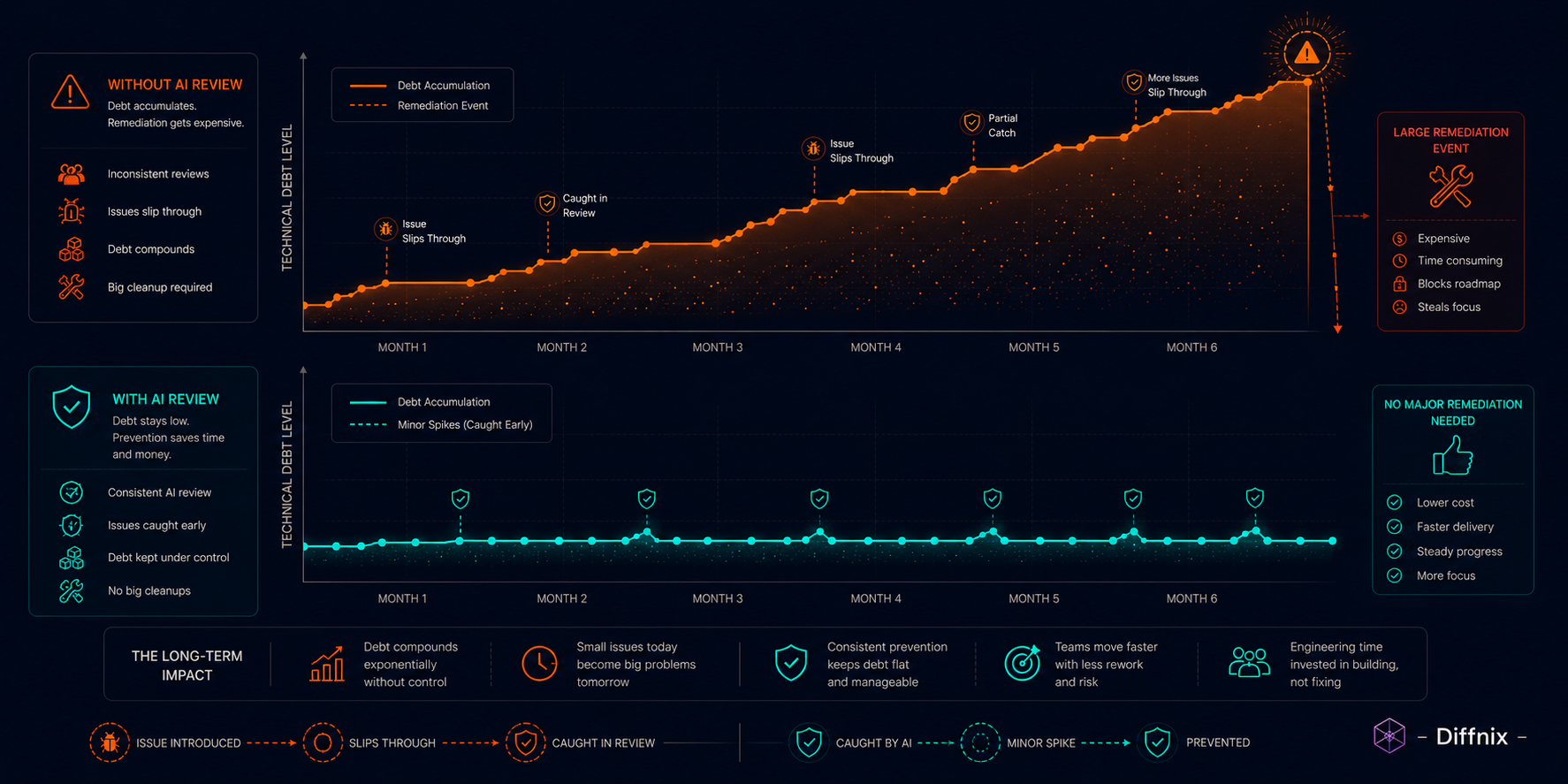
WITH VARIABLE HUMAN REVIEW:
  Instance 1: Caught (reviewer was fresh, flagged it)
  Instances 2-6: Missed (reviewed under time pressure)
  Instance 7: Caught (different reviewer, caught it again)
  Instances 8-34: Mostly missed (each looks isolated and reasonable)
  Outcome: 34 instances accumulated, remediation sprint required

WITH CONSISTENT AI REVIEW:
  Instance 1: Caught, fixed before merge
  Instance 2: Caught (same pattern, same finding)
  Instance 3: Developer recognizes the pattern from feedback on instances 1-2
  Instances 4-34: Most developers have internalized the pattern
  Outcome: Pattern does not accumulate
The second-order benefit is the learning effect: consistent feedback on the same pattern creates developer awareness. After the third time a developer receives a finding about N+1 queries, they stop writing N+1 queries. Consistent AI review is also implicit developer education.
Real-World Use Case: The Two-Week Sprint That Did Not Happen
The backend team's experience illustrates the before-state clearly. Six months of inconsistent N+1 approval led to a performance regression detected in production when order list API response times degraded from 120ms average to 2.3 seconds average as the customer database grew past 50,000 records.
The remediation sprint: two weeks, three engineers, identifying all 34 instances, refactoring each one to use proper eager loading, adding performance regression tests, and deploying the fixes incrementally.
After the sprint, the team adopted Diffnix and ran it for the following six months. The same N+1 pattern was flagged in four PRs during that period. All four were fixed before merge. No equivalent performance regression appeared in the second six-month period.
The sprint that did not happen in the second period: approximately 240 hours of engineering time, roughly $30,000 at fully-loaded cost.
The cost of AI review findings on four PRs: approximately 40 minutes of developer time each.
For the broader quantification of what shallow review costs per incident, the cost of shallow code reviews analysis runs the full numbers on the relationship between review quality and incident cost.
Advanced Tips for Engineering Managers
Run a debt source analysis before your next sprint
Before your next tech debt sprint, spend two hours tracing 20-30 debt tickets back to the PRs that introduced them. For each one: what pattern was approved? Was it a pattern violation or a logic issue? Was a similar pattern flagged in any other PR? This analysis almost always reveals that most debt comes from a small number of recurring patterns approved inconsistently over time.
Use AI findings to build a debt pattern registry
After 60 days of AI review, export the finding categories and frequencies. The most common findings represent the debt patterns your team is most likely to introduce. Build a brief pattern registry: "these are the five patterns our AI reviewer flags most often, here is why each creates debt, here is the correct approach." This turns AI findings into developer education that reduces future debt creation.
Track the finding recurrence rate over 90 days
If a specific finding category (N+1 queries, missing error handling, string concatenation in SQL) appears repeatedly over the first 30 days and then decreases significantly in days 60-90, the learning effect is working. Developers are internalizing the pattern. This is measurable evidence that AI review is reducing debt creation at the source, not just catching it after the fact.
⚠️ Warning: Consistent AI review catches patterns. It does not catch all debt. Architectural debt, design decision debt, and debt accumulated before AI review adoption are outside its scope. Use AI review for ongoing prevention, not as a substitute for periodic architectural review and intentional refactoring investment.
Conclusion
Technical debt accumulates primarily because the same problematic patterns get different treatment from different reviewers on different days. One reviewer catches it. Another misses it. The variable is not the pattern or the developer. The variable is reviewer state at the moment of review.
AI review eliminates that variable. The 34th instance of an N+1 query gets the same finding as the first. Patterns that would accumulate across a quarter get caught and fixed before they compound.
The debt that does not accumulate does not require a sprint to fix. That is the economic argument for review consistency at a level that human review cannot sustain at scale.
We built Diffnix because tech debt sprints are a symptom of a solvable upstream problem. The upstream problem is inconsistent review. The solution is consistency that does not depend on reviewer state.
Diffnix is a private, AI-powered code intelligence platform that understands your code, not just scans it.
See how Diffnix enforces your code standards on every single PR.