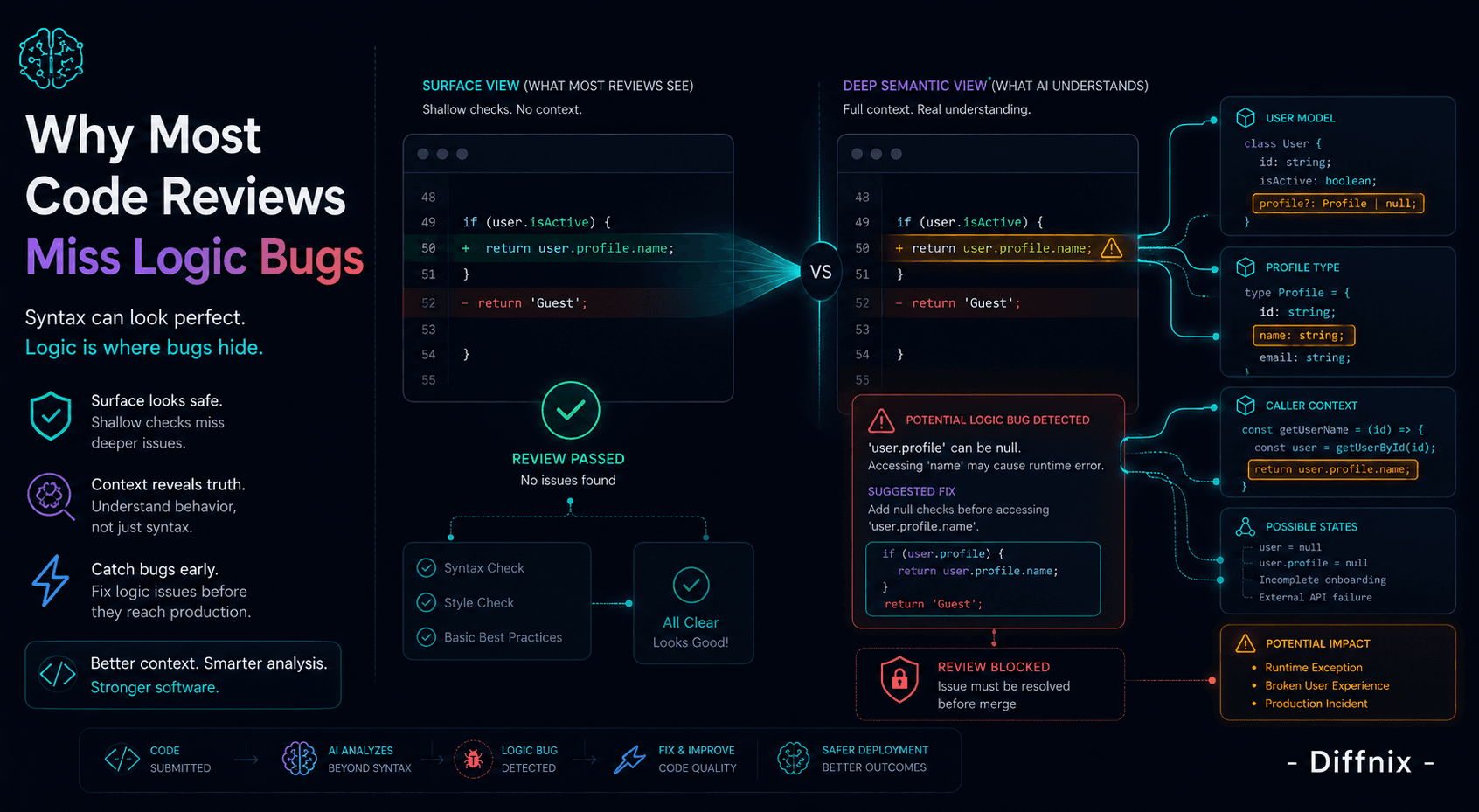
Why Most Code Reviews Miss Logic Bugs (And What Actually Fixes It)
Your CI passes. Your linters are clean. Your PR was approved by a senior engineer. And yet a logic bug still made it to production. This post explains exactly why that keeps happening, what reviewers are structurally unable to catch, and how semantic AI analysis closes the gap that no amount of reviewer effort can.

Introduction
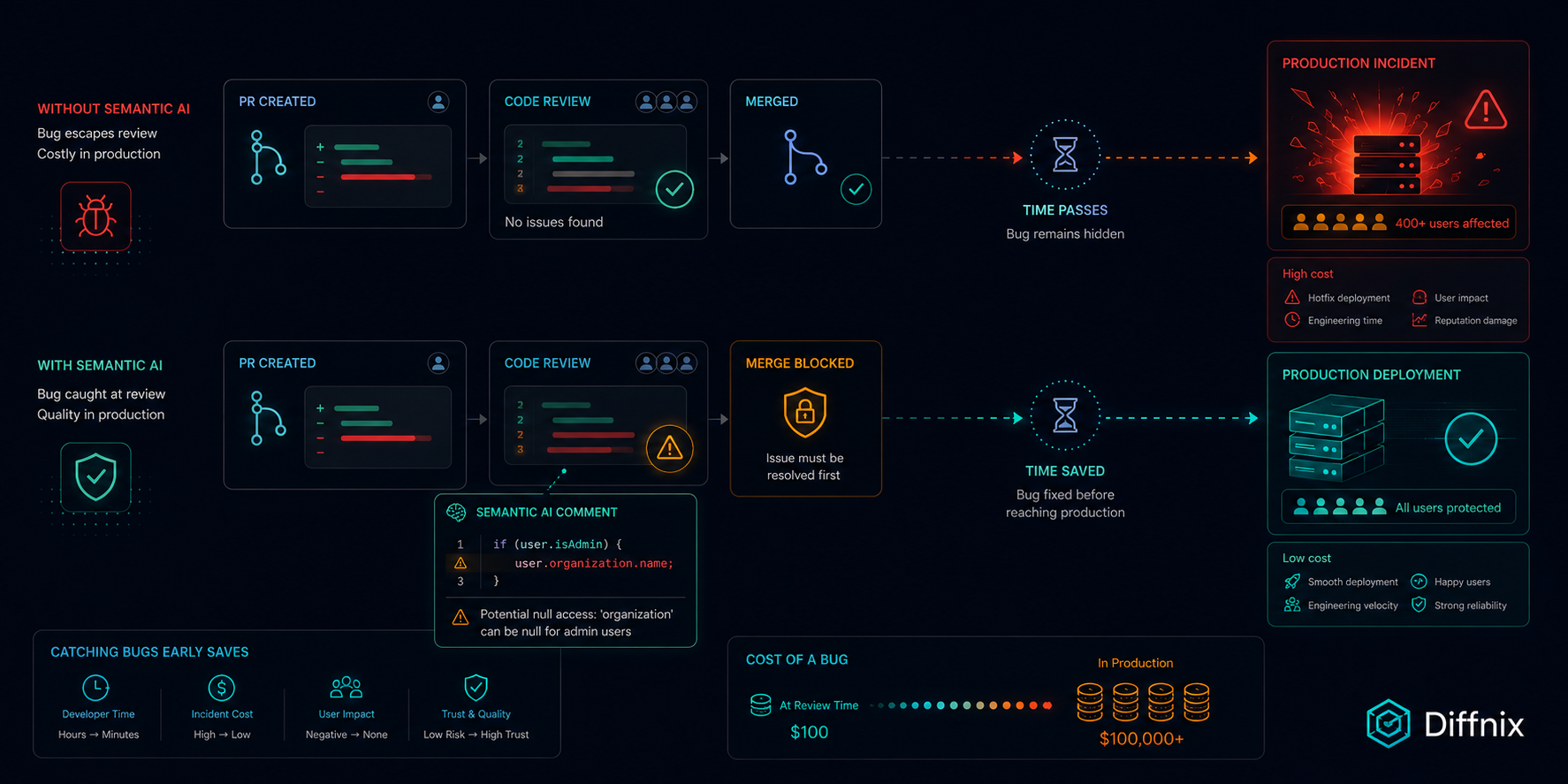
Here is a scenario every engineering manager has seen at least once. A developer submits a PR adding null checking to a payment function. The reviewer scans the diff, sees that error handling was added, thinks "good defensive coding," and approves it in 18 minutes. The PR merges. Three days later, a TypeError in production. Payment failures for 400 users on their first purchase.
The null check was there. It was checking the wrong object.
The reviewer was not careless. They looked at the code, saw an improvement, and approved it. What they could not do — what no reviewer reliably does at scale — was trace the full data flow to verify whether the guard covered every failure path. They saw the pattern of "null check added" and approved the pattern, not the implementation.
This is the logic bug problem. It does not live in careless review. It lives in the structural gap between what a diff shows and what a function actually does.
By the end of this post you will understand exactly where that gap comes from, why current tools cannot close it, and what actually can.
The Three Reasons Logic Bugs Survive Code Review
The reasons are structural. None of them are about effort or attention or team culture.
Reviewers read diffs, not programs
A diff shows you what changed. It does not show you what the code does. It does not show you what the calling code passes in, what the downstream code assumes about the return value, or what invariants the changed function depends on.
Reading a diff and checking correctness is a bit like proofreading a chapter without having read the rest of the book. The words might be grammatically perfect. The sentence might contradict something three chapters earlier. You would never know.
The context that makes a logic bug visible — callers, model definitions, related modules — is almost never in the diff. It exists in the parts of the codebase the reviewer is not looking at.
Attention degrades under review pressure
Reviewing code requires sustained, focused attention. A reviewer processing their third PR of the morning applies full scrutiny. A reviewer processing their twelfth PR at 4pm applies whatever is left.
Logic checking is expensive cognition. Under volume pressure, reviewers shift from "does this actually work?" to "does this look structurally sound?" Those are different questions with different answers. The second question is answerable from the diff alone. The first one is not.
No one talks about this directly. But every engineering manager who has done a post-mortem on a production bug has found a PR where the review comment was "LGTM" and the reviewer had been on their fourteenth PR that day.
Pattern-completion approval
This is the most insidious one. Reviewers see a pattern they recognize — null check, try/catch, bounds validation — and approve based on the pattern, not the implementation. "They added error handling" registers in the brain as "they handled the error correctly." It does not mean the same thing.
The developer added a null check. The reviewer saw "null check added." Neither of them stopped to ask whether the null check was on the right variable for the actual failure mode in production.
📌 Insight: The missing ingredient is not effort. It is information. A reviewer who cannot see the calling context, the model definition, and the downstream assumptions cannot evaluate whether a guard condition is complete. Working harder does not help when the information needed to find the bug is not in front of you.
What Linters Miss and Why
When teams realize they are missing logic bugs, the first response is usually "we need better linting." It is the wrong response, and understanding why matters for choosing what actually helps.
Linters operate on abstract syntax trees. They check whether nodes in that tree match configured rules. A null safety rule might look like this: "if a property access occurs on a variable, verify a null check is present somewhere before it." The check passes as long as the structure is present.
# This passes most null-safety linters without issue
def process_payment(user):
    if user is not None:         # null check present -- linter satisfied
        charge(user.account_id)  # account_id itself can still be None
The linter sees: null check present, property access guarded. Rule satisfied.
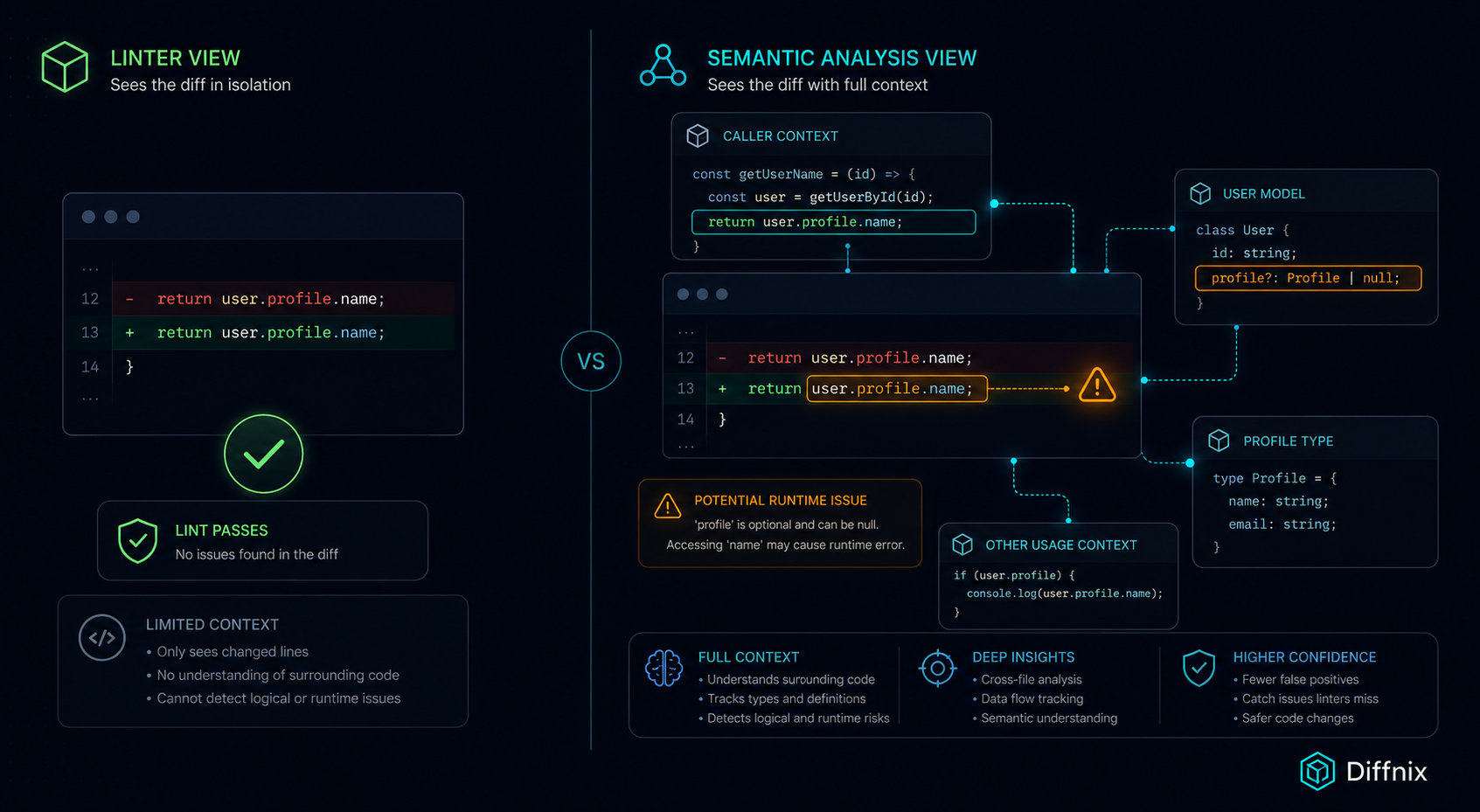
What the linter cannot see: the User model definition, which shows that account_id is set asynchronously by a background job. What the linter cannot see: the calling code, which sometimes invokes this function immediately after account creation before the background job completes. What the linter cannot see: the behavior of charge() when account_id is None.
The bug is not in the syntax. It is in the relationship between this function and the data model and the calling sequence. No rule-based tool can check that relationship because the rule would have to describe your specific data model. Linters describe patterns. Logic bugs are context.
This is the reason the gap between linters and semantic code analysis is categorical, not incremental. You cannot lint your way to catching these bugs. The information needed to find them is not available at the AST level.
How Semantic Analysis Catches What Linters Miss
Semantic AI analysis approaches code review differently. Instead of checking for patterns in the diff, it builds context and reasons about behavior.
The process has three meaningful steps:
Step 1: Parse the diff structurally. Not as text, but as a structured set of changes with position metadata. The system knows which function changed, what was added, what was removed, and where in the file this lives.
Step 2: Enrich with context. For the changed function, the system fetches: the imports at the top of the file, the class and method signatures, the call sites of the function across the codebase, and any interface or type definitions the function depends on. This is the step that makes finding logic bugs possible.
Step 3: Reason about correctness. With actual context available, the system asks: does the stated intent (from the PR description) match the implementation? Are there code paths that violate the guard conditions? Do the caller assumptions match what this function now does?
Here is the same null check bug, analyzed with context:
# Changed function (from the diff)
def process_payment(user):
    if user is not None:
        charge(user.account_id)

# User model (fetched from models/user.py as context)
class User:
    def __init__(self):
        self.account_id: Optional[str] = None  # set async by background job

# Caller (fetched from payments/processor.py as context)
def handle_new_purchase(user_id: str):
    user = create_user(user_id)          # account_id not set yet here
    process_payment(user)                # called immediately after creation
With that context, the finding writes itself: "The guard checks that user is not None but does not guard user.account_id. Based on the User model, account_id is set asynchronously and can be None immediately after account creation. The calling code in processor.py invokes this function before the background job completes for new users. Recommend: if user is not None and user.account_id is not None."
Without context: "null check added." With context: a finding that would have prevented a production incident.
Real-World Use Case: The Account ID Bug
A fintech team was refactoring their payment processing module. A developer submitted a 90-line PR adding error handling throughout the payment flow. The changes looked like quality improvements: null guards, error messages, cleaner control flow.
The reviewer approved in 18 minutes. The PR merged.
Three days later: 400 users on the mobile referral flow encountered payment failures on their first purchase attempt. The error in the logs: AttributeError: 'NoneType' object has no attribute 'charge_id'.
Here is the exact change that was approved:
# payments/processor.py

- def process_payment(user_id: str):
-     user = get_user(user_id)
-     charge_account(user.account_id)

+ def process_payment(user_id: str):
+     user = get_user(user_id)
+     if user is not None:
+         charge_account(user.account_id)  # account_id not guarded
The reviewer saw a null check added before a function call. That looks correct. That is the pattern-completion approval in action.
What the reviewer could not see without knowing the codebase: the User model had account_id: Optional[str] because referral accounts go through an async setup step. The referral onboarding flow called process_payment immediately after account creation, before the async job completed. For those users, user was not None. user.account_id was.
When a semantic AI reviewer with context enrichment analyzed this PR, it produced the following finding:
Line 7: The null guard covers
userbeing None but does not coveruser.account_id. Based on theUsermodel definition (models/user.py, line 12),account_idis typed asOptional[str]and is set asynchronously by the account setup job. The calling code inreferral/onboarding.py(line 84) invokes this function during the referral flow before the setup job completes. Recommend addingand user.account_id is not Noneto the guard condition.
The fix was four words. Catching it required context that was never in the diff.
The review that missed it was done by a senior engineer who knew the codebase well. They just did not happen to have the referral account creation flow in mind while reading an 18-minute review of a 90-line payment refactor. That is not a failure of the engineer. That is a structural limitation of diff-based review.
For a deeper look at how AI correctly parses diffs and builds that calling context, the full technical walkthrough is worth reading if you are evaluating tools.
Advanced Tips for Engineering Managers
Write PR descriptions as correctness contracts
The single highest-leverage change your team can make to improve AI review quality is writing better PR descriptions. AI review quality is bounded by the context available to the model, and the PR description is the primary statement of intent.
Compare these two:
Weak: "Fixed null pointer exception in payment flow"
Strong: "Added null guards to process_payment to handle missing users. Expected behavior: if user is None, the function now returns early with a PaymentError. Edge case noted: account_id can also be None for new referral accounts — this PR does not address that case, tracking in issue #412."
The second description gives the reviewer a stated intent to verify against the implementation. It also explicitly flags what was not addressed. A reviewer — AI or human — can check the code against the stated intent. They cannot check code against an intent that was never written down.
Watch specifically for pattern-completion approvals in human reviews
During your next code review session or post-mortem, look for this pattern: a reviewer approved a PR because a recognizable improvement pattern was present, without verifying the implementation of that pattern. Null check added. Try/catch added. Bounds check added. These are the approvals most likely to contain logic bugs.
When you train reviewers, teach them to verify the guard condition specifically. Not "is a guard present?" but "does this guard cover the actual failure cases for this code path?"
Tune AI review confidence for domain risk
Not all logic bugs have the same consequences. An off-by-one in a report template is not the same as an off-by-one in a financial calculation. Most AI review tools let you configure confidence thresholds per repository or per file path.
For code that touches payments, authentication, data writes, or external API calls, set a lower confidence threshold. You would rather see a finding that turns out to be a false positive than miss a real one. For code that is genuinely low-risk, raise the threshold to keep review noise manageable.
⚠️ Warning: Deploying AI code review with default confidence settings across all repositories often leads to teams dismissing the tool as noisy. The default settings are a compromise. Calibrate them per repository and per domain before drawing conclusions about tool quality.
Conclusion
Logic bugs survive code review not because engineers are bad at reviewing. They survive because reviewing a diff is not the same as understanding code. The diff shows what changed. Logic bugs live in the relationship between what changed and everything around it.
Linters check patterns. Human reviewers check what they can see in the time they have. Semantic AI analysis checks what requires context that was never in the diff.
We built Diffnix because we kept seeing this gap. The bugs that made it to production were not obvious. They were reasonable-looking code that did the wrong thing when the right context was applied. That is exactly the gap that context-aware AI review closes.
Diffnix is a private, AI-powered code intelligence platform that understands your code — not just scans it.
See how Diffnix catches the logic bugs your reviewers approve.