Cloud AI vs Local LLM for Code Review: The Real Security Trade-off No One Talks About
Most teams pick cloud AI review for convenience and call the privacy question a future problem. That calculation changes significantly when you run the actual numbers on compliance overhead and incident risk. This post makes the architecture comparison honest: where cloud wins, where local wins, and how to decide which trade-off is right for your organization.

Introduction
The cloud AI code review pitch is straightforward: connect your repository, get reviews on every PR in minutes, no infrastructure to manage. The pitch is accurate. The convenience is real.
What the pitch does not include: the compliance audit that happens 14 months later when a SOC2 assessor asks which external services receive access to your source code. Or the legal review triggered when your security team reads the AI vendor's data processing agreement for the first time. Or the GDPR Article 28 assessment that determines your US-based AI vendor needs Standard Contractual Clauses for EU data.
Most teams pick convenience first and handle the compliance question when it surfaces. For some teams, that is the right call. For teams in regulated industries, it is a decision that creates expensive remediation work down the road.
This post does not argue that cloud AI is always wrong or that local LLM is always right. Both have genuine advantages and real trade-offs. What it does is make the comparison honest, with actual numbers where possible, so you can make the decision with accurate information rather than incomplete ones.
What This Comparison Actually Covers
Five dimensions where cloud AI and local LLM deployment make different trade-offs:
Data privacy and compliance risk. Where does your code go, what happens to it, and what are the compliance implications?
Model capability. How good is the code review output? Has the gap between cloud frontier models and capable local models closed?
Operational overhead. What does it cost in engineering time to run and maintain each approach?
Total cost of ownership. API costs plus compliance overhead vs infrastructure plus operational time — which is actually cheaper at scale?
Review quality for your specific use case. Benchmark performance is not the same as performance on your codebase. What matters is findings quality on your actual code, in your actual language stack.
Dimension 1: Data Privacy and Compliance Risk
This is where the comparison is most clear-cut.
Cloud AI: Your source code — diffs, context files, function definitions — is transmitted to an external API endpoint, processed on third-party infrastructure, and subject to the vendor's privacy policy. Default behavior for most vendors includes data retention (hours to weeks), potential use for model improvement, and processing in jurisdictions that may not align with your data residency requirements.
Local LLM: Inference runs on your hardware or in your private cloud. Code never leaves your network boundary. The vendor's privacy policy is irrelevant because there is no data transmission to manage.
For teams subject to HIPAA, GDPR, SOC2, or ISO 27001, this dimension is often decisive on its own. Sending source code to an external API creates obligations — BAAs, DPAs, vendor assessments, audit documentation — that local deployment eliminates entirely.
⚠️ Warning: "We don't train on your data" is a common claim in AI vendor marketing. Read the actual privacy policy, not the marketing summary. The claim may apply only to enterprise contract tiers, may require explicit opt-out configuration, or may have exceptions that apply to aggregate usage patterns. Get the specific terms in writing before making compliance decisions based on them.
Dimension 2: Model Capability — Has the Gap Closed?
Two years ago, local models were noticeably worse than GPT-4 on code tasks. The performance gap was real and significant enough to be a genuine argument for cloud AI despite the privacy trade-off.
That gap has narrowed considerably. Code Llama 34B, DeepSeek Coder 33B V2, and Mistral-based code fine-tunes now produce findings on structured code review tasks that are competitive with GPT-4 on the metrics that matter: finding rate for the categories of bugs that semantic review is designed to catch, false positive rate, and specificity of findings.
The remaining gap: general reasoning tasks that require broad world knowledge rather than code-specific analysis. Highly novel architectural patterns that local models have seen less training data for. Tasks that require understanding multi-modal context (images, documentation, external references).
For code review specifically — diff parsing, context enrichment, correctness and security reasoning — the gap between a well-configured 34B parameter local model and a frontier cloud model is smaller than the marketing materials for cloud tools suggest.
💡 Tip: Before concluding that local models are insufficient, run a 30-day parallel review test: cloud AI and local LLM both running on the same PRs. Compare the findings by category and severity. Most teams find the local model produces comparable findings on the bug categories that matter most, with differences primarily in style and maintainability commentary — the lower-priority dimensions.
Dimension 3: Operational Overhead
Cloud AI:
Setup: 15-45 minutes
Ongoing: API key management, cost monitoring, occasional version migration when the vendor updates their model
Failure modes: API rate limits, vendor outages, model behavior changes after silent updates
Local LLM:
Setup: 2-4 hours including hardware configuration, model download, and integration testing
Ongoing: Hardware maintenance, model updates (quarterly for major releases), capacity planning as team grows
Failure modes: Hardware failures, model update regressions, inference latency spikes under load
The operational overhead difference is real. Local deployment requires infrastructure ownership that cloud deployment outsources. For teams with dedicated platform or DevOps engineers who already manage internal ML infrastructure, the incremental overhead is manageable. For smaller teams without that capacity, it is a meaningful cost.
The break-even point shifts when you include the compliance overhead of cloud deployment: vendor assessment time, legal review of DPAs and BAAs, ongoing audit documentation, and the remediation work if a compliance finding surfaces.
Dimension 4: Total Cost of Ownership
This is where the comparison gets counterintuitive.
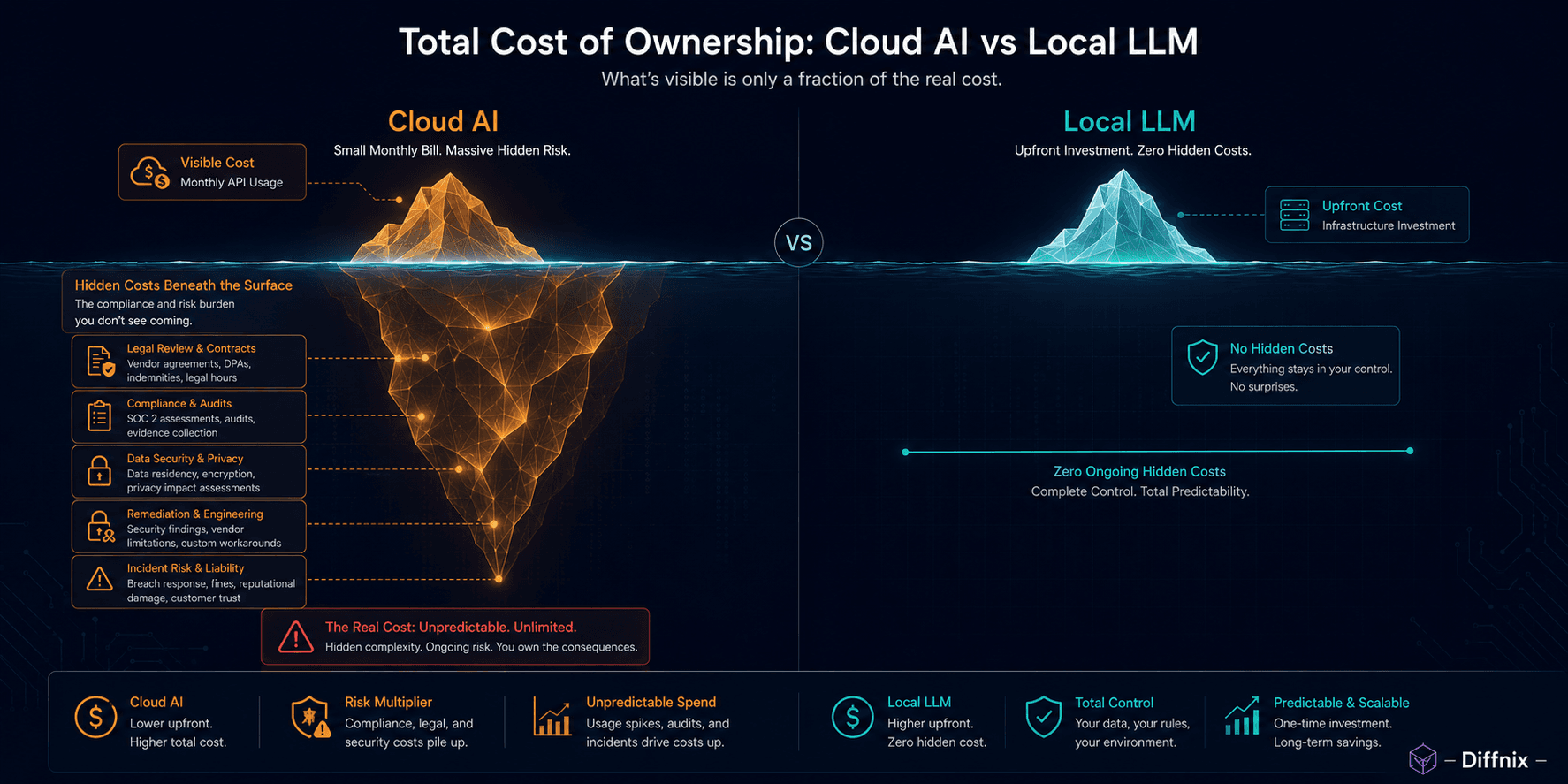
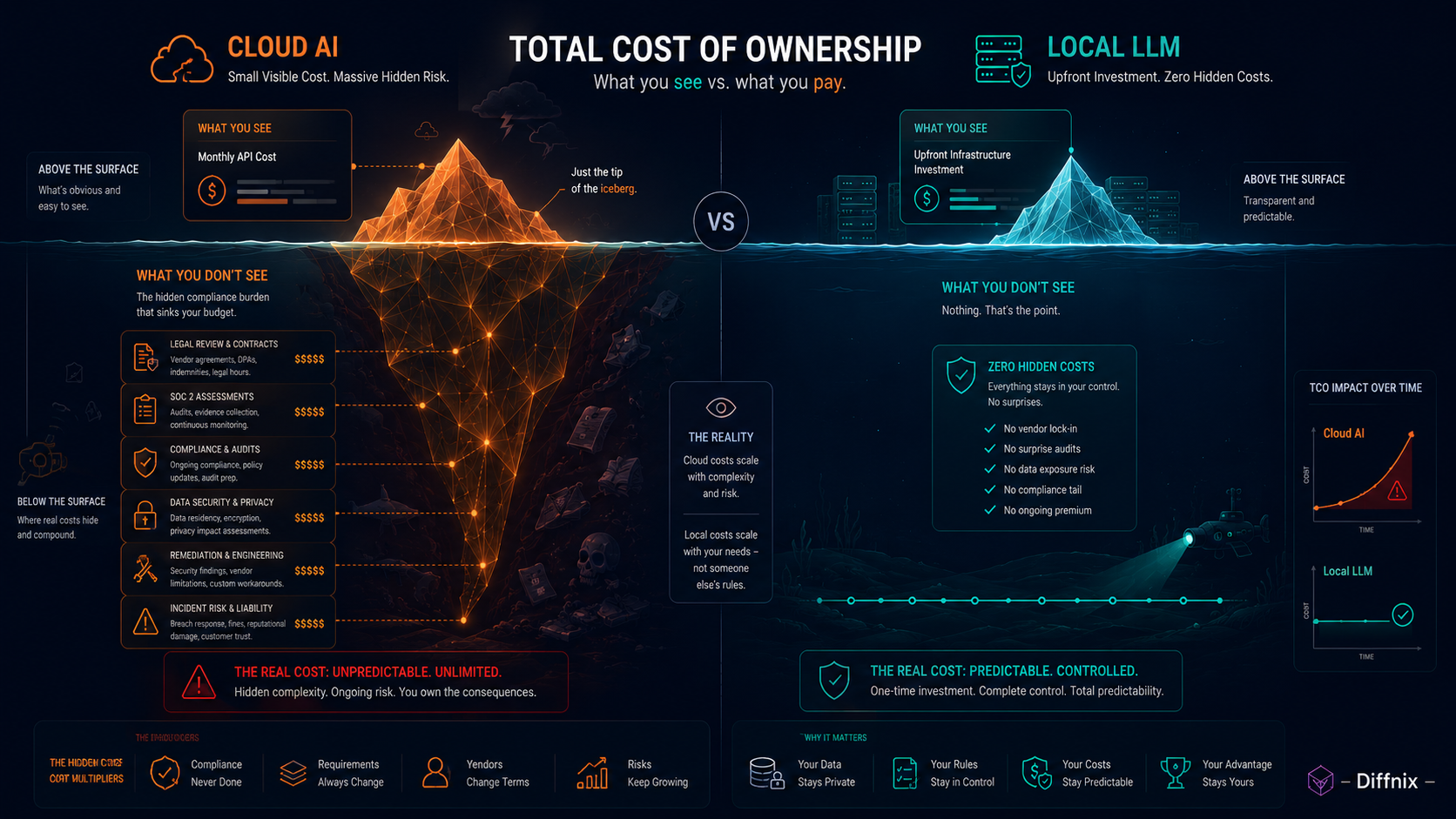
Cloud AI apparent cost: Most cloud AI review tools charge per PR or per seat. For a 20-person engineering team submitting 40 PRs per week, the direct API cost might be $150-400 per month. Sounds cheap.
Cloud AI actual cost includes:
API token cost: $150-400/month (direct)
GDPR DPA legal review: $8,000-15,000 one-time
SOC2 vendor assessment: $3,000-6,000 annually
Ongoing compliance monitoring: $2,000-4,000 annually
Potential remediation if compliance gap found: $20,000-50,000 one-time
For a team operating in a regulated environment, the true first-year cost of a cloud AI code review tool is not $1,800-4,800 in API fees. It is $35,000-80,000 when compliance overhead is included.
A healthcare SaaS team that adopted a cloud AI code review tool experienced this directly. Their API costs were running at $220 per month. Their legal team's assessment, triggered by a routine vendor review six weeks after adoption, identified a HIPAA compliance gap that required: immediate tool removal, a legal review of six weeks of data transmission exposure, migration to a local deployment, and documentation for their next compliance audit cycle.
Total first-year cost of the cloud AI tool: approximately $47,000. The tool cost $220 per month.
Local LLM actual cost:
Hardware (two 24GB GPUs): $8,000-16,000 amortized over 3-4 years
Infrastructure management: 0.5 FTE engineering hours per month
Model updates: quarterly, 2-4 hours each
Compliance overhead: zero — code never leaves the network
For a team that already has GPU infrastructure for other purposes, the incremental cost of local LLM code review is primarily the engineering time to integrate it. For teams provisioning hardware specifically for this purpose, the first-year hardware cost is comparable to the compliance overhead of cloud AI for a regulated team.
📌 Insight: The convenience argument for cloud AI is strongest when compliance overhead is zero. The moment HIPAA, GDPR, or SOC2 requirements enter the equation, the total cost comparison shifts significantly in favor of local deployment.
Dimension 5: Review Quality for Your Use Case
Benchmark numbers tell you how a model performs on standardized tests. Your codebase is not a standardized test.
The factors that matter for real-world review quality:
Language stack. Local models have varying capability across languages. Python, JavaScript, TypeScript, Go, and Java are well-represented in training data and produce strong findings. Less common languages may see a larger quality gap with cloud frontier models.
Codebase age and patterns. Older codebases with established internal patterns benefit from context enrichment regardless of model choice. The enrichment step compensates for model knowledge gaps by providing explicit context.
PR size distribution. Local models at 34B parameters handle context windows of 16,000-32,000 tokens, which covers most PRs. Very large PRs (500+ lines across many files) may benefit from the larger context windows available in frontier cloud models.
Finding type distribution. For correctness, security, and performance findings — the categories with the highest business impact — local and cloud models perform comparably with good context enrichment. For style and maintainability commentary, cloud models often produce more nuanced output.
The practical recommendation: run a parallel evaluation on your actual PRs before making the infrastructure commitment. Four weeks of parallel reviews gives you enough data to assess finding quality for your specific stack and codebase characteristics.
The Decision Framework
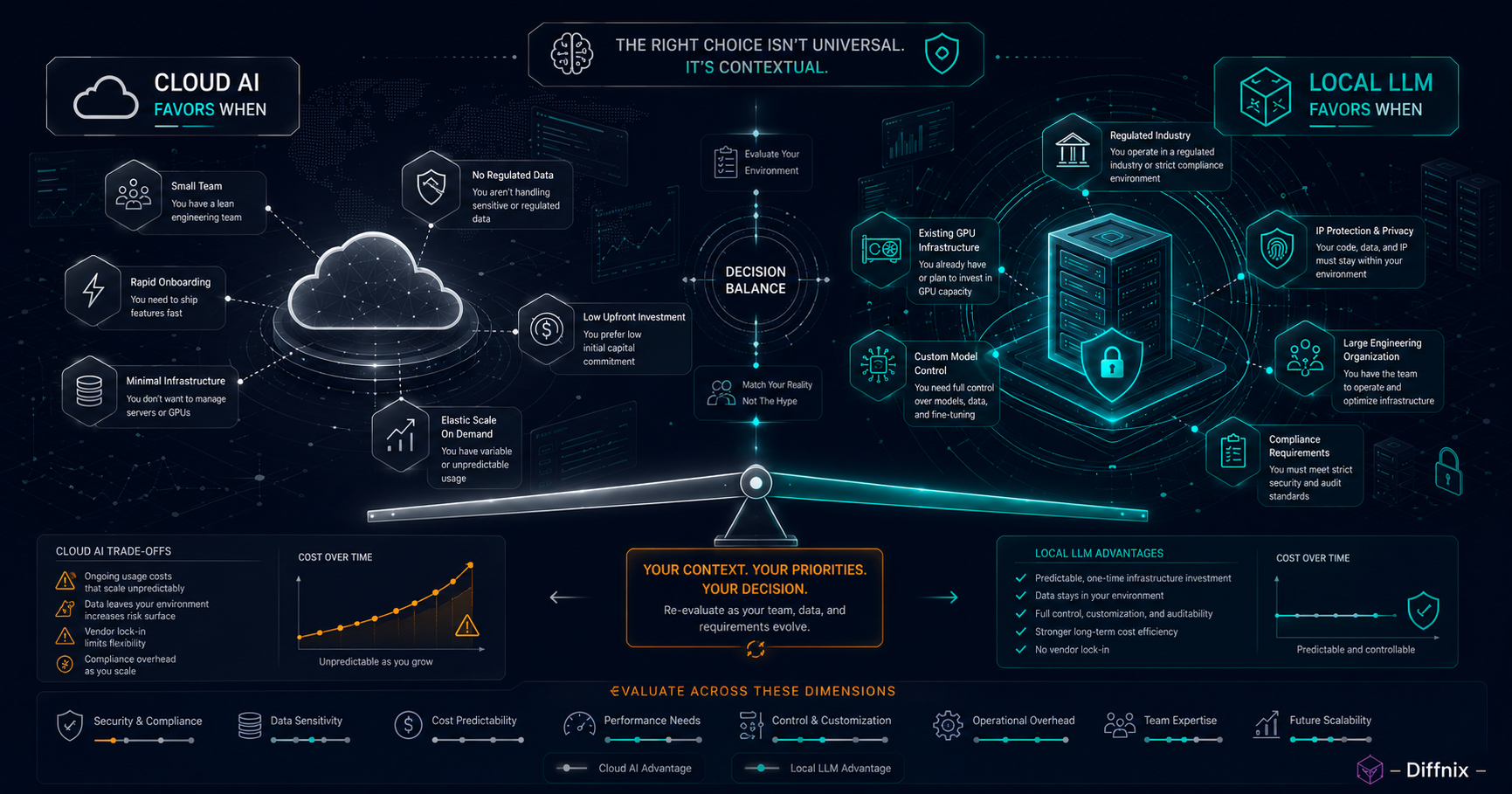
Given the five dimensions, here is a practical decision framework:
Choose cloud AI if:
Your codebase contains no regulated data (HIPAA, GDPR, SOC2)
Your team has no GPU infrastructure and no DevOps capacity to manage it
Your engineering team is fewer than 8 people and operational overhead matters
You need the absolute highest model capability for novel or complex code patterns
Choose local LLM if:
Your codebase is subject to HIPAA, GDPR, SOC2, or similar compliance requirements
Your team already manages ML or GPU infrastructure for other purposes
You have IP or proprietary logic that cannot leave your network
Your team is large enough that API cost savings and compliance overhead justify infrastructure investment
You want to eliminate a vendor dependency from a critical development workflow
✅ Best Practice: If you are in a regulated industry, start with local deployment rather than adopting cloud AI and migrating later. Migration always costs more than starting correctly, and the compliance exposure during the cloud AI period creates risk that local deployment avoids entirely.
Real-World Example: The Hidden Compliance Cost
A 50-person product engineering team adopted a cloud AI code review tool during a period of rapid hiring. The tool cost $280 per month in API fees. Developers liked it. Finding quality was good.
Fourteen months later, their SOC2 Type II renewal audit included a new section on AI tooling in the development environment. The auditor asked: which external services receive source code? What are their security certifications? What data processing agreements exist?
The engineering team's cloud AI code review tool was not in the vendor register. No security assessment had been conducted. No data processing agreement existed with the vendor. The SOC2 auditor classified this as a Confidentiality criterion gap.
Remediation required:
Vendor security questionnaire completion: 3 weeks (vendor's response time)
Legal review of the vendor's data processing terms: 2 weeks
Determination that terms did not meet their compliance requirements: week 5
Tool removal and migration to local deployment: 3 weeks
SOC2 audit addendum documenting the gap and remediation: 2 weeks
Total remediation timeline: 15 weeks. Engineering and legal time: approximately $35,000. The tool had cost $3,920 in API fees over 14 months.
Migration to Diffnix local deployment took three weeks. Setup time for the inference server: one afternoon. The SOC2 scope for the following year excluded AI code review tools from the vendor assessment list because code no longer left the network.
For the complete picture of local deployment architecture, why Diffnix runs AI code review locally covers every architectural decision and compliance consideration. And for the shift-left security workflow that benefits from local deployment, shift-left security at the PR stage goes deep on the vulnerability detection dimension.
Conclusion
The cloud vs local LLM decision for code review is not primarily about model quality. It is about compliance architecture, total cost of ownership, and risk tolerance.
For teams with no compliance requirements, cloud AI is the faster, lower-overhead choice and a reasonable one. For teams in regulated industries or with IP that cannot leave the network, the hidden costs of cloud AI — compliance overhead, remediation risk, vendor dependency — make local deployment the better economics even before factoring in the privacy argument.
Most teams pick convenience and handle the compliance question when it surfaces. The teams that handle it upfront avoid the 15-week remediation cycle.
We built Diffnix to make the local deployment option as frictionless as possible. Setup takes an afternoon. Findings quality is comparable to cloud models on the categories that matter. Your code stays on your network, your compliance posture stays clean, and your developers get the same review quality they would get from a cloud tool.
Diffnix is a private, AI-powered code intelligence platform that understands your code — not just scans it.
Run Diffnix locally with your existing LLM infrastructure.