Shift-Left Security: How to Catch Vulnerabilities in PRs Before They Reach Production
The most dangerous security vulnerabilities are not the ones that look dangerous. They look like legitimate code, pass static analysis, and get approved by senior engineers who were not looking for an authorization gap in an otherwise clean refactor. This post explains shift-left security at the PR stage, shows what AI review catches that SAST tools cannot, and walks through a real vulnerability that would have been a significant incident if it had not been caught at review.

Introduction
Every security vulnerability in production started as a line of code in a pull request. Someone wrote it, someone reviewed it, and both of them missed it. That is not a failure of effort. It is a failure of information, the reviewer did not have the context to see the authorization gap, the injection path, or the missing rate limit in a 200-line PR that changed eight files.
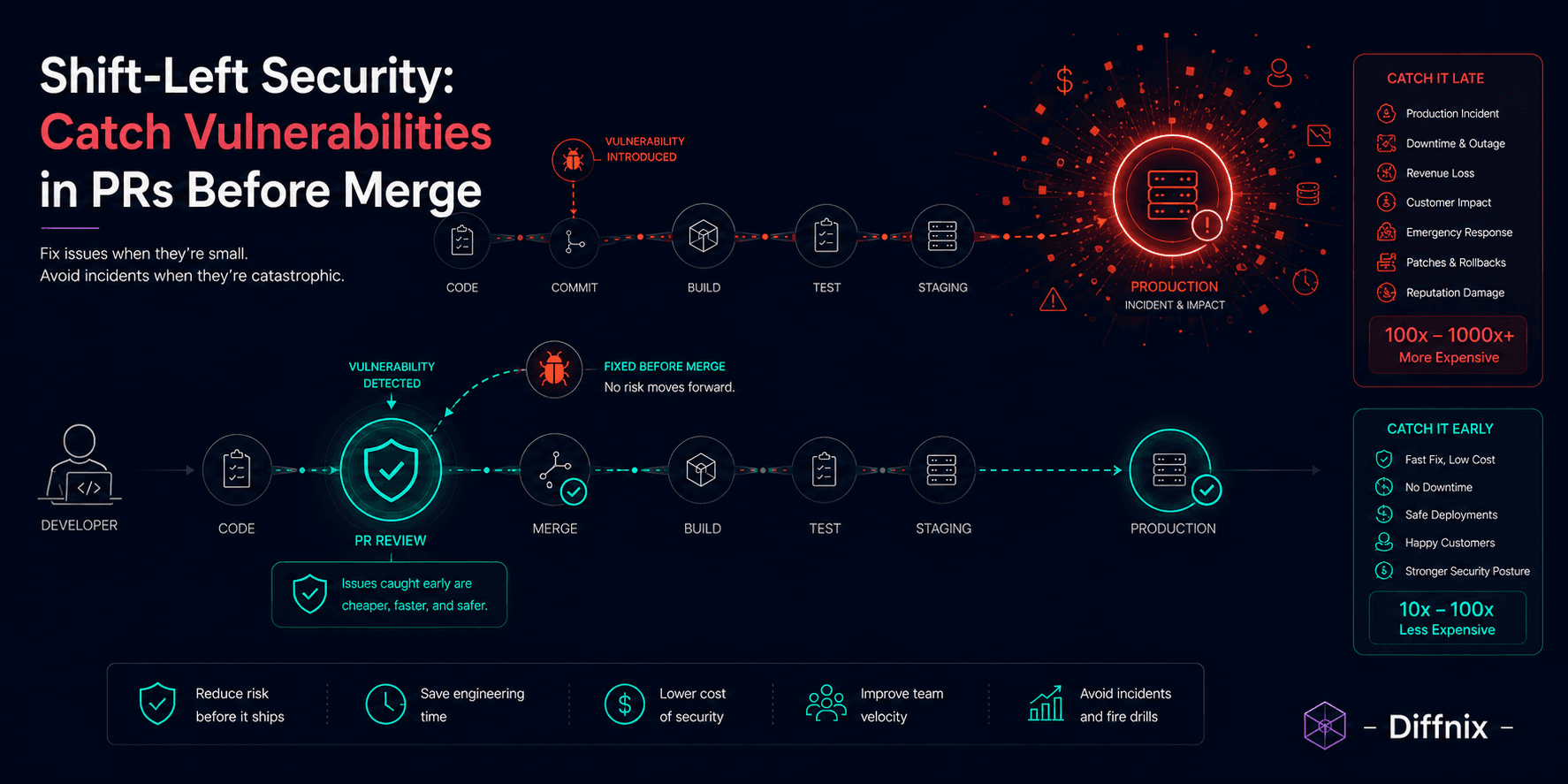
"Shift-left security" is the principle of catching vulnerabilities earlier in the development process, when they are cheap to fix, rather than later, when they are expensive. The terminology has been around for years. The implementation has consistently lagged the principle because the tools available for PR-stage security review have been limited to pattern-based static analysis that catches known vulnerability patterns but misses the context-dependent ones.
AI semantic analysis changes what is possible at the PR stage. Not by checking more patterns by reasoning about authorization, input validation, and data flow in a way that requires understanding the code's context, not just its structure.
This post covers how shift-left security works at the PR stage, where traditional SAST tools stop and AI analysis starts, and what a real vulnerability catch looks like from submission to finding to fix.
The Cost Curve of Finding Security Bugs Late
There is a consistent pattern in how security vulnerabilities are discovered and what they cost when discovered at different stages.
A vulnerability found during code review costs the developer 30-60 minutes to understand and fix before the PR merges. The total organizational cost is measured in developer time.
The same vulnerability found by a security team during a penetration test typically quarterly or annually costs engineering time to understand, reproduce, and fix, plus the penetration test cost, plus the remediation cycle, plus the regression testing to confirm the fix. Total cost: days of engineering time across multiple teams.
The same vulnerability found by an external researcher, or worse, exploited by an attacker, involves incident response, customer notification, potential regulatory reporting, legal review, and public disclosure depending on severity. The engineering fix is the cheapest part of the response.
The multiplier between "caught at PR review" and "caught in production exploitation" is not linear. For high-severity vulnerabilities, authentication bypass, mass data exposure, command injection, the cost difference is measured in orders of magnitude.
Security as a separate phase that happens after development is a structural guarantee that your security review arrives too late to prevent the most expensive outcomes. Security at the PR stage, applied to every PR automatically, is the only architecture that catches vulnerabilities before they enter the codebase.
📌 Insight: The reason shift-left security has been difficult to implement consistently is not philosophical disagreement every engineering leader agrees that earlier is better. It is that the tools available for PR-stage security review were limited to pattern-matching SAST, which misses the context-dependent vulnerabilities that cause the most costly incidents.
Where SAST Stops and AI Analysis Starts
Traditional SAST tools — SonarQube, Semgrep, Snyk Code — are genuinely valuable for what they do. They catch known vulnerability patterns: SQL injection via string concatenation, hardcoded credentials in source files, known insecure function calls. They run fast, integrate cleanly with CI pipelines, and produce reliable findings for the patterns they cover.
The limit of pattern-based SAST is that it checks whether code matches a known bad pattern. It cannot check whether the authorization model is correct, because "correct authorization" is not a pattern. It is a relationship between the request, the requesting user, the resource being accessed, and the permissions model that governs that relationship.
Here is the specific vulnerability type that SAST consistently misses: Insecure Direct Object Reference (IDOR).
# A PR adds a new REST endpoint for fetching user invoices
# This is syntactically clean code — no SAST rule fires

@app.route('/api/invoices/<invoice_id>')
@login_required
def get_invoice(invoice_id):
    invoice = Invoice.query.get_or_404(invoice_id)
    return jsonify(invoice.to_dict())
This code passes every SAST rule:
The query is parameterized — no SQL injection
Authentication is present via
@login_requiredNo hardcoded credentials
No known insecure function calls
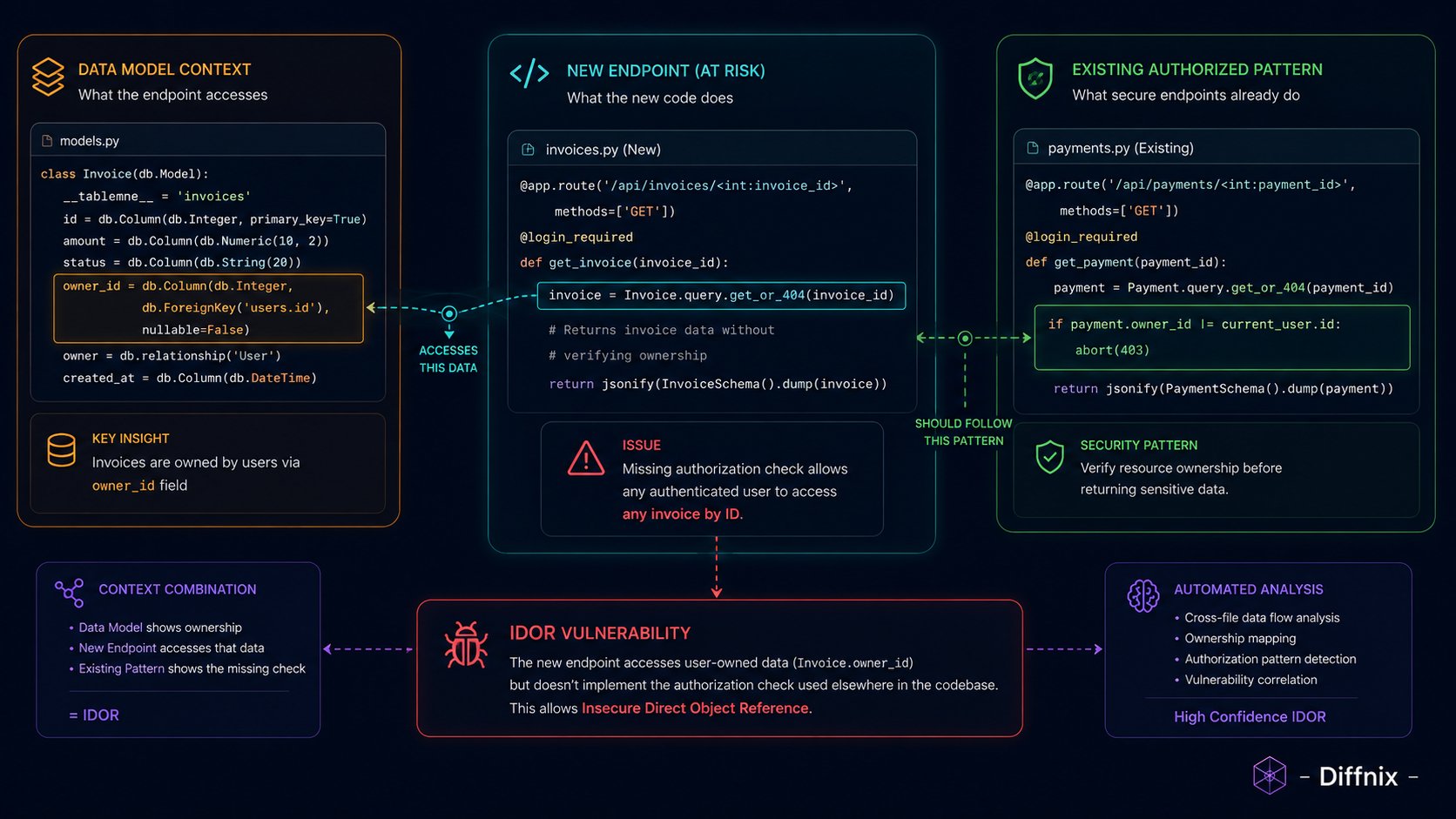
The vulnerability: there is no check that the requesting user owns or has permission to view the invoice identified by invoice_id. Any authenticated user can substitute any invoice_id in the URL and retrieve any other user's invoice. This is a textbook IDOR.
SAST cannot catch this because "check that the user owns the resource" is not a syntactic pattern. It is a semantic requirement that depends on knowing what invoice_id represents, what the Invoice model contains, and what the authorization model for invoice access should be.
An AI reviewer with context enrichment sees: the Invoice model has an owner_id field, the endpoint accepts a user-controlled invoice_id parameter, and no comparison between invoice.owner_id and current_user.id exists in the handler. That is the finding.
How AI Catches the IDOR at PR Stage
Walk through what happens when PRInspector analyzes this endpoint addition.
Diff parsing identifies: a new Flask route added, the route accepts a URL parameter invoice_id, @login_required is present, and Invoice.query.get_or_404(invoice_id) is called with the user-controlled parameter.
Context enrichment fetches: the Invoice model definition from models/invoice.py (which shows owner_id: int, foreign_key: users.id), the existing invoice-related endpoints in the file to understand the established authorization pattern, and similar resource-access endpoints in the codebase to check what the standard authorization approach is.
Reasoning evaluates: is there a check that current_user.id matches invoice.owner_id before returning the resource? Answer: no. Is this the expected pattern based on similar endpoints? Answer: all similar endpoints in api/resources.py include ownership validation. Is the absence of that check a vulnerability? Answer: yes, this is an IDOR.
Output:
FINDING [Security / Critical] — api/invoices.py, Line 8

This endpoint fetches an Invoice by a user-controlled ID without verifying
that the requesting user owns or has permission to view that invoice.

The Invoice model (models/invoice.py, line 14) has an `owner_id` field
linked to the users table. No comparison between `invoice.owner_id` and
`current_user.id` is present in this handler.

All similar resource endpoints in api/resources.py (lines 44, 87, 132)
include ownership validation before returning the resource.

An authenticated user can retrieve any invoice by substituting a known or
enumerated invoice_id in the URL parameter.

Suggested fix:
    if invoice.owner_id != current_user.id:
        abort(403)
Add this check between the query and the return statement.
The finding is specific, grounded in the actual model definition and the established pattern from similar endpoints, and includes a concrete fix.
Real-World Use Case: The Invoice API Vulnerability
An e-commerce platform team was building a self-service invoicing feature for their B2B customers. A senior developer added the invoice retrieval endpoint as part of a two-week sprint. The PR touched 11 files across the authentication middleware, the invoice controller, the model layer, and the API documentation.
The reviewer — also a senior engineer — focused on the architectural changes: the new middleware integration, the model additions, and the API versioning approach. The endpoint itself looked clean: authenticated, parameterized query, standard response format.
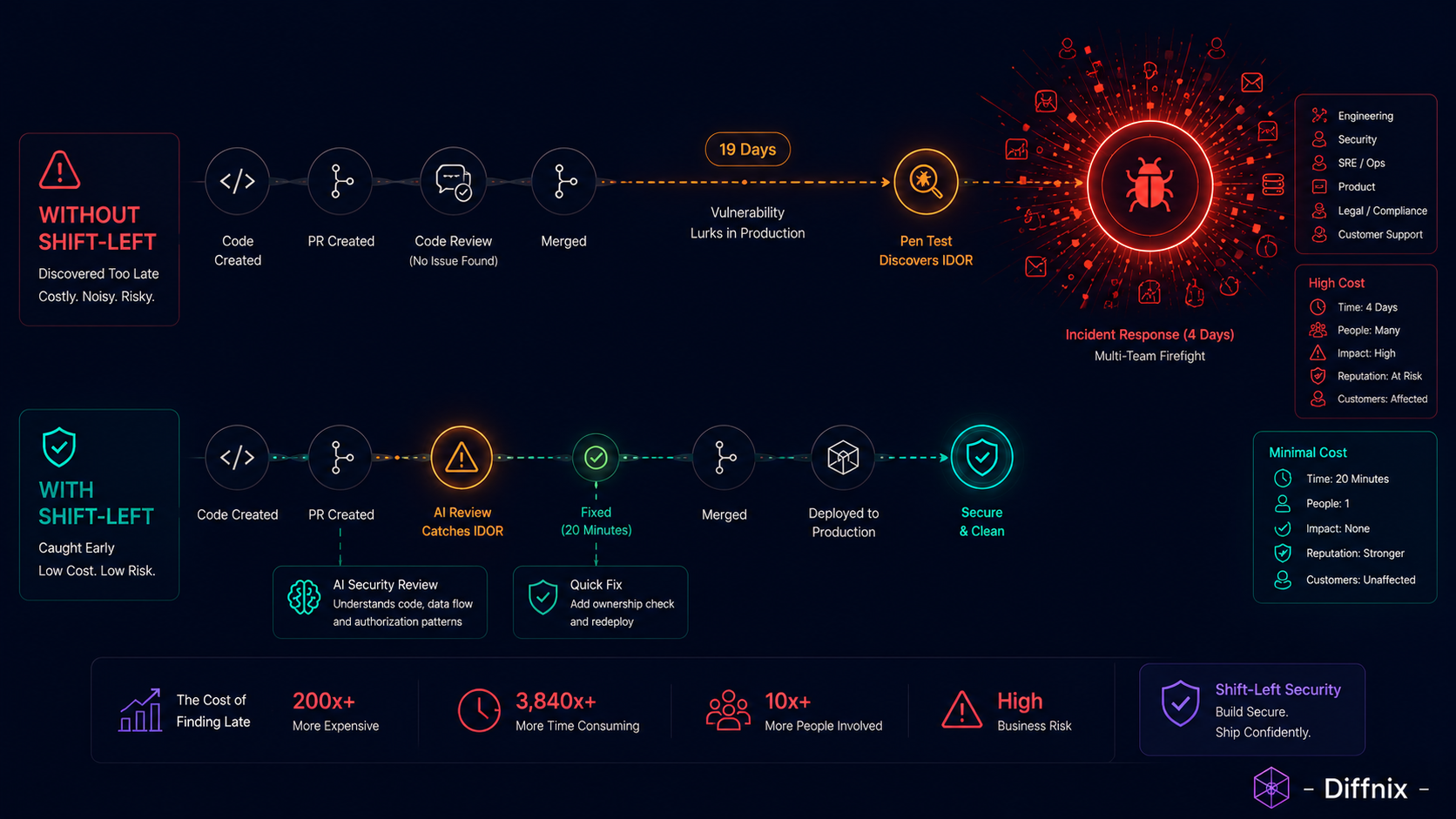
The endpoint shipped. It was live for 19 days before the security team's quarterly penetration test ran a standard IDOR check on the invoice API and retrieved invoices belonging to other accounts using sequential ID enumeration.
Severity assessment: high. Invoice data included billing addresses, order line items, payment amounts, and company names. Approximately 4,200 invoices were potentially accessible to any authenticated user.
Remediation: the endpoint fix took 20 minutes. The incident response process internal notification, customer impact assessment, legal review of exposure scope, and documentation for the security audit trail took four days across three teams.
The entire class of issue could have been caught at the PR stage with the two-line fix:
@app.route('/api/invoices/<invoice_id>')
@login_required
def get_invoice(invoice_id):
    invoice = Invoice.query.get_or_404(invoice_id)
    if invoice.owner_id != current_user.id:    # ownership check
        abort(403)                              # added by security fix
    return jsonify(invoice.to_dict())
The SAST tools in the CI pipeline flagged zero issues on the original code. The IDOR was not a pattern violation. It was an absent check that requires understanding the authorization model to identify.
For teams wanting to understand the full landscape of security bugs that pass pattern-based review, the security bugs that slip through senior code reviews covers seven categories with real examples.
Advanced Tips for Engineering Managers Implementing Shift-Left Security
Prioritize authorization checks as a distinct review dimension
When configuring AI review for your team, enable the security dimension with a lower confidence threshold than other dimensions. Authorization bugs IDOR, missing authentication, privilege escalation are high-severity and often subtle. You want to see them even when the finding is uncertain.
Security findings that turn out to be false positives are a minor annoyance. Security vulnerabilities that ship to production are incidents. Set your confidence calibration accordingly.
Pair AI security review with manual security review for high-risk PRs
AI review is consistent and fast. It does not replace a security engineer reviewing a high-risk PR: a new authentication flow, a new external API integration, a payment processing change. Use AI review as the first pass that catches the common issues, so that when a security engineer reviews high-risk code, they spend their time on architecture and threat modeling rather than hunting for IDOR patterns.
Build a security finding taxonomy for your codebase
After running AI security review for 30 days, review the findings by category. You will likely see patterns: your team has a consistent blind spot for one specific type of vulnerability, or a particular service generates more security findings than others. Use that data to improve developer education, not just to catch individual bugs.
At Diffnix, we observed that teams running security review for 90 days typically see a 40-60% reduction in security-related findings not because the tool gets worse at finding them, but because developers internalize the patterns and stop introducing them.
⚠️ Warning: Shift-left security review at the PR stage does not eliminate the need for penetration testing, security audits, or bug bounty programs. It catches authorization gaps, injection vectors, and missing validations in new code. It does not catch vulnerabilities in existing code that was written before AI review was deployed, vulnerabilities that require authenticated application state to trigger, or issues that require understanding multi-service interactions at the architectural level.
Conclusion
Security should not be a phase. It should be a property of the code review process itself applied automatically, on every PR, before any code reaches the main branch. That is what shift-left security means in practice, and that is what AI semantic review at the PR stage enables.
The IDOR that passed a senior engineer's review and a comprehensive SAST scan is exactly the kind of vulnerability that semantic AI review is designed to catch. It is not a pattern violation. It is an absent check that requires understanding the authorization model to identify.
We built Diffnix because security at review time should be as automatic as running tests. Every PR gets the same security analysis, regardless of whether the reviewer had authorization vulnerabilities in mind when they approved the change.
Diffnix is a private, AI-powered code intelligence platform that understands your code not just scans it. Security findings stay private because inference runs locally.
For the complete enterprise security picture, start with the private AI code review playbook. And if you want to see the full range of security bugs that AI review catches that SAST cannot, the security bugs that slip through senior reviews covers seven categories in depth.
Book a security-focused demo and see Diffnix catch a real vulnerability in your codebase.