Why Diffnix Runs AI Code Review Locally (And Why Your Code Should Never Leave Your Network)
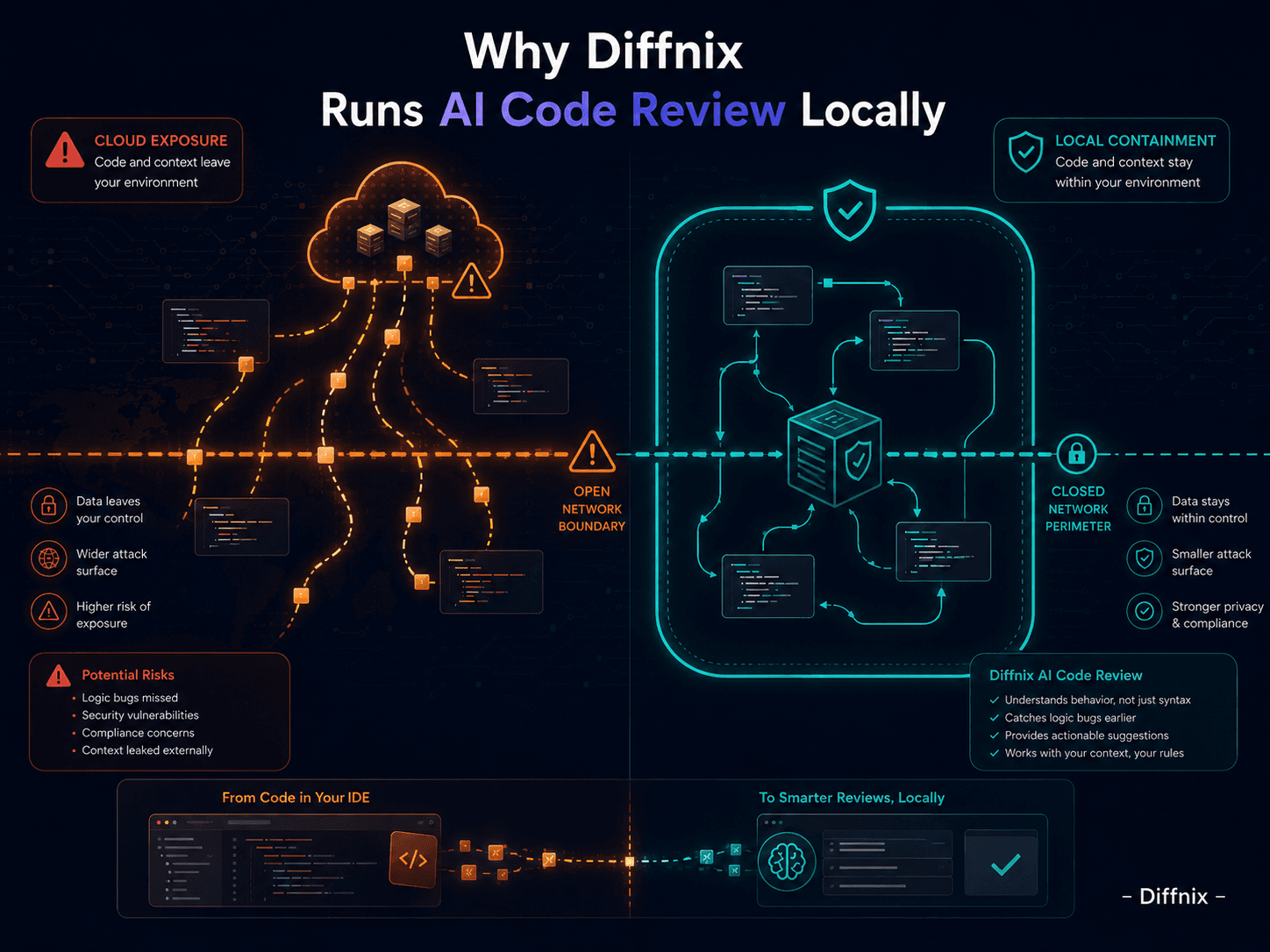
The moment you connect a cloud AI code review tool to your repository, your source code starts leaving your network on every PR. Most teams make this trade without fully understanding what they are trading. This post explains exactly what happens to your code when you use cloud AI review, what the compliance implications are for regulated industries, and why local deployment is the only architecture that eliminates the risk entirely.

Introduction
Here is something no cloud AI code review tool puts in its onboarding flow: when you install it, your source code starts being transmitted to an external API on every pull request you open.
That sentence is not alarmist. It is a description of how these tools work mechanically. The diff, and often supplemental file context fetched to improve review quality, leaves your network, gets processed on the tool vendor's infrastructure, and the findings come back. The value is real. The data transmission is also real.
For most consumer web apps, this is an acceptable trade. For teams working in healthcare, financial services, defense contracting, or any environment subject to data sovereignty requirements, it is a compliance question that needs an explicit answer before adoption, not a surprise that shows up in an audit two years later.
We built Diffnix to run entirely within your infrastructure because we refused to accept that you had to choose between AI-quality code review and keeping your code on your own network. This post explains exactly how we made that work and why the architecture matters.
What Actually Happens When You Use Cloud AI Review
Walk through the technical reality of a typical cloud AI code review tool's operation.
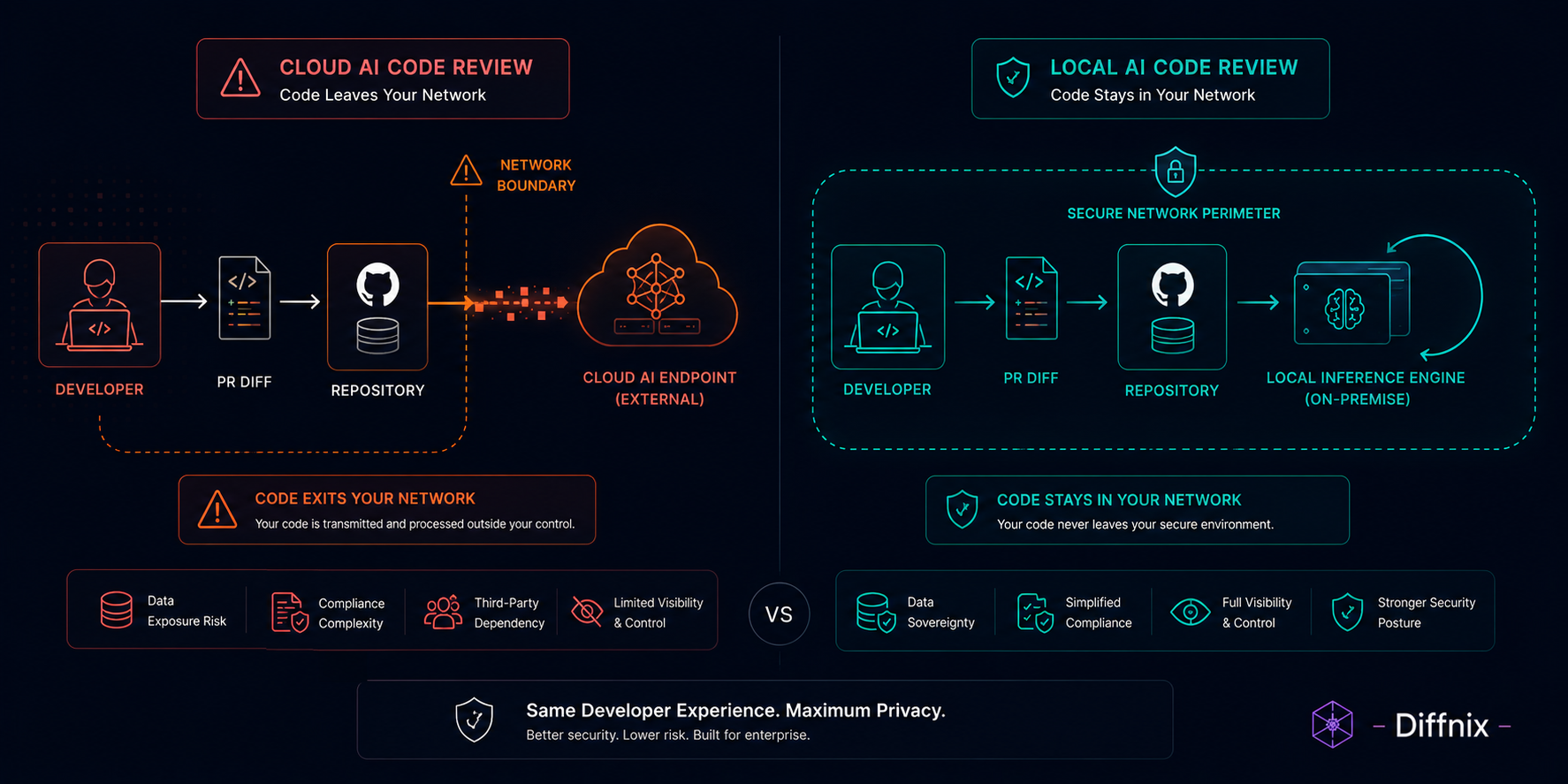
You open a pull request. The tool's GitHub App or webhook receives the PR event. It fetches the diff from the GitHub API. It sends that diff — along with any additional context files it fetches for better review quality — to its AI inference endpoint. The model processes the code. The findings come back. Comments appear on your PR.
That is the flow. The key step is "sends that diff to its AI inference endpoint." That endpoint is running on the tool vendor's cloud infrastructure, not yours.
# What cloud AI review tools do internally (simplified)
def review_pull_request(diff: str, context_files: list[str]) -> list[Finding]:
    payload = {
        "diff": diff,
        "context": "\n".join(context_files),  # your source code
    }
    response = requests.post(
        "https://api.ai-review-vendor.com/v1/review",  # external endpoint
        json=payload,
        headers={"Authorization": f"Bearer {vendor_api_key}"}
    )
    return parse_findings(response.json())
Your source code is in payload. It just crossed your network boundary.
What happens to it on the other side depends on the vendor's privacy policy. Read the actual policy language, not the marketing copy. Common clauses to look for:
"We may use submitted content to improve our services." This means your code can be used for model training.
"Data may be retained for up to 30 days for debugging purposes." This means your code sits on their infrastructure for a month.
"We process data in accordance with our standard terms unless enterprise terms apply." This means default behavior applies unless you have negotiated otherwise.
None of these clauses make the tool malicious. They make the data handling explicit. And for regulated environments, that explicit data handling creates compliance obligations that do not disappear because the tooling is convenient.
📌 Insight: The argument "we only send the diff, not the whole file" does not resolve the compliance question. A diff that modifies a HIPAA-regulated data handling function reveals your HIPAA-regulated data handling architecture. The content transmitted matters, not the volume.
The Compliance Case for Local Deployment
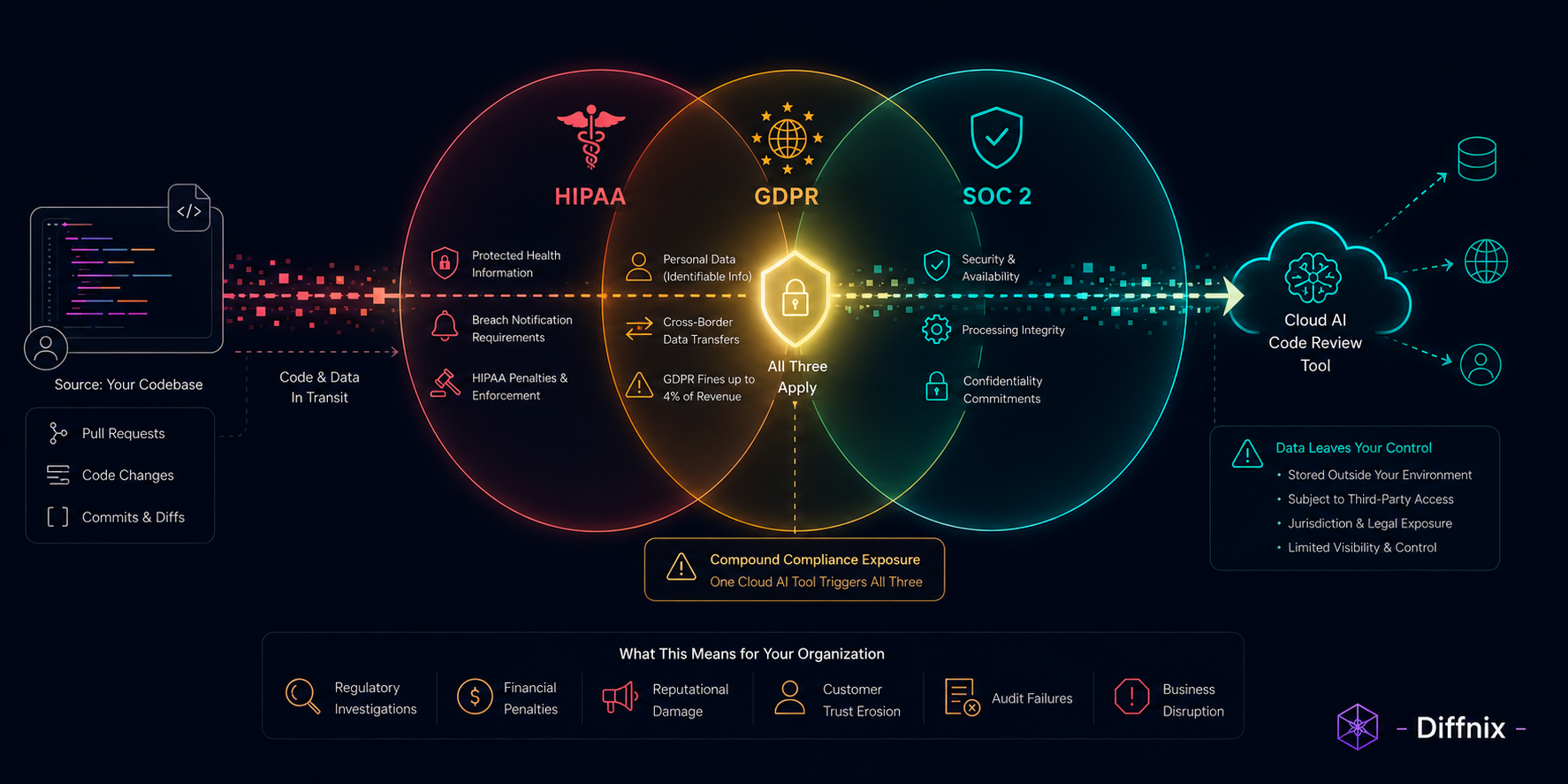
Three frameworks where cloud AI review creates direct compliance risk:
HIPAA
If your codebase processes Protected Health Information, the vendors who process your code may qualify as Business Associates under HIPAA. Business Associates require Business Associate Agreements. Most standard cloud AI API providers do not offer HIPAA BAAs for their general API products.
Even if a BAA is available, it requires negotiation, legal review, and ongoing vendor monitoring. And code that contains test data with realistic patient identifiers, schema definitions for PHI tables, or encryption key management logic represents PHI exposure that a BAA must specifically cover.
A healthcare SaaS team learned this the hard way. They adopted a cloud AI code review tool during a rapid growth phase. Six weeks later, their security team reviewed the tool's privacy policy during a routine vendor assessment. The standard API terms permitted use of submitted data for model improvement. Their code included patient intake form logic, de-identification routines, and a PHI retention schedule configuration.
They were out of HIPAA compliance without realizing it. The remediation: immediate tool removal, legal review of the data exposure, and three weeks of migration work to a local deployment. The alternative would have been a $50,000+ HIPAA audit finding.
GDPR Article 28
If your codebase handles data belonging to EU residents, and an AI tool processes that code, that tool may qualify as a data processor under GDPR Article 28. Article 28 requires a Data Processing Agreement with every data processor. Most US-based cloud AI providers are not GDPR-compliant data processors by default.
Additionally, transmitting EU personal data to a US processor requires Standard Contractual Clauses or another approved cross-border transfer mechanism. Teams that have not gone through this assessment for their AI code review tools are likely in violation of GDPR transfer restrictions.
SOC2 Type II
SOC2 auditors increasingly include AI development tools in their scope. The Confidentiality criterion is directly relevant: "The entity protects confidential information to meet the entity's objectives." Source code is confidential information. Transmitting it to an unaudited third-party AI service without a documented vendor assessment creates a SOC2 gap that auditors will find.
How Local LLM Deployment Works
The practical objection to local deployment used to be capability. Two years ago, local models produced noticeably worse output than frontier cloud models on code tasks. That gap has closed significantly.
Code Llama 34B, DeepSeek Coder 33B, and Mistral-based code fine-tunes now produce findings competitive with GPT-4 on structured code review tasks. The reasons: code review is a constrained reasoning task. It benefits more from good context enrichment and prompt engineering than from raw model scale. A 34B parameter model with well-structured context about calling code, type definitions, and PR intent produces findings at a level that matches cloud models on the specific task of finding logic errors, security vulnerabilities, and correctness issues in diffs.
The infrastructure side has matured too. Ollama, vLLM, and similar inference frameworks provide HTTP-compatible endpoints that accept standard message formats. The diff parsing, context enrichment, and reasoning pipeline that Diffnix runs is identical whether the model endpoint is a cloud API or a local inference server.
# Diffnix local inference configuration
# Code never leaves this network segment

class LocalInferenceClient:
    def __init__(self, endpoint: str, model: str):
        self.endpoint = endpoint   # http://inference.internal:11434
        self.model = model         # codellama:34b-instruct

    def complete(self, messages: list[dict]) -> str:
        response = requests.post(
            f"{self.endpoint}/api/chat",
            json={"model": self.model, "messages": messages},
            timeout=60,
        )
        return response.json()["message"]["content"]
    # The HTTP request never leaves your network boundary
Hardware requirements for team-scale deployment: a server with 48GB of VRAM handles a 34B parameter model. For teams reviewing 50-150 PRs per day, a single inference node comfortably handles the load. For larger teams, horizontal scaling across multiple nodes is straightforward with a load balancer in front of the inference endpoints.
The operational overhead — model updates, hardware maintenance, capacity planning — is real. It is the genuine trade-off in local deployment. For teams in regulated industries, that trade-off is typically worth it. For teams not subject to compliance requirements, the cloud option may be a better fit. The cloud AI vs local LLM comparison covers that decision in full detail.
Real-World Use Case: The Healthcare Team Migration
A healthcare SaaS company processing patient intake forms and appointment scheduling data adopted a cloud AI code review tool as part of a developer productivity initiative. The tool produced useful findings. Developers liked it. Adoption spread across three engineering teams over two months.
At the six-week mark, the security team included the tool in their quarterly vendor review. They read the actual privacy policy, not the marketing page. The standard API terms included: "We use submitted data to improve our models and services." The engineering teams' PRs included: patient form validation logic, PHI encryption key rotation code, de-identification routine implementations, and database schema migrations for patient record tables.
The legal team's assessment: potential HIPAA Business Associate relationship without a BAA, constituting an ongoing compliance violation.
The remediation timeline:
Week 1: Tool removed from all repositories
Week 2: Legal review of data transmitted over 6 weeks and risk assessment
Week 3: Migration to Diffnix local deployment + vendor assessment documentation
Total cost: approximately three weeks of engineering and legal time, plus the risk assessment overhead
The local deployment has been running for eight months since. Code never leaves their network. The compliance audit that followed found no issues with the replacement architecture.
Advanced Tips for Teams Evaluating Local Deployment
Read the privacy policy, not the privacy page
Every AI tool has a marketing privacy page that says reassuring things about data security. The actual privacy policy — the legal document — is what matters for compliance. Look specifically for: data retention periods, model training permissions, opt-out mechanisms, and what "enterprise" terms differ from standard terms. The gap between the marketing page and the legal policy is often significant.
Assess model quality on your actual codebase, not benchmarks
Code review benchmarks measure model performance on synthetic examples. Your codebase has specific patterns, languages, and conventions that may perform better or worse on different models. Before committing to a local model, run a month of parallel reviews — cloud and local — on real PRs and compare finding quality. This takes more time than a benchmark check but gives you accurate data for your specific context.
Plan for model updates
Open-weight models update frequently. When a new model version releases with significantly better code performance, you will want to upgrade. Build the update process into your local deployment plan from the start. Ollama and similar tools make model switching straightforward, but the process should be tested and documented before you need to do it under pressure.
⚠️ Warning: Local deployment does not automatically make AI review compliant with every framework. The inference runs locally, but the findings that appear in your PR are still subject to your organization's data classification policies. A finding that quotes a line of code containing PHI in a PR comment creates its own data exposure question. Configure your review tool to produce findings that reference line numbers and describe issues without reproducing sensitive content.
Conclusion
The choice between cloud and local AI code review is not primarily a features question. It is a security and compliance question. For regulated industries, the answer is clear: code that cannot leave your network should not go to an external API, regardless of how useful the tool is.
We built Diffnix because we believed that engineering teams should not have to choose between AI-quality code review and code privacy. Local deployment closes that gap. The findings quality is comparable to cloud tools. The compliance posture is correct by architecture, not by policy.
Diffnix is a private, AI-powered code intelligence platform that understands your code — not just scans it. Your code stays on your network. The intelligence arrives at your PR the same way it would from any other review tool.
For the complete picture of what private AI code review means for enterprise security, start with the private AI code review enterprise guide. And to understand how local deployment fits with shift-left security practices, how Diffnix catches vulnerabilities at the PR stage covers that workflow in detail.
Run Diffnix locally with your own LLM stack. No code leaves your network.