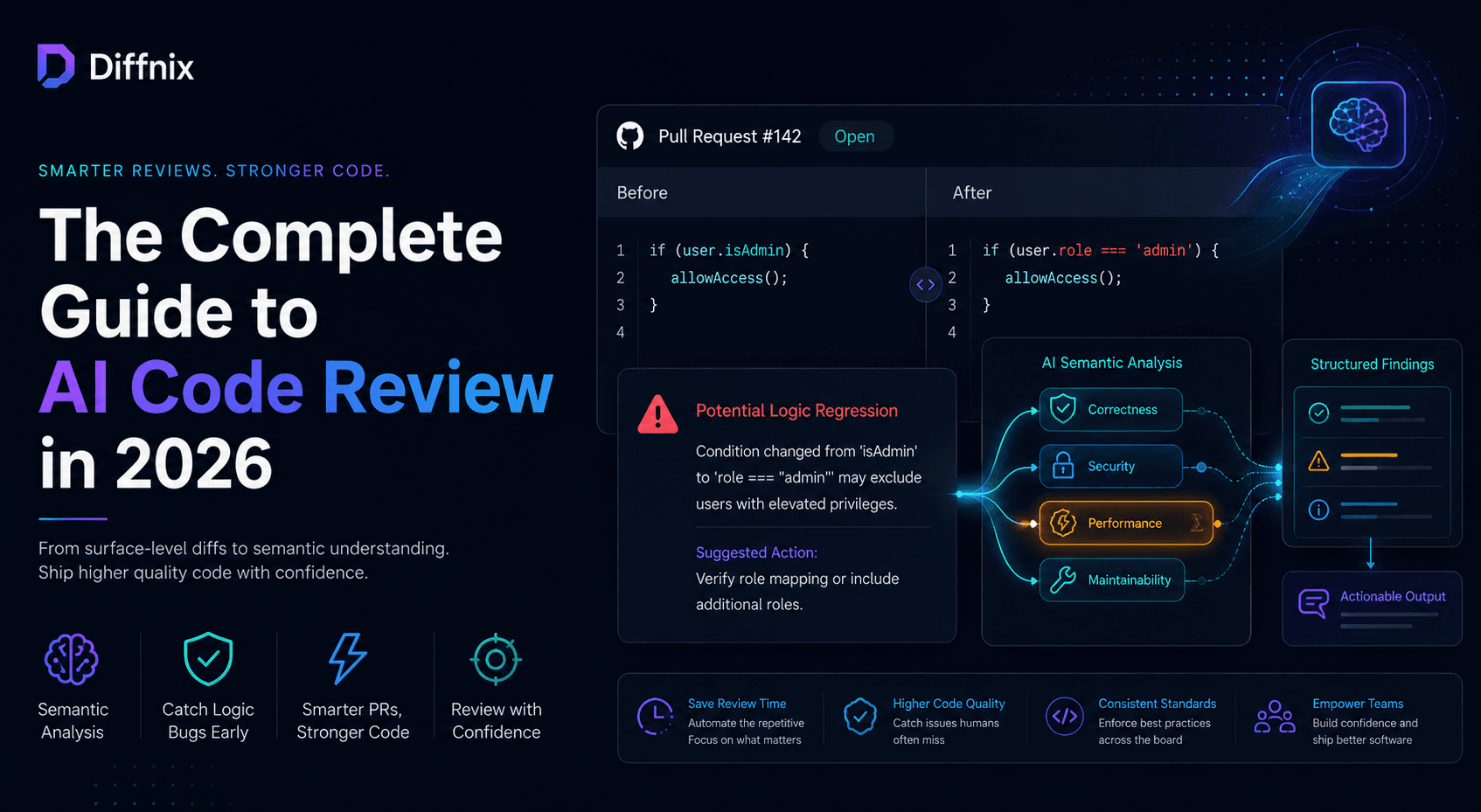
The Complete Guide to AI Code Review in 2026
Most engineering teams are doing AI code review wrong. Not because the tools are bad, but because they are using the wrong layer of the stack for the wrong job. This guide explains how AI code review actually works, where it fits alongside linters and static analysis, how to implement it in a way your team will trust, and what to watch for when it gets things wrong.

Introduction
Pull request review is the highest-leverage quality gate in software development. Every line of code that ships to production has passed through it. Which makes it remarkable that most teams treat it as a bottleneck to clear rather than an investment to optimize.
The typical state of affairs: two or three senior engineers review 80% of all PRs. Everyone else approves things that look structurally right. Average review wait time is 2-3 business days. Average time a senior engineer spends reviewing each PR is 20-35 minutes, most of which is reading context that could have been provided automatically.
Linters help with the low-level mechanical stuff, but they have a hard ceiling. Rule-based tools find what their rules describe. They cannot reason about what your code does.
AI code review entered this gap. The problem is that "AI code review" now describes everything from pasting a diff into a chat window to running a purpose-built multi-stage reasoning pipeline against your pull request. These are not the same thing, and conflating them is why so many teams have already tried "AI review" and concluded it was noisy and unreliable.
This guide draws a clear line between what works and what does not, explains the mechanics of the approach that does work, and shows you how to deploy it in a way that your team will actually use.
What AI Code Review Actually Means
The term covers a spectrum of sophistication, and the quality difference between the ends of that spectrum is enormous.
At the low end: paste a diff into a general-purpose chat interface and ask for a review. The model sees a fragment of code, has no context about the codebase, and produces comments that are sometimes useful but frequently wrong about things that require knowing how the code is actually used.
At the mid level: a tool automatically sends your PR diff to an LLM API when a PR is opened, and posts the response as a review comment. This is better. The review is automatic and fast. But the model is still operating on a text fragment. Without access to calling context, import structures, and interface definitions, it reasons about code it cannot fully see.
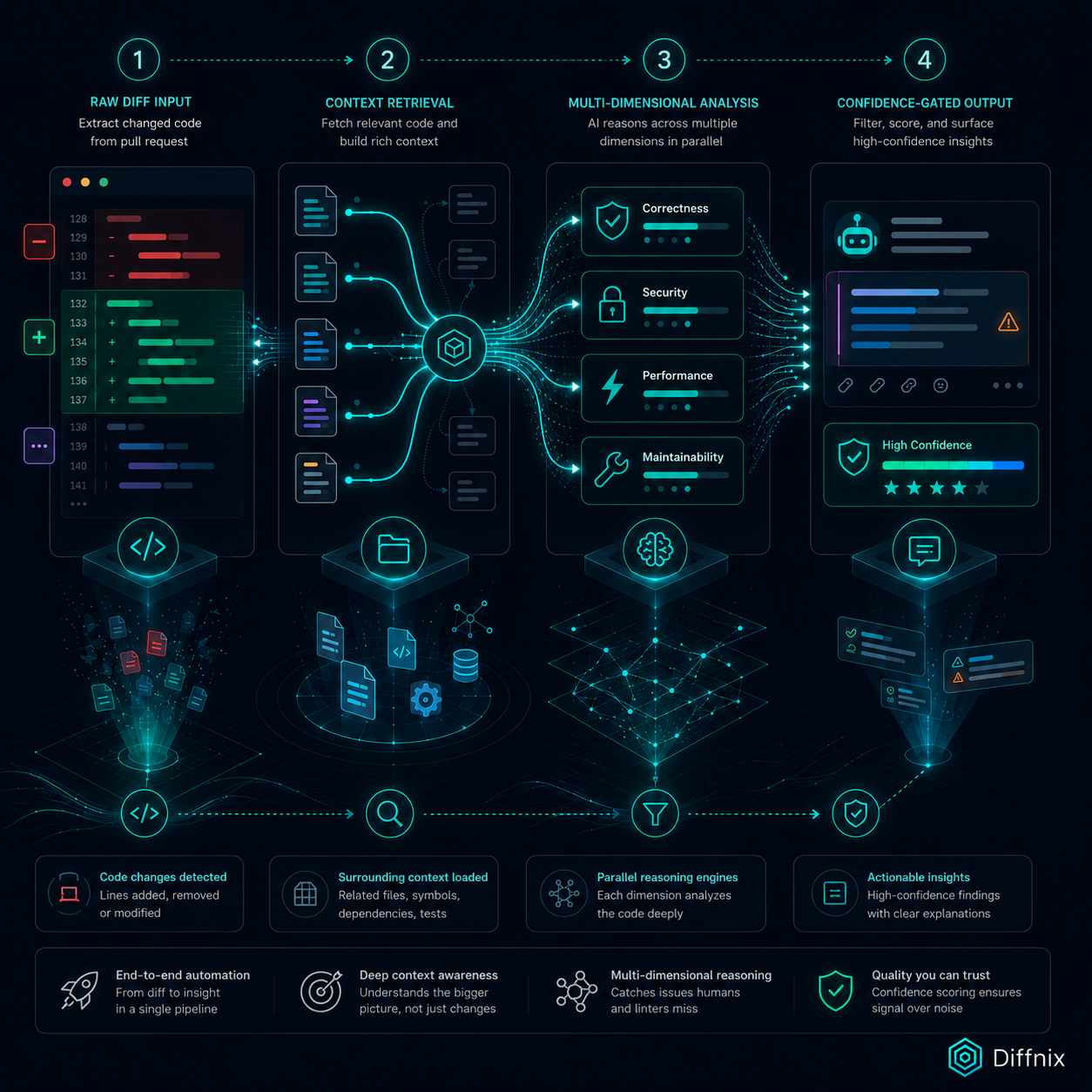
At the high level: a system that parses the diff structurally, enriches it with relevant context from the surrounding codebase, runs multi-dimensional reasoning across correctness, security, performance, and maintainability, and produces confidence-calibrated findings mapped to specific line numbers. This is actual code intelligence.
Teams that evaluate mid-level tools and conclude "AI review doesn't work" are right about those tools. They are wrong about the category.
💡 Tip: Before evaluating any AI code review tool, ask this question: does the tool fetch context beyond the diff, or does it only see the changed lines? If the answer is "only the diff," the tool will hallucinate feedback on code it cannot understand. Real code review requires context.
Why Traditional Code Review Breaks at Scale
Code review worked well when teams were small, PRs were small, and reviewers had time. None of those conditions reliably hold at scale.
The volume problem. A 10-engineer team submitting one PR per engineer per day means 10 PRs to process. A 50-engineer team means 50. Reviewer capacity does not scale with team size the way PR volume does.
The expertise concentration problem. Most teams have two or three engineers whose reviews actually find bugs. Everyone else approves things that look structurally right. The result is a bottleneck: everything waits for the two people whose review is worth having, and their attention is finite.
The diff blindness problem. A reviewer reads what changed. They do not read the full function, the callers, the interface being implemented, or the model definitions that the changed code depends on. A diff that looks correct in isolation can be wrong in context, and the context is rarely in the diff.
The attention degradation problem. A reviewer processing their third PR applies more scrutiny than the reviewer processing their twelfth. Logic checking is expensive attention. Under time pressure, reviewers default to "does this look structurally sound?" rather than "does this actually work?"
Linters address the first few seconds of review: style, common error patterns, type mismatches. They do not address the reasoning work that finds real bugs.
The gap between what linters check and what semantic analysis understands is not incremental. It is categorical. And the cost of what falls into that gap is not small — a single logic bug that reaches production typically costs ten to a hundred times what it would have cost to catch at review. For the full breakdown, see what shallow code reviews actually cost your engineering team.
How AI Actually Understands Code
Most descriptions of AI code review stop at "the AI reads your PR and gives feedback." That is not useful. Here is what actually happens in a well-built system.
Step 1: Structured Diff Parsing
A unified diff is not just text. It has structure: hunk headers that encode file position, context lines that anchor changes in the surrounding code, added and removed lines that together describe a transformation. A well-built AI review system parses this structure first.
@@ -18,6 +18,9 @@ def process_payment(user_id: str):
     user = get_user(user_id)
-    charge_account(user.account_id)
+    if user is not None:
+        charge_account(user.account_id)
+    return
From this fragment, the system knows the change is in process_payment, a null guard was added before charge_account, and the position is line 18 of the original file. That structural information shapes what context is worth fetching next.
Step 2: Context Enrichment
Raw hunk data is not enough to reason about correctness. To evaluate the null guard above, a reviewing system needs to know: what is the type annotation on user? Can user.account_id itself be None? What does charge_account do when it receives None? What calls process_payment, and with what arguments?
A context enrichment step fetches the relevant parts of the file (imports, class definitions, method signatures), plus the call sites of the changed function. This is the step that separates a reviewer that says "null check added" from one that says "null check added, but user.account_id is not guarded, and based on the User model, account_id can be None for new referral accounts."
Step 3: Multi-Dimensional Reasoning
A single prompt asking "is this code correct, secure, performant, and maintainable?" produces generic answers. Each dimension requires different context and different reasoning.
A correctness check on the null guard uses: the caller context, the model definition, the behavior of the called function. A security check on the same code uses: the input origin (is user_id user-controlled?), the query execution pattern, the authentication context. Running them in separate, scoped prompts produces more reliable output than a single catch-all prompt.
Step 4: Confidence-Gated Output
Not every finding is equally certain. A finding grounded in three call sites and a type annotation is more credible than one grounded in just the changed lines. A well-built system scores each finding by how much supporting context was available, and filters out low-confidence noise before posting to the PR.
This is what separates a tool that engineers trust from one they learn to ignore after a week.
For a complete technical walkthrough of how this pipeline works, see how Diffnix PRInspector processes a pull request end to end.
The Code Analysis Spectrum
It helps to think of code analysis as a stack rather than a competition between tools.
Level 1: Style and formatting Tools like Prettier, Black, and gofmt. They check indentation, naming conventions, and line length. Fast, deterministic, and valuable. They should run on every commit.
Level 2: Rule-based static analysis Tools like ESLint, Pylint, and golangci-lint. They check common error patterns, type mismatches, and unused variables. They find what they were programmed to find. They miss everything else.
Level 3: Semantic static analysis Tools like SonarQube and Semgrep. They add vulnerability pattern matching, complexity metrics, and some cross-file analysis. Better, but still fundamentally pattern-matching: they identify code that matches a known bad pattern, not code that does the wrong thing for novel reasons.
Level 4: AI semantic analysis This is where reasoning enters. AI reviewers can evaluate logic correctness relative to intent, catch authorization gaps that require understanding the request context, flag N+1 queries by recognizing the call pattern within the loop structure, and identify contract violations between calling and called code. They reason about what the code does, not just what it looks like.
✅ Best Practice: Do not replace Level 1-3 tools with AI review. Run them together. Linters handle the cheap, deterministic checks. AI handles the reasoning-intensive work. They operate at different layers of the analysis stack and are not in competition.
Implementing AI Code Review in Practice
Write PR descriptions like contracts
AI review quality is bounded by the context available to the model. The PR description is context. A description that states the intended behavior change, the root cause of the problem, and any edge cases the author considered gives the reviewer something to check against.
"This change modifies the payment function to guard against missing account IDs in the referral account creation flow. Expected behavior: if account_id is None, raise PaymentError with a descriptive message rather than crashing."
That description gives the AI reviewer a stated intent to verify. "Fixed payment bug" gives it almost nothing.
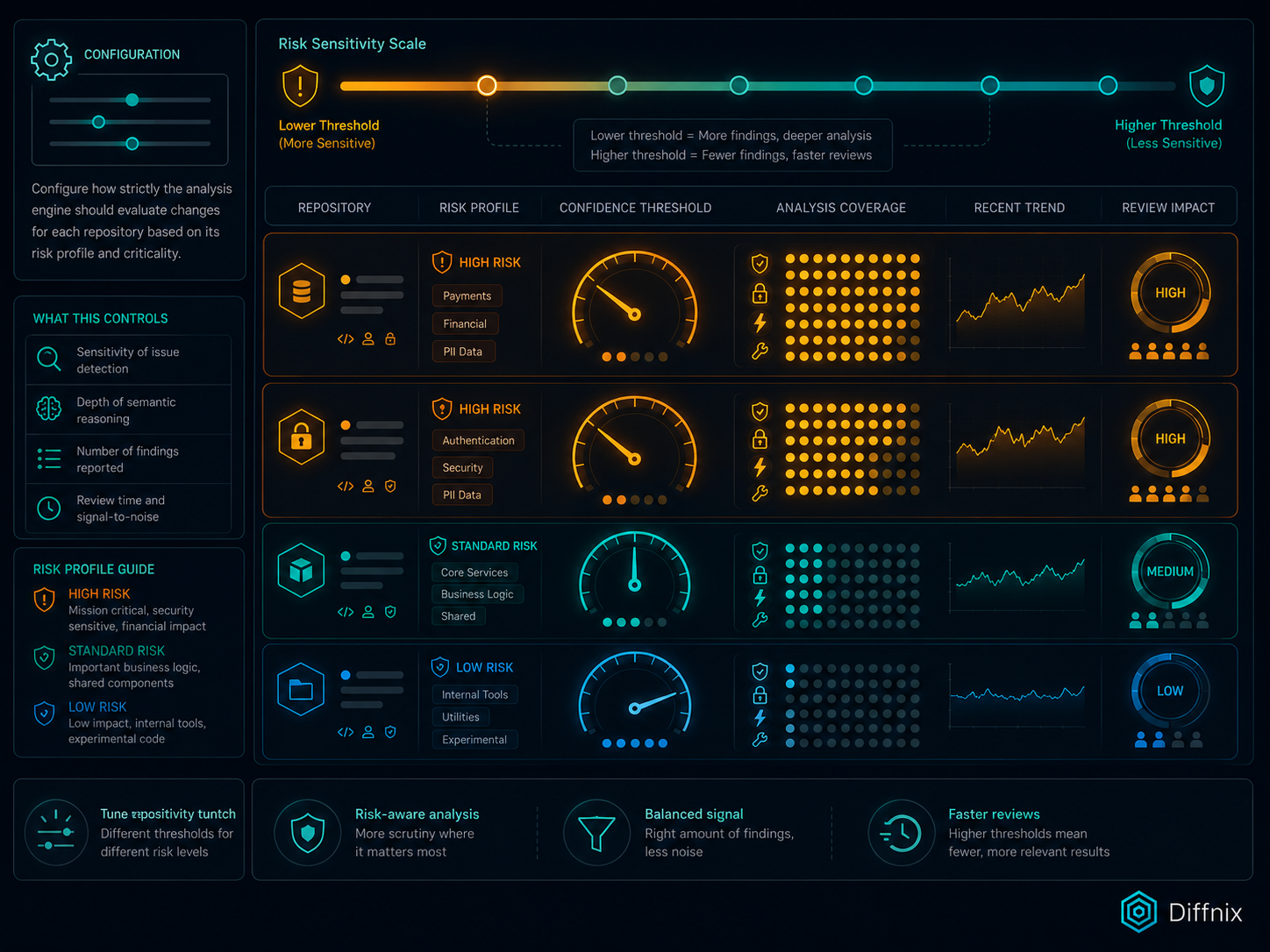
Configure confidence thresholds per repository
Default confidence settings are a compromise. A team shipping a payments service should see everything, including low-confidence findings. A team shipping a marketing landing page probably wants only critical issues. Most AI review tools expose this as a configuration option. Use it.
# Example configuration
pr_review:
  confidence_threshold: 0.5     # lower = more findings
  dimensions:
    security:
      confidence_threshold: 0.4  # security: prefer false positives
    performance:
      confidence_threshold: 0.6  # performance: higher bar to reduce noise
Use the reasoning trace
The best AI review tools show you what context informed each finding. A finding grounded in three specific call sites and a type annotation is more credible than one grounded in just the changed lines. When a finding seems wrong, check the reasoning trace before dismissing it. The model may have found something you missed.
Common Mistakes Teams Make
Using AI review as the only review. AI review is a first pass, not a final one. Architectural decisions, team conventions, and long-term maintainability still need human judgment. The goal is to free up human review time for those concerns, not to eliminate it.
Not tuning the false positive rate. If your AI reviewer posts 15 comments per PR and 12 of them are wrong, developers will stop reading it within a week. That is not a technology failure. It is a configuration failure. Spend time calibrating confidence thresholds before rolling out to the full team.
Ignoring the context configuration. Tools that only see the diff produce noisier output than tools configured with repository access. If your tool supports fetching file context, set it up. The quality difference is significant.
Treating AI findings as verdicts. AI findings are probabilistic. "This might cause a null pointer exception" requires human confirmation. The finding is a signal to investigate, not a proof of a bug.
⚠️ Warning: Teams that implement AI code review without confidence tuning often report that the tool is useless. Usually the tool is fine. The signal-to-noise ratio has not been calibrated. Before writing off an AI review tool, spend time adjusting its threshold settings and reviewing a sample of findings with your team.
The Privacy Question
If your code contains proprietary algorithms, encryption implementations, patient data handling logic, or anything that qualifies as intellectual property, sending it to a cloud AI review API deserves explicit legal and security review before you do it.
Most cloud AI tools have privacy policies that permit using submitted content for service improvement or model training. That may be acceptable for open-source projects. It is not acceptable for code that cannot leave your network under your compliance framework.
Local LLM deployment solves this entirely. Modern local models are now competitive with cloud models on code tasks. Running inference inside your network perimeter means your code never crosses an external boundary.
For a full breakdown of the compliance implications and architecture options, see the private AI code review guide.
Why We Built Diffnix
We built Diffnix after watching team after team try mid-level AI review tools, conclude they were noisy and unreliable, and return to purely manual review. The problem was not that AI review was wrong as an approach. It was that the tools were reasoning about code fragments without the context needed to reason well.
Diffnix is a private, AI-powered code intelligence platform that understands your code — not just scans it. It runs locally, so your code never leaves your network. Its pipeline parses diffs structurally, enriches hunks with real calling context, runs multi-dimensional reasoning, and gates output on confidence. The result is findings that developers act on rather than ignore.
If you want to see what that looks like on your team's actual PRs, try PRInspector with your next pull request.
Conclusion
AI code review in 2026 is not a single product or a single approach. It is a category that spans from low-value diff-pasting to genuine code intelligence with structured reasoning and context enrichment.
The teams getting value from it have understood one thing: AI review does not replace human review. It removes the work that does not need a senior engineer, so that senior engineers can focus on the work that does.
Linters for style. Static analysis for known patterns. AI for reasoning. Humans for judgment. That is the stack that works.
These posts go deeper on each piece: