Private AI Code Review: The Enterprise Security Playbook
Sending your source code to a third-party AI API is a security decision, not just a tooling choice. This guide covers the real compliance implications, the architectural options for keeping code private, and how to implement AI-powered code review that gives your team the intelligence it needs without exposing the IP, patient data, or proprietary logic your codebase contains.

Introduction
Every AI code review tool that runs in the cloud receives your source code. That is not a feature. It is a fact about how those tools operate, and most engineering teams adopt them without fully understanding what it means for their compliance posture or their data exposure risk.
Your source code is not just text. It contains your business logic, your authentication architecture, your encryption implementation, and your data handling patterns. In regulated industries, it is the system that processes patient records, financial transactions, and personally identifiable information. Sending it to an external service — any external service — raises a data exposure question that your security and legal teams need to answer before adoption, not after an audit finding.
This is not theoretical. Privacy policies for AI services typically include language permitting use of submitted content for service improvement. API traffic to external endpoints is a potential breach surface. And compliance frameworks including HIPAA, GDPR, SOC2 Type II, and ISO 27001 have specific requirements about what constitutes a data processor and what obligations that classification triggers.
This guide covers what those obligations mean in practice, the architectural spectrum of options available, and how to deploy AI code review that strengthens your security posture rather than creating new risk within it.
What Cloud AI Review Actually Does With Your Code
When you connect a cloud-based AI code review tool to your repository, here is what happens mechanically: your pull request diff — and in many implementations, supplemental file context — is transmitted to an external API endpoint, processed by a model running on third-party infrastructure, and the response is returned to your CI pipeline or PR interface.
The important word in that sequence is "transmitted." Your code leaves your network.
What happens to it on the other side depends on the service's privacy policy and data retention configuration. Some services retain submitted data for a configurable period. Some use submitted content to improve their models unless you explicitly opt out. Most require reading documentation carefully to understand the actual data handling behavior, because the default marketing copy almost never includes it.
For teams in regulated industries, the question is not whether the AI produces useful findings. The question is whether the act of transmitting source code to that service constitutes a compliance violation under the frameworks your organization operates within.
📌 Insight: "We only send the diff, not the whole file" is a common defense teams use when adopting cloud AI review. A diff is still source code. A diff that modifies a patient data handling function still reveals your patient data handling architecture. The content transmitted matters more than the volume.
The Compliance Landscape
HIPAA
If your codebase handles Protected Health Information — patient records, medical imaging systems, appointment scheduling, insurance processing — the tools you use to process that code may qualify as Business Associates under HIPAA.
HIPAA requires a Business Associate Agreement (BAA) with every vendor who handles PHI or whose services result in PHI exposure. Most general-purpose AI API providers do not offer HIPAA-compliant BAAs for their standard API products. Those that do typically require enterprise contracts, impose data handling restrictions that conflict with how AI review tools work, and conduct their own audits to verify compliance.
Even with a BAA in place, source code that contains test data with real patient identifiers, schema definitions that reveal PHI structure, or configuration files showing how PHI is encrypted constitutes PHI exposure. The standard of care is: if your code touches PHI, treat tooling decisions as PHI handling decisions.
GDPR
Article 28 of GDPR requires a Data Processing Agreement with any service that processes personal data on your behalf. If your codebase handles EU resident data — which is true of virtually any SaaS product with European users — and an AI tool processes code that contains or references that data, that AI service may qualify as a data processor under Article 28.
US-based AI providers create an additional complication: cross-border data transfer restrictions. Sending EU personal data to a US processor requires Standard Contractual Clauses, an adequacy decision, or another approved transfer mechanism. Most organizations using cloud AI review tools have not gone through this assessment.
SOC2 Type II
SOC2 auditors are increasingly asking about AI tools used in the development process. The Confidentiality and Security criteria in the Trust Services Criteria both apply. An auditor assessing your SOC2 posture will want to know: what external services receive access to your source code, what their security posture is, and whether you have conducted due diligence on them as vendors.
Using a non-audited AI tool that receives source code without a documented vendor assessment creates findings in SOC2 audits. These are correctable, but they add remediation cycles and increase audit scope in subsequent years.
ISO 27001
ISO 27001's Annex A.15 covers supplier relationships. Any supplier who receives access to your source code — including AI tools — requires a supplier security assessment, contractual security requirements, and ongoing monitoring. Most teams adopting AI code review tools skip this process because the adoption happens at the developer tooling level rather than the procurement level. The ISO 27001 auditor does not distinguish between those two.
⚠️ Warning: The gap between "developers adopted this tool informally" and "this tool is in scope for our compliance review" is where most compliance findings originate. If an AI code review tool is being used in any environment that touches regulated data, it should go through your vendor assessment process regardless of how it was originally adopted.
The Architecture Spectrum
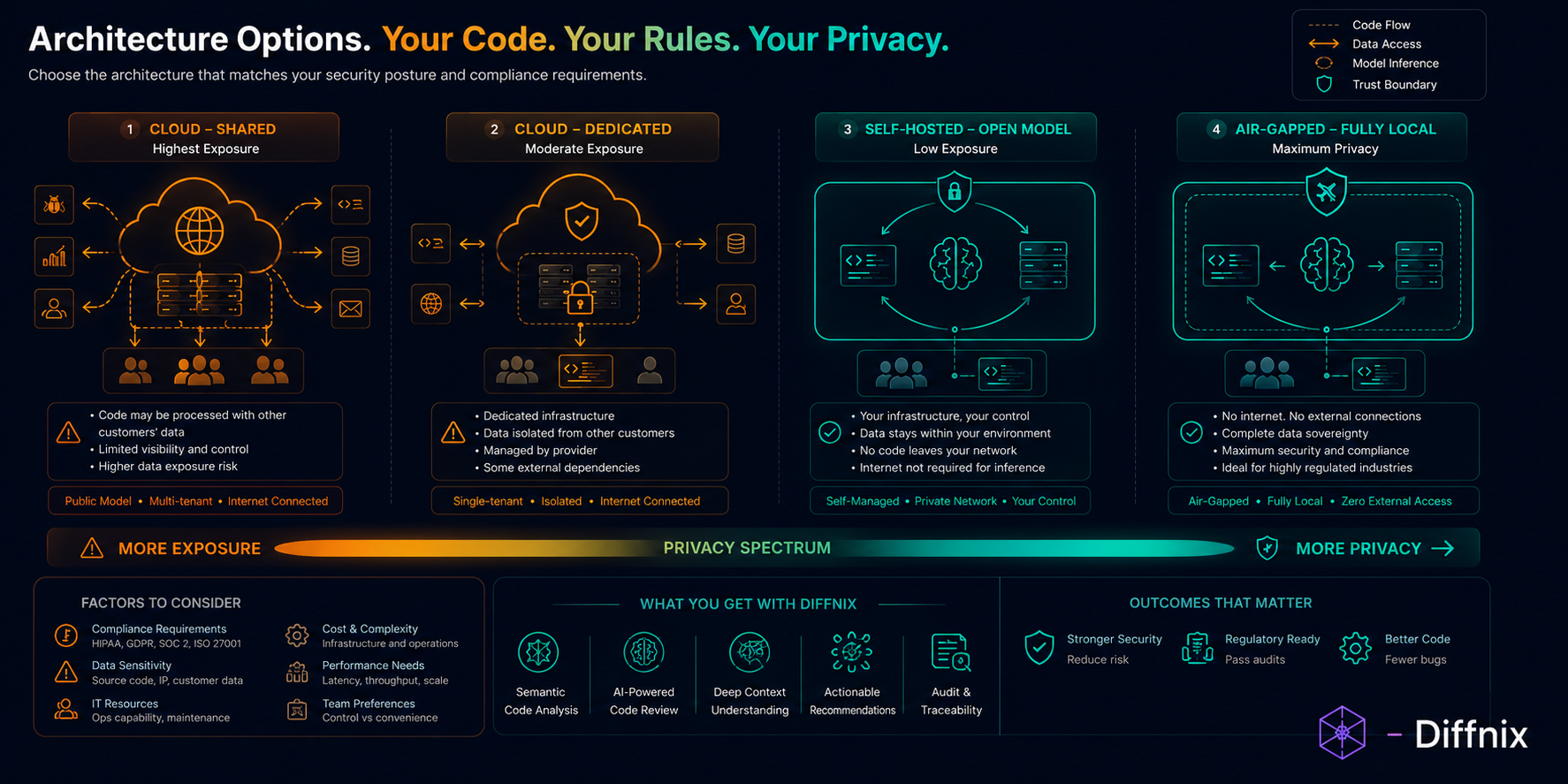
AI code review tools fall into four architectural categories with different privacy profiles.
Cloud-hosted with shared infrastructure. Your code is sent to an API, processed on shared compute, and the provider controls data retention. This is the most common and most convenient option. It is also the highest exposure profile, particularly for regulated industries.
Cloud-hosted with dedicated infrastructure. Some enterprise AI providers offer dedicated processing environments where your data is isolated from other customers. Better than shared infrastructure, but code still leaves your network and is still processed under the provider's privacy policy.
Self-hosted open models. Open-weight models like Code Llama, DeepSeek Coder, and Mistral Code can be deployed on your own infrastructure. Code never leaves your network. Model capability is slightly below frontier models for some tasks but fully competitive on code review tasks where context enrichment compensates for raw model size.
Air-gapped local deployment. The most secure option: inference runs on dedicated hardware with no external network connectivity. Required for classified government environments and the most sensitive commercial applications.
How Local LLM Deployment Works
Deploying AI code review locally is more accessible than it was two years ago. The tooling has matured, and the model quality for code tasks has converged with cloud models to a degree that makes local deployment a genuine engineering choice rather than a compromise.
The core components:
The model. Open-weight code models now include Code Llama 34B, DeepSeek Coder 33B, and Mistral 7B with code-tuned fine-tunes. For most code review tasks, a 13B or 34B parameter model running on dedicated GPU hardware produces findings comparable to GPT-4 on code-specific benchmarks. The gap is wider for general reasoning tasks and narrower for the structured analysis that code review requires.
The inference layer. Tools like Ollama, vLLM, and LM Studio provide HTTP-compatible inference endpoints that accept the same API format as cloud providers. This means the rest of the review pipeline — diff parsing, context enrichment, prompt construction — works identically regardless of whether the model is cloud-hosted or local.
The hardware. A reasonable starting point for team-scale deployment: a server with 48-64GB of VRAM (two to four 24GB GPUs). This runs a 34B parameter model at acceptable inference speed for code review tasks. For teams reviewing 50-200 PRs per day, a single inference node handles the load comfortably.
# Example local deployment configuration for Diffnix
inference:
  provider: local
  endpoint: http://inference-server.internal:11434
  model: codellama:34b-instruct
  max_context_tokens: 16384
  timeout_seconds: 60

privacy:
  network_isolation: true
  telemetry_enabled: false
  code_retention: none
For the detailed walkthrough of why this architecture was chosen for Diffnix and what the compliance implications are, why Diffnix runs AI code review locally covers every decision in the design.
Evaluating AI Review Tools on Privacy
The questions that matter when evaluating any AI code review tool from a security perspective:
What does the privacy policy say about training data? Look for language about "service improvement," "model improvement," or "usage data." These phrases typically mean submitted content can be used to improve the model. Explicit opt-out mechanisms exist in some tools but must be configured, not assumed.
Where is inference happening? Cloud inference means your code is processed on the provider's infrastructure. Local inference means it stays on yours. The technical architecture should be documented, not inferred from the marketing copy.
What is the data retention policy? Some tools retain submitted diffs and context for days or weeks. In regulated industries, this retention creates a data exposure window that may violate your compliance obligations even if the provider otherwise handles data responsibly.
Can you get a BAA / DPA? For HIPAA or GDPR-regulated environments, a Business Associate Agreement or Data Processing Agreement is not optional. If the vendor cannot provide one, the tool cannot be used with regulated data.
Has the vendor completed a security assessment? SOC2 Type II and ISO 27001 certifications provide some assurance about how a vendor handles the data you send them. A vendor without either is an unaudited third party in your compliance scope.
✅ Best Practice: Treat AI code review tool adoption like any other third-party vendor adoption. Run a vendor security questionnaire. Document the data flows. Assess the compliance implications before developers start using the tool, not after it appears in your next audit scope review.
Common Mistakes Security Teams Make With AI Review
Approving cloud tools for development environments without scoping regulated data. Development environments often contain realistic data, including production-like datasets used for testing. Assuming that "development" means "not regulated" is a common and expensive mistake.
Trusting "we don't train on your data" without documentation. This claim appears in many vendor marketing materials but is often conditional — it may apply to paid enterprise tiers, require opt-in configuration, or have exceptions. Get the actual privacy policy terms in writing, not the marketing summary.
Not including AI review tools in the third-party vendor register. If a tool receives source code, it is a vendor with access to sensitive assets. It belongs in the vendor register and should go through the same assessment process as any other vendor with code access.
Accepting convenience as justification. "It's just developer tooling" is not a sufficient response to a compliance question about external data transmission. Developer tooling that receives source code has the same security implications as any other software-as-a-service that receives sensitive data.
How Diffnix Approaches Privacy by Design
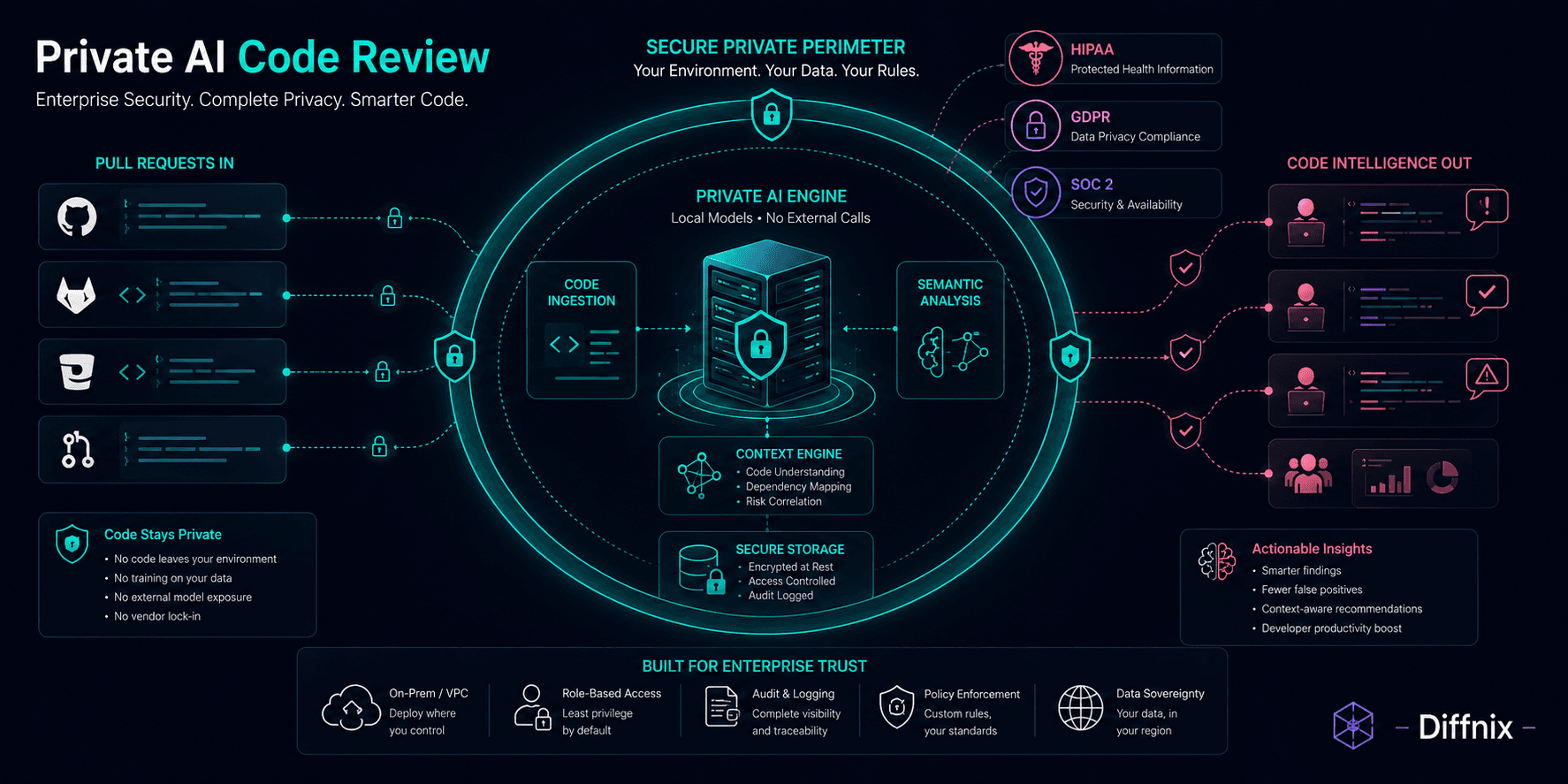
We built Diffnix with a clear starting point: your source code should never leave your network. That is not a configuration option. It is the architecture.
Diffnix runs entirely within your infrastructure. The inference engine connects to a local model endpoint you control. Diff parsing, context enrichment, and reasoning all happen on your hardware or in your private cloud environment. There is no API call to an external service, no data retention policy from a third-party vendor, and no compliance question about where your code goes.
The findings arrive at your PR the same way they would from a cloud tool. The code path that produces them stays entirely private.
Diffnix is a private, AI-powered code intelligence platform that understands your code — not just scans it. "Private" is the first word in that description for a reason.
Conclusion
AI code review is a genuine productivity and quality investment. But for teams operating in regulated industries — or any team that takes intellectual property protection seriously — the implementation architecture matters as much as the feature set.
A cloud AI review tool that finds 20% more bugs but creates a HIPAA violation is not a good trade. A local AI review tool that matches cloud quality on code tasks and keeps your code inside your network boundary is.
The cluster articles in this pillar go deep on each dimension of the private AI code review decision:
Why Diffnix runs AI code review locally and what that means for your architecture
How to catch security vulnerabilities at the PR stage before they ship
The security bugs that pass senior code review and why AI catches them
Cloud AI vs local LLM: the honest comparison across five dimensions
If you are ready to see what a private local deployment looks like for your team, run Diffnix locally with your own LLM stack.