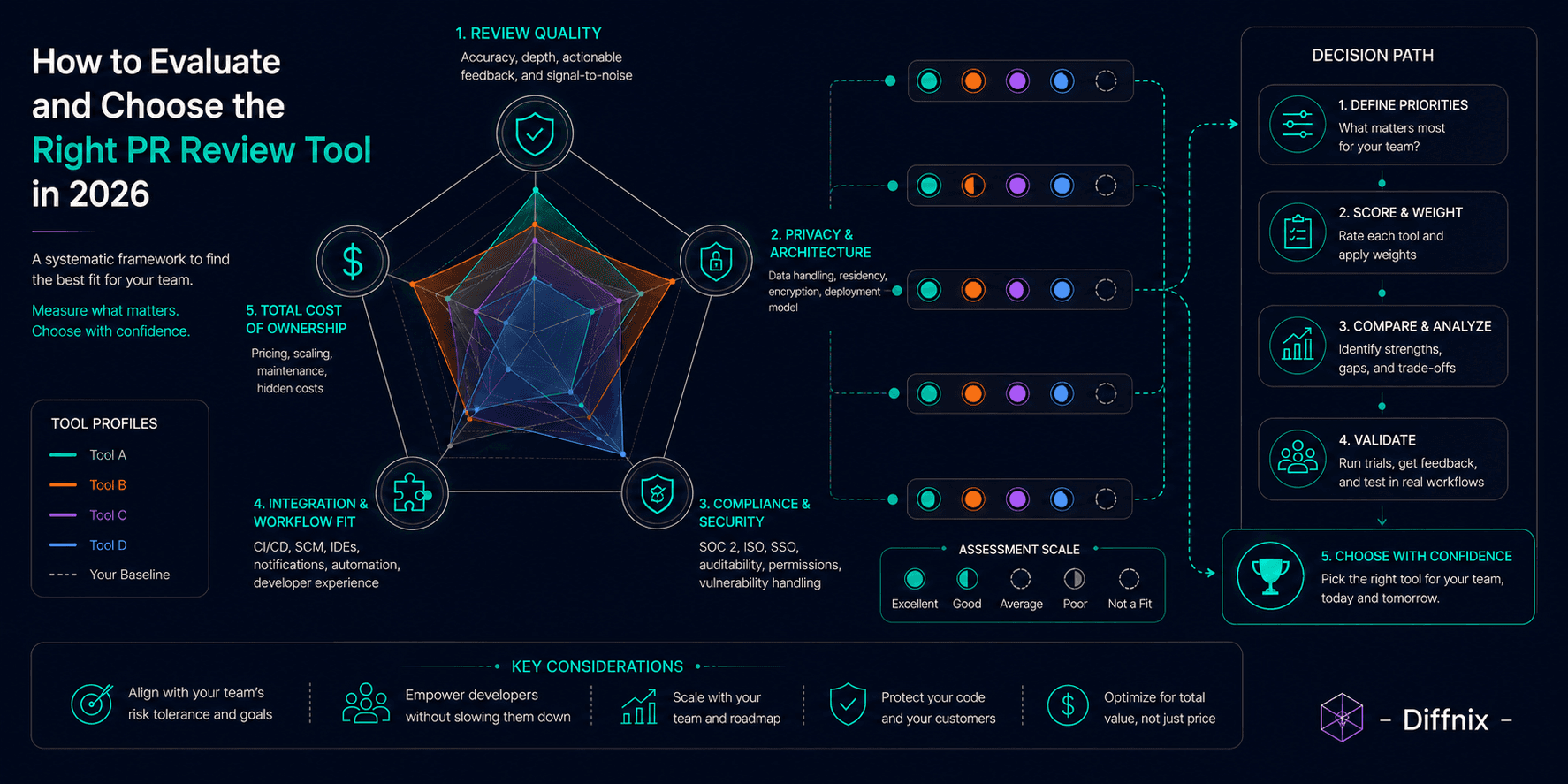
The AI Code Review Buyer's Guide: How to Evaluate and Choose the Right Tool in 2026
Buying an AI code review tool in 2026 means choosing between a dozen options with very different architectures, privacy models, and quality profiles. Most teams make the decision based on which tool has the smoothest onboarding. Most regret it. This guide gives you the framework to evaluate tools systematically before you commit.

Introduction
Two years ago, the AI code review landscape was sparse enough that the evaluation was simple. There were two or three serious options and the differences between them were obvious. That is no longer true.
Today you can choose between cloud AI tools powered by frontier models, purpose-built review agents with semantic reasoning pipelines, SAST tools with LLM features bolted on, open-source frameworks that require significant engineering to operationalize, and SaaS products at every price point. The marketing copy for all of them uses the same vocabulary: AI-powered, intelligent, semantic, context-aware.
The vocabulary does not distinguish them. The architecture does.
This guide breaks down the five dimensions that actually predict whether a tool will work for your team, gives you the questions to ask vendors before committing, explains when building your own makes sense (and when it does not), and tells you how to run a 30-day evaluation that produces reliable data rather than sales demo impressions.
If you already know what you are looking for and want the direct comparison, see the best AI code review tools in 2026. If you are weighing build versus buy, the build vs buy cost analysis covers that decision with real numbers. This guide covers the evaluation framework that helps you use both.
What AI Code Review Tools Actually Do
The term "AI code review" is used for four distinct categories of product, and they are not equivalent.
Category 1: Chat-based review. You paste a diff into a general AI assistant and ask for feedback. This is the floor of the category. Review quality depends entirely on the model's general reasoning and the context you happen to include. No structured pipeline. No context enrichment. Useful for quick sanity checks, not for team-scale adoption.
Category 2: API-connected review agents. The tool connects to your repository, receives PR events via webhook, sends the diff to a cloud LLM API, and posts the response as review comments. Convenient, fast to set up, and better than category 1. The ceiling is the quality of the LLM's reasoning on the diff text alone. Without context enrichment, findings are often generic or wrong about things that require knowing the broader codebase.
Category 3: Semantic review agents. These tools parse diffs structurally, enrich context from the surrounding codebase (callers, imports, type definitions), run multi-dimensional reasoning across correctness and security and performance, and gate output on confidence. This is the category where review quality actually competes with senior engineer review on the categories AI handles well.
Category 4: SAST with AI overlay. Established static analysis tools (SonarQube, Semgrep) that have added LLM-generated explanations or suggestions on top of their existing rule-based findings. Better UX around existing findings, but the underlying finding set is still rule-based. The LLM does not expand what gets caught. It expands how findings are explained.
Most buyer confusion happens between categories 2 and 3. They look similar in demos. The difference is only visible when you test them on code that requires cross-file reasoning to evaluate correctly.
📌 Insight: The fastest way to distinguish category 2 from category 3 in a vendor evaluation: give the tool a PR that contains an IDOR vulnerability. No authorization check on a REST endpoint that fetches a resource by a user-controlled ID. SAST passes it. Category 2 tools usually miss it. Category 3 tools catch it because they fetch the model definition and the existing authorization pattern from comparable endpoints.
The Five Evaluation Dimensions
Dimension 1: Review Quality
What types of bugs does the tool reliably catch, and what does it miss?
The categories that matter most:
Logic errors (incorrect null guards, off-by-one conditions, wrong variable in a comparison)
Authorization gaps (IDOR, missing authentication, privilege escalation paths)
SQL and command injection via non-obvious paths (ORM bypass, shell execution)
Performance anti-patterns (N+1 queries, unbounded loops in request handlers)
Ask vendors to demonstrate findings on a PR that you provide, not one they prepared. Use a PR with a subtle IDOR or a missing authorization check. The quality difference between category 2 and 3 tools is most visible on this class of bug.
Metrics to track during evaluation:
Finding rate (total issues surfaced per 100 PRs)
Precision (percentage of findings that are valid issues)
False positive rate (percentage of findings that are incorrect)
Coverage by category (what types of issues does the tool catch vs miss)
Dimension 2: Privacy Architecture
Where does your code go, what happens to it, and what are the compliance implications?
This dimension is decisive for teams in regulated industries or with proprietary IP. The questions to ask every vendor:
"Where does inference run?" (Your infrastructure or theirs) "What is your data retention policy for submitted diffs?" "Can you provide a HIPAA BAA or GDPR Article 28 DPA?" "Do you use submitted content for model training or service improvement?" "Has your service undergone a SOC2 Type II audit?"
For teams subject to HIPAA, GDPR, or SOC2, the answer to these questions often makes the decision before any review quality evaluation occurs.
Dimension 3: Integration and Workflow Fit
Does the tool integrate with your specific Git provider, CI pipeline, and team workflow?
Questions:
Does it support your Git provider (GitHub, GitLab, Bitbucket, Azure DevOps)?
Does it post findings as inline PR comments or as a separate review interface?
Can it be triggered from CI pipeline steps, not just PR events?
Does it support monorepos with multiple service roots?
Can findings be suppressed or acknowledged inline?
Does it work with your branch protection rules?
Dimension 4: Configurability
Can you tune the tool for your specific risk profile and team conventions?
Look for:
Confidence threshold configuration per repository
Ability to enable or disable specific finding dimensions (security, performance, maintainability)
Custom rules or ignore patterns for team-specific conventions
Per-file or per-directory scope control
Generic default settings produce generic results. The tools that produce the best outcomes for specific teams are the ones with enough configurability to match the team's actual risk profile.
Dimension 5: Total Cost of Ownership
API fees are the visible cost. Compliance overhead, maintenance, and operational complexity are the hidden ones.
For cloud AI tools in regulated environments, the true first-year cost typically includes: vendor security assessment, legal review of data processing terms, potential DPA or BAA negotiation, and remediation work if a compliance gap is identified after adoption. For some teams, this overhead exceeds the tool's direct cost by a factor of 10 or more.
For local deployment tools, the costs include: hardware or private cloud infrastructure, model update maintenance, and integration engineering time. These are predictable, controllable, and do not compound the way compliance remediation does.
The cloud AI vs local LLM comparison covers this in full detail, including specific numbers from real teams.
The Build vs Buy Question
Some engineering organizations consider building their own AI code review tool rather than adopting a third-party product. The argument: more control, customized to your codebase, no vendor dependency.
The argument is valid for a specific class of organization: one with unique review requirements that no existing tool addresses, an existing AI infrastructure team, and the organizational patience for a 6-12 month build cycle with ongoing maintenance cost.
For most organizations, the argument breaks down on the economics. Building a production-quality AI review tool requires: structured diff parsing, context enrichment with cross-file resolution, multi-dimensional reasoning pipelines, confidence calibration, false positive filtering, and ongoing maintenance as underlying models update. That is approximately 4-6 months of senior engineering time to build, plus ongoing maintenance as models update.
The opportunity cost of that engineering time is the work those engineers are not doing. The build vs buy cost analysis quantifies this for a real 60-person engineering organization that built their own tool, ran it for seven months, and then migrated to Diffnix. The numbers are worth reading before starting a build.
✅ Best Practice: If you are seriously considering building, time-box the evaluation. Spend two weeks prototyping a basic diff-to-findings pipeline and evaluating the output quality on 20-30 real PRs from your codebase. If the output quality is competitive with what a semantic review tool produces, the build may be justified. If it is not, you have two weeks of data rather than six months of sunk cost.
How to Run a 30-Day Evaluation
Most vendor evaluations are based on demos, which show the tool at its best on carefully selected examples. A 30-day evaluation on your actual PRs gives you data on real performance.
Week 1: Setup and baseline
Install the tool on a staging environment or a low-risk repository. Configure it to your approximate preferred settings (do not spend a week on configuration before seeing any output). Run it on at least 20 PRs from the previous month and manually evaluate each finding: valid issue, false positive, or missed issue.
Week 2: Expand to a production repository
Move the evaluation to a real production repository. Track: finding rate, false positive rate, developer response rate (how often do developers address the finding before human review). Survey two or three developers who received findings about their experience.
Week 3: Evaluate the privacy and compliance dimensions
Review the vendor's privacy policy, data processing terms, and security certifications. Run the compliance questions from Dimension 2 past your security team or legal counsel if your organization operates in a regulated environment. This is a step most teams skip during evaluation and then address reactively after adoption.
Week 4: Calculate TCO and make the decision
Combine the review quality data from weeks 1-3 with the compliance and TCO assessment from week 3. Compare against the alternative (another tool or a build). Make the decision based on data, not demo impressions.
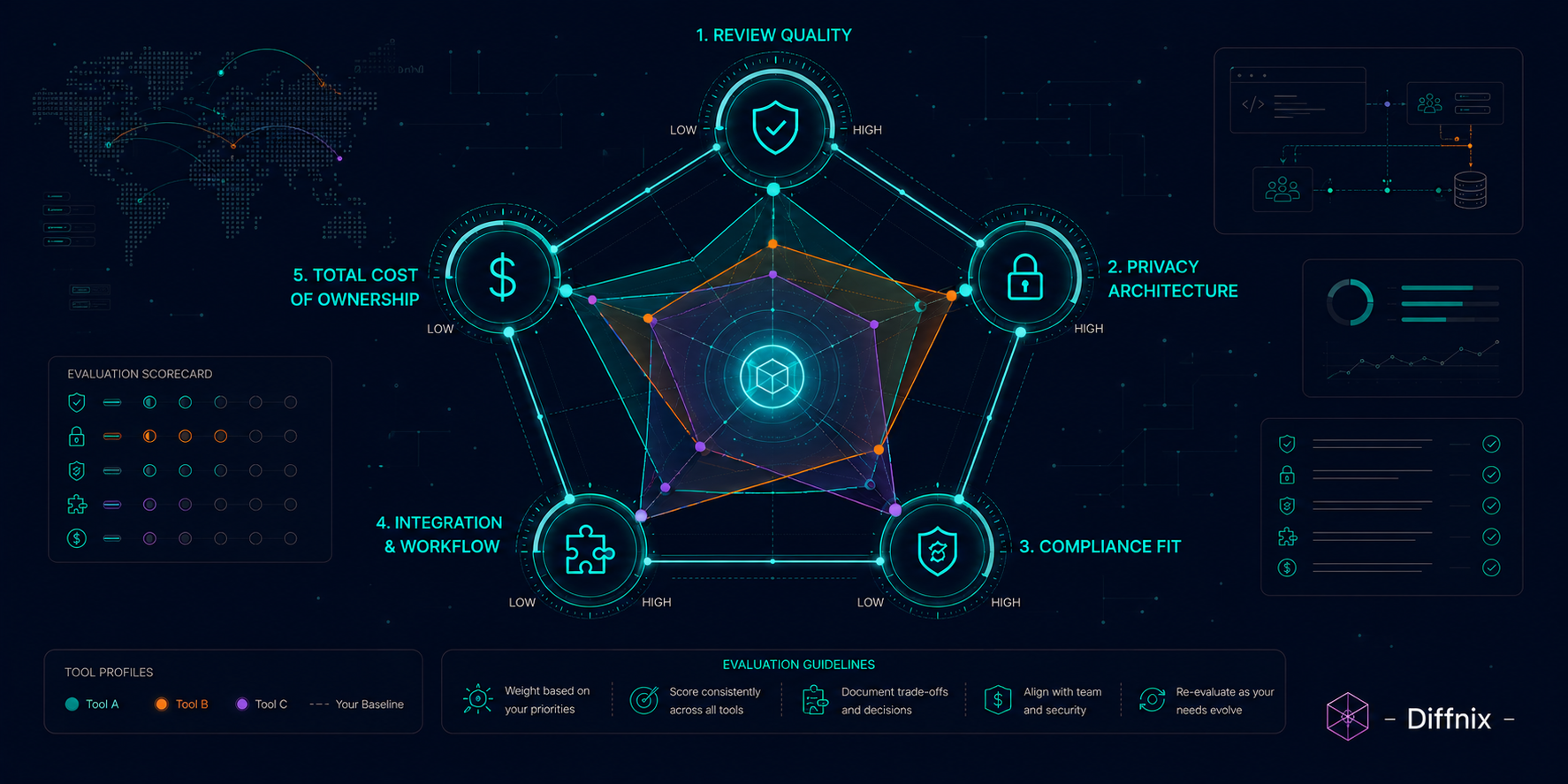
The Honest Landscape Summary
For teams without compliance requirements and small budgets: Cloud AI review tools (GitHub Copilot Code Review, CodeRabbit) offer the fastest setup and lowest friction. Review quality is good on standard bug categories. Privacy trade-off is real but acceptable for teams without regulated data.
For teams in regulated industries or with IP protection requirements: Local deployment is the only architecture that eliminates compliance risk by design. Review quality with capable local models is competitive. Setup overhead is real but predictable.
For teams with existing SonarQube investment: SonarQube's AI features improve the explanation and remediation UX around existing findings but do not expand finding coverage into the semantic layer. Consider it a UX enhancement, not a category change.
For teams considering building their own: The build case is strongest when you have unique codebase requirements, an existing AI infrastructure team, and organizational patience. For everyone else, the economics of building versus buying favor buying by a significant margin.
How Diffnix Fits This Framework
We built Diffnix specifically to win on the dimensions that matter most to security-conscious teams: local deployment with no code leaving your network, semantic reasoning that goes beyond pattern matching, and production-grade configurability that makes findings useful rather than noisy.
On the dimensions where cloud tools are genuinely better (faster initial setup, zero infrastructure maintenance, the absolute highest model capability ceiling), we are honest about the trade-off. Diffnix requires 45-60 minutes to set up rather than 5. It requires infrastructure that you manage.
The teams that choose Diffnix are the ones for whom those trade-offs are worth making. They care about code privacy, compliance posture, and review quality on the categories that matter most. For them, the 55-minute setup is a better deal than the 5-minute setup that comes with a 14-month compliance remediation cycle.
Diffnix is a private, AI-powered code intelligence platform that understands your code, not just scans it.
Conclusion
The right AI code review tool depends on your team's specific requirements across review quality, privacy architecture, compliance obligations, workflow fit, and total cost of ownership. There is no universal answer.
What there is: a clear evaluation framework that produces reliable data from your actual PRs in 30 days, rather than impressions from vendor demos in 30 minutes.
Use that framework. Evaluate on your actual code. Compare the findings that matter to your risk profile. Make the decision with data.
If you want to see how specific tools compare on the dimensions that matter, the best AI code review tools comparison for 2026 covers the landscape with real evaluation results. If you are weighing the build option, the build vs buy cost breakdown has the numbers.
And if you want to see how Diffnix performs on your actual PRs before committing: compare Diffnix against your current stack or book a walkthrough.